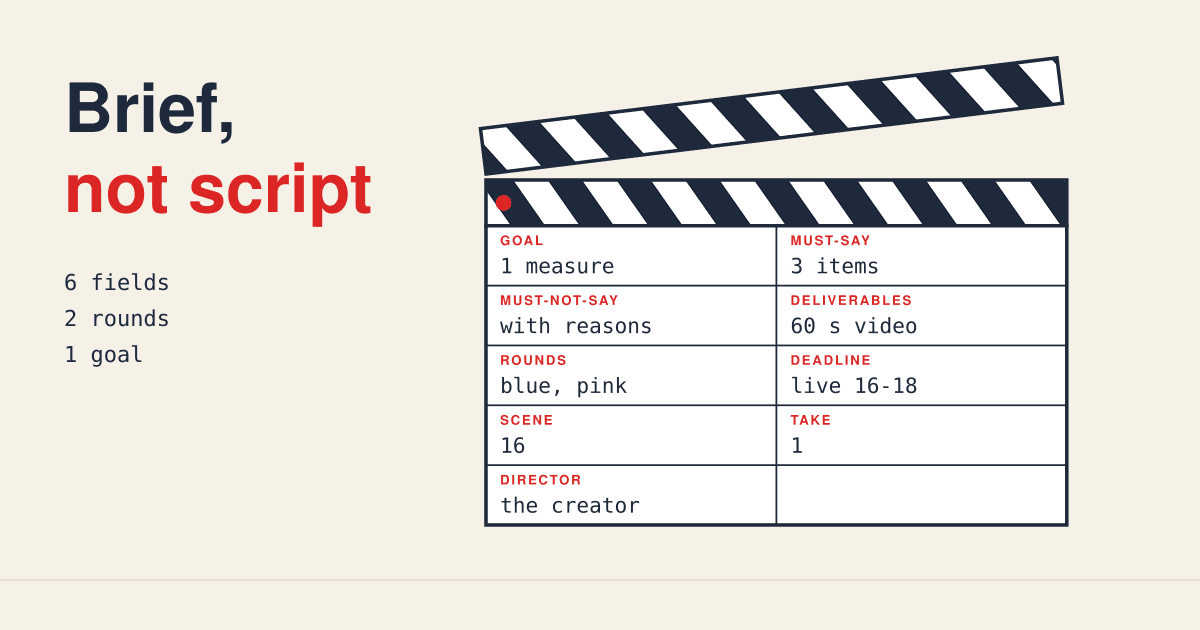
Six fields carry a creator sponsorship brief, and nearly everything else a brand adds to the page is the brand talking to itself. A creator needs to know what the post is for, the few things it has to say, the things it must never say, what to deliver, how many times you will send it back, and by when. Give them that and leave the rest to the person whose audience you are renting.
The brief is also the one document that has to work for both sides. It tells the creator where the edges are, and it is your written proof that you told them. The second part is not a formality: under US rules, the brand is expected to give that guidance.
- $37Bprojected US creator economy ad spend for 2025, up 26% on 2024 (IAB, Creator Economy Ad Spend and Strategy Report, 2025)
- 48%of US ad spenders call creators a "must buy", behind only social media and paid search (same report)
- 46%of creator ad buyers who use AI use it to write creator briefs (same report)
The six fields a creator actually reads
Read each field the way a creator will: once, quickly, looking for what they can and cannot do. If a field cannot be answered in two or three lines, it is usually two fields, or a document that belongs in the contract instead.
GOAL
(one goal, and the number that will judge it)
Say what the post should change, not what it should look like. Pick one: people who hear of the product, people who try it, or people who buy it. Name the measure you will read afterwards, so the creator knows what "worked" means before they start.
Example Get people who cook on weeknights to try the app. Judged by sign-ups on the tracked link in the first 14 days.
MUST-SAY
(three items at most, one of them the disclosure)
The facts the post cannot leave out: the product's name said clearly, the one benefit you are paying to have heard, and the offer if there is one. Add the disclosure here as a hard requirement, not a courtesy. Give facts, never finished sentences: the creator writes the words.
Example Say the app name. Say it plans a week of dinners from what is already in the fridge. Say the code DINNER20 gives 20% off the first year. Disclose the partnership up front.
MUST-NOT-SAY
(legal and brand lines only, each with its reason)
Claims you cannot prove, health or money promises, competitor names, prices that may change, and anything your category's rules forbid. One line of reason per item helps: a creator who knows why a line exists can write around it instead of tiptoeing.
Example Do not say it saves a set amount of money (we have no study). Do not name other apps. Do not show alcohol (platform rule for our category).
DELIVERABLES
(what, where, how long, and what comes with it)
Format, platform, length, number of posts, the link and code, and whether you need raw files, captions or a thumbnail. If you want to run the video as an ad later, say so here and price it separately: usage rights are a deliverable too.
Example One vertical video, 45 to 75 seconds, on the creator's main account. Link in bio for 7 days. Raw file delivered for organic reposting on our account for 30 days.
APPROVAL ROUNDS
(how many, what each may change, how fast you answer)
The number of rounds you get, what a round may and may not touch, who on your side signs off, and how many working hours you take to reply. Without this field the brief has no end.
Example One concept check, then up to two rounds on the edit. Rounds fix facts, legal lines and the disclosure, not delivery or jokes. One reviewer. Reply within 48 working hours.
DEADLINES
(every date, and what happens if one slips)
Concept due, first cut due, your feedback due, final due, go-live window. Put your own deadlines in the list too: a creator who waits four days for feedback should not lose the posting slot because of it.
Example Concept 3 Dec. First cut 10 Dec. Our notes 12 Dec. Final 15 Dec. Live between 16 and 18 Dec. Late notes from us move the live date, not the fee.
A short paragraph of context about the brand and the audience helps too, but it is background, not a field the creator must answer. If you already sent a rate card request, the creator's own audience data will tell you more about their viewers than your persona sheet will. What reuse and exclusivity should cost on top of the fee is covered in the usage rights post.
Approval rounds, colored like script revisions
Film scripts mark every revision with a new page color, so everyone on set can see at a glance which version they hold. A sponsorship brief can borrow the habit: name each round and decide in advance what it is allowed to change.
-
White draft
Concept check
The creator sends the idea in a few lines or a rough outline before filming. This is the cheap moment to say "not that angle". Notes here may change the idea itself.
-
Blue pages
Round 1 on the edit
Facts, must-say items, must-not-say items, the disclosure, the link and the code. Notes say what is wrong, not how to say it. Wording is the creator's.
-
Pink pages
Round 2 on the edit
Only the items round 1 flagged, checked again. A new objection that could have been raised in round 1 waits for the next campaign.
-
Yellow pages
Anything after that
A reshoot or a new edit is new work: agree it in writing, with a fee or a trade, before asking. Endless rounds are how a 60-second post costs a week.
Committees are what usually breaks this. If legal, brand and the product team each send notes, merge them into one list with one voice before it reaches the creator, and drop any note the three of you disagree on.
Brief lines that flatten the creator's voice
None of these lines is illegal or rude. Each one feels safe to the person writing it, and each one makes the post sound like an ad the audience has already learned to skip.
-
"Please read the following script word for word."Why it hurts The audience follows the creator for how they talk. A script in your voice turns them into a narrator, and the comments usually notice.
Write instead Must-say facts as bullet points, and let them write the sentences.
-
"Mention all eight key features."Why it hurts Eight features in 60 seconds is a spec sheet read aloud. Nobody remembers feature six.
Write instead One benefit you are paying to have heard. Put the rest on the landing page.
-
"Show the product in the first three seconds, smiling, logo facing camera."Why it hurts It tells the creator how to direct their own video and makes every sponsored post look the same.
Write instead What must be visible at some point, for example the app screen with the week of dinners.
-
"Talk about how much you love using it every day."Why it hurts If they do not use it daily, this asks them to say something untrue, and the FTC Endorsement Guides say an endorsement must reflect the endorser's honest opinion and, where use is claimed, real use.
Write instead Send the product early, ask them to try it, and let them say what they found.
-
"Use these 12 hashtags and tag our 4 accounts."Why it hurts It buries the caption and can push the disclosure out of sight.
Write instead One tag for the brand account, the disclosure first, and at most one campaign hashtag.
-
"Revisions until the brand is happy."Why it hurts It has no end, so the creator prices the risk into the fee or stops replying.
Write instead A fixed number of rounds, as in the approval field above.
-
"Follow the attached 40-page brand book."Why it hurts Nobody reads it, and the parts that matter disappear among the parts that do not.
Write instead The two or three brand rules that apply to this post, copied into must-not-say.
Why the brief is your paper trail
Director's note
The FTC Endorsement Guides (16 CFR Part 255) say advertisers can be liable for misleading endorsements, or for an undisclosed connection with an endorser, even when the endorser is not. Section 255.1(d) says advertisers should give endorsers guidance on keeping statements truthful and disclosing the connection, monitor whether they do, and act when they do not. Free product counts as a connection under section 255.5, not only cash.
In the UK, the ASA says that when a brand pays for content and also has "editorial control" over it, the ASA can act under the CAP Code, and its social media guidance names both the influencer and the brand in rulings. Approval rounds are editorial control, so a post you approved is treated as your ad.
Platforms add their own switch on top: YouTube, for example, asks creators to tick the paid promotion box for branded content, which shows a label at the start of the video. Put the platform's label and a spoken or written disclosure in must-say, and check both in round 1.
This is general information, not legal advice. For the labels themselves, country by country, see which disclosure label works in the US, UK and EU.
The fill-in template
Copy it into a document, fill in every line, and send nothing else with it except the contract. Every example below comes from the made-up dinner app used above; replace them all.
-
01 Brand and product, one line
[ who you are ] / [ what the product does ]
e.g. A meal-planning app that builds a week of dinners from what is in your fridge.
-
02 Why this creator
[ the one reason you picked them ]
e.g. Your weeknight cooking videos reach exactly the people we want.
-
03 Goal and measure
[ one goal ] judged by [ one number ] over [ days ]
e.g. Trials of the app, judged by sign-ups on the tracked link over 14 days.
-
04 Must-say, three items at most
1 [ ] 2 [ ] 3 [ ] plus the disclosure
e.g. The app name; plans a week from your fridge; code DINNER20 for 20% off; "paid partnership" up front.
-
05 Must-not-say, each with a reason
[ line ] because [ reason ]
e.g. No savings figures, because we have no study behind one.
-
06 Deliverables
[ format ] on [ platform ], [ length ], [ number ]; link [ ]; extras [ ]
e.g. One vertical video, 45 to 75 s, main account; link in bio 7 days; raw file.
-
07 Usage rights
[ where we may reuse it ] for [ days ], paid [ separately / included ]
e.g. Organic repost on our account for 30 days, included. No paid ads without a new fee.
-
08 Approval rounds
Concept check + [ n ] rounds; rounds may change [ ]; reviewer [ name ]; we reply in [ hours ]
e.g. Concept + 2 rounds; facts, legal lines, disclosure only; one reviewer; 48 working hours.
-
09 Deadlines
Concept [ ] First cut [ ] Our notes [ ] Final [ ] Live window [ ]
e.g. 3 Dec / 10 Dec / 12 Dec / 15 Dec / 16 to 18 Dec.
-
10 Creative freedom, in writing
You decide [ ]. We only check [ ].
e.g. You decide the idea, the words, the format and the edit. We only check facts and the disclosure.
-
11 Payment and contact
[ fee ] paid [ when ]; questions to [ name, channel ]
e.g. Fee paid within 15 days of going live; questions to one named contact by email.
Line 10 is the one most briefs leave out. Writing down what the creator decides is what stops round 2 from quietly becoming a rewrite. Once the post is live, measure it the way field 03 promised, and tag the link before it goes out, not after.
Questions buyers ask about briefs
How long should a creator brief be?
Short enough to read in one go. There is no official length; the template above fits on one page, and anything longer usually holds a brand book or a contract clause that belongs elsewhere.
Can we ask the creator to say a specific sentence?
You can require a fact, a product name, an offer code or a disclosure. Asking them to read your sentence about their own experience is where it gets risky: the FTC guides say an endorsement must reflect the endorser's honest opinion or experience.
Is a brief the same as the contract?
No. The contract holds fees, rights, exclusivity and what happens if things go wrong. The brief tells the creator how to make the post. Keep them consistent, and let the contract win if they differ.
Should we use AI to write the brief?
Many buyers already do: in the IAB 2025 report, 46% of creator ad buyers using AI said they use it for briefs. Check what comes out against the six fields: generated briefs tend to add exactly the lines this post suggests cutting.
Sources and what they are
- IAB, Creator Economy Ad Spend to Reach $37 Billion in 2025 (trade body press release on its 2025 report; source of the $37B, 26%, 48% and 46%; US market; the full report was not read)
- eCFR, 16 CFR Part 255, Guides Concerning the Use of Endorsements and Testimonials in Advertising, with section 255.1 and section 255.5 (US federal regulation text)
- ASA, Recognising ads: Social media and influencer marketing (UK advertising regulator guidance)
- YouTube Help, Add paid product placements, sponsorships and endorsements (platform help page)
All pages read on 2026-11-12. The example brief, its dates and its 20% code are invented to show the format. The revision colors follow the film habit loosely; no standard sets the number of approval rounds, so the two rounds suggested here are this site's advice, not a rule.