Two quotes land from one YouTube channel in the same week: $1,600 for a 60-second read in next Tuesday's upload, and $9,000 for a whole video built around your product. Both quotes lean on the same line of the creator's media kit, average views per video, and neither says how many of those viewers will still be watching when your part starts.
Single to the short answer
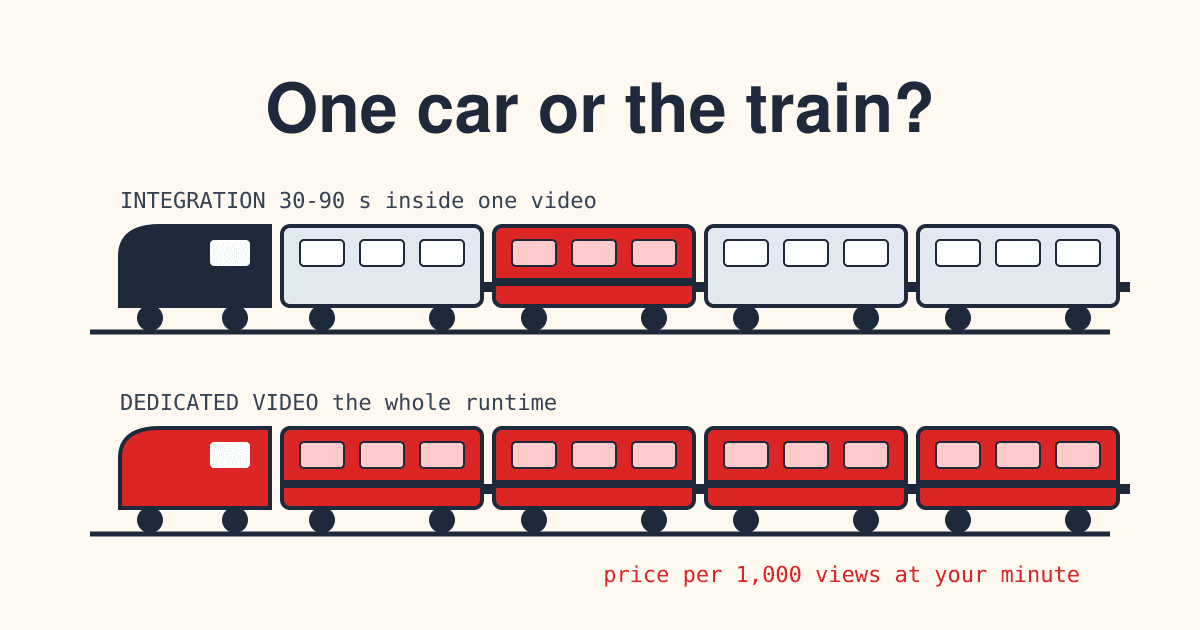
An integration is one carriage in somebody else's train: cheaper, quick to book, and seen only by the viewers still aboard when it comes round. A dedicated video paints the whole train in your colours: every minute is about you, the creator gives up a regular upload for it, and its views can differ from the channel average. Price both per 1,000 views, then correct the integration for the viewers who left before your minute and the dedicated video for the views its topic actually draws.
- $15-$30CPM that YouTube sponsorships often fall between, per Influencer Marketing Hub's 2026 rate guide
- 30-90 susual length of an integrated read, as a mid-roll or pre-roll mention (same guide)
- $37Bprojected US creator economy ad spend in 2025, up 26% (IAB)
One carriage or the whole train: what each format buys
Influencer Marketing Hub's 2026 YouTube rate guide draws the line this way. A dedicated video is built entirely around the brand: the creator structures the concept, script and story around the sponsor, it takes more planning, filming and editing, and it is priced at a premium because it replaces a regular video and carries a higher opportunity cost for the channel (the guide credits that reasoning to Modash). An integrated segment places the brand inside an existing video, usually as a 30 to 90 second mid-roll or pre-roll mention, so the creator keeps their normal schedule.
| Row | Integration (one carriage) | Dedicated video (full livery) |
|---|---|---|
| Screen time | 30 to 90 seconds of one video | The whole runtime, title and thumbnail |
| Who sees it | Only viewers still watching at the timestamp | Everyone who opens the video, from the first second |
| Views to expect | The video's views, minus those who left before your slot | Can differ from the channel average: the topic is your product, not the creator's usual subject |
| Creator's cost | A minute of an upload they were making anyway | A regular upload given up |
| Price | Lower; easy to spread over several channels | Higher, per video |
| Fits | Reach and frequency across many channels, testing a creator | A product that needs showing at length, a launch, a review-style demo |
The same guide's trade-off holds as a rule of thumb, not a measurement: dedicated videos often deliver stronger brand recall, integrations better cost efficiency and scale across several creators. Neither claim comes with a published study, so treat it as the starting hypothesis your own tracking links test.
How many viewers are still aboard when your carriage arrives
A view is counted for the video, not for the minute you bought. YouTube's own help page on key moments for audience retention says audience sizes typically decrease over the length of a video, and its "intro" figure is the share of the audience still watching after the first 30 seconds. So an integration at 1:30 is seen by fewer people than the view counter shows, and one at 8:00 by fewer still.
-
0:00
100% everyone who pressed play
-
0:30
78% still watching after the intro
-
1:30
70% reach a mid-roll read placed here
-
4:00
58% reach a read placed here
-
8:00
44% reach a late read or a post-roll
The creator can show you the real curve. The retention report sits at video level in YouTube Studio, under a video's Analytics, and takes one to two days to process; its key moments only appear on videos at least 60 seconds long with at least 100 views. Ask for screenshots of the curve on two or three recent videos with sponsor reads, with the read's timestamp marked.
Placement changes price on the seller's side too. ThoughtLeaders' sponsorship calculator asks where in the video the placement will run (pre-roll, mid-roll or post-roll), alongside average views, category, sponsor history and the share of the audience based in the US, before it sends a rate.
Four ways to price it, worked on one example channel
The channel below is made up so the arithmetic is easy to follow: 400,000 subscribers, recent videos averaging 80,000 views, past dedicated sponsor videos averaging 50,000 views. The two published rates used are a rule of about $20 per 1,000 subscribers for YouTube from Sprout Social's influencer pricing guide (May 2024) and the $15 to $30 CPM range from Influencer Marketing Hub. The retention share at the slot (70%) and the average minutes watched are example values; swap in the creator's own screenshots.
-
Stage 1
Per 1,000 subscribers
400 x $20 = $8,000
Integration quote on this basis: $8,000
Leaves out: how many subscribers watch a given video. Subscriber counts include people who stopped watching years ago.
-
Stage 2
Per 1,000 average views
80 x $15 to 80 x $30 = $1,200 to $2,400
At $20 CPM: $1,600, the first quote in this post
Leaves out: that views are counted for the video, not for your minute in it.
-
Stage 3
Per 1,000 views at your timestamp
80,000 x 70% = 56,000 viewers reach the read; $1,600 / 56 = $28.57
Effective CPM of the same $1,600: $28.57, near the top of the range
Leaves out: what a dedicated video gives that a read does not: minutes of attention.
-
Stage 4
Per 1,000 minutes about your product
Integration: 56,000 x 1 min = 56,000 min, $1,600 / 56 = $28.57. Dedicated: 50,000 views x 4 min watched on average = 200,000 min, $9,000 / 200 = $45
Dedicated per 1,000 views: $180; per 1,000 minutes: $45
Leaves out: whether a minute of a demo is worth as much to you as a minute of a read. That depends on the product.
Read the stages from top to bottom and the gap closes: on views alone the dedicated video costs more than six times the integration ($180 against $28.57 per 1,000), on minutes about the product it costs about 1.6 times. Which number matters is a question of what you are buying: one exposure across many channels (stage 3) or time to show something (stage 4).
Use views from the channel's own sponsored videos. Influencer Marketing Hub's guide notes that brands often rely on recent average views over subscriber counts, because views reflect the exposure you actually get. For a dedicated video, ask for the views of the creator's past dedicated videos, not the channel average: a video about a sponsor's product is a different video from the ones that built the average.
Eight lines to write into the deal before the read is filmed
IAB's November 2025 creator economy release puts US creator ad spend at a projected $37 billion for 2025, with 48% of ad spenders calling creators a must-buy, and quotes its own vice president on varying partnership models and limited standardization. With no standard contract, these lines carry the terms the two formats differ on:
- Format and slot. Integration or dedicated video; for an integration, its length in seconds and the latest minute it may start.
- The views basis. Which number the price rests on (average views of recent videos, of past sponsored videos, or a guarantee), and on which day after upload it is read. ThoughtLeaders lists a view guarantee among standard sponsorship terms; if you agree one, write what happens when the video falls short (an extra read, or a partial refund).
- Retention proof. A screenshot of the retention curve with the read's timestamp marked, sent after the one to two days the report needs to process.
- Audience proof. Screenshots of the Audience tab in YouTube Analytics, which YouTube describes as including top geographies, device type, and age and gender reports.
- Disclosure. The paid promotion box ticked in the video details, which YouTube requires for sponsorships and which adds a label at the start of the video, plus the spoken and written labels in the disclosure labels guide.
- Links. The description link and a pinned comment, both tagged as in the UTM guide for creator buys, so stage 3 and stage 4 can be checked against sales.
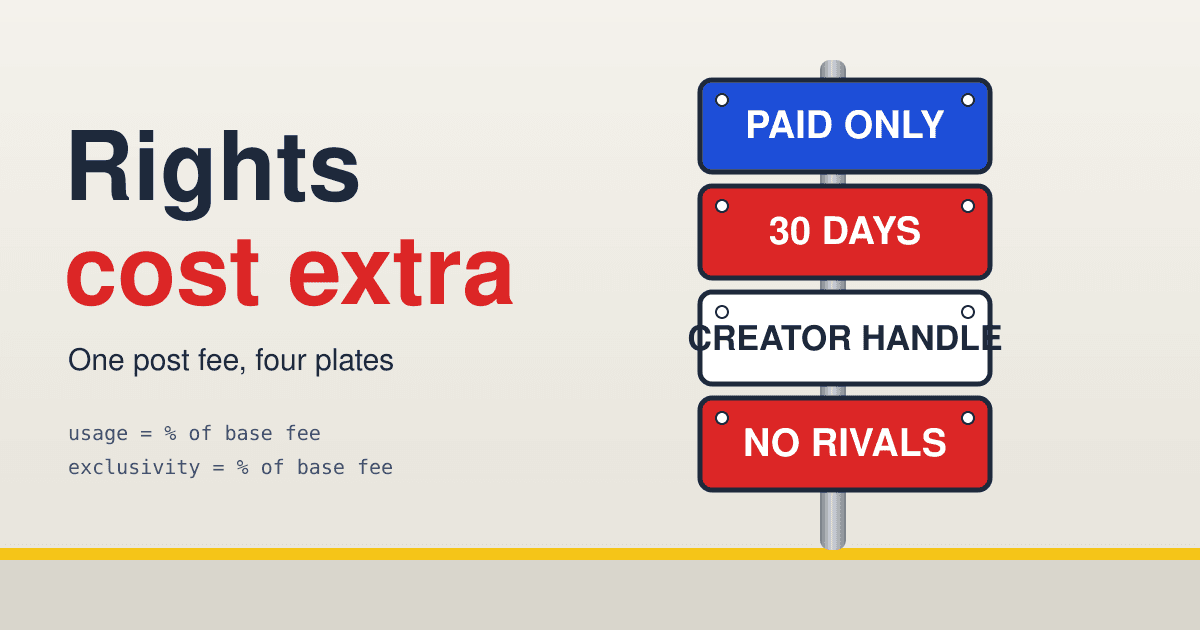
- Exclusivity and reuse. Any competitor ban or right to run the clip as an ad is priced on top, as the usage rights post sets out.
- Staying public. How long the video stays up and unedited. Views keep coming after the reporting day; a deleted or recut video takes your read with it.
Questions buyers ask
Is a dedicated video always better value?
No. In the example above it costs more per 1,000 views and less per 1,000 minutes about the product than its face value suggests. It is better value when you need the time: a demo, a setup walkthrough, a launch. For reach across many audiences, the same money buys several integrations.
Pre-roll, mid-roll or post-roll for an integration?
Earlier slots reach more of the audience, because audiences shrink as a video plays (YouTube's retention help). Later slots can sit in a more engaged moment. Ask for the retention curve and price the slot by the share still watching at its timestamp.
What CPM is fair for a YouTube sponsorship?
Influencer Marketing Hub puts it often between $15 and $30, depending on niche, audience geography and demand. Treat that as a published range, not a quote. ThoughtLeaders' calculator also asks for the share of the audience in the US, which shows geography moves the price.
Do sponsored segments need a disclosure on YouTube?
Yes. YouTube's help says creators who feature branded content, sponsorships or endorsements must select the paid promotion button, which adds a label at the start of the video. Laws in your market add their own rules on top.
How do I price a channel with no sponsor history?
Use stage 2 on its recent average views, then pay part as a flat fee and test one integration before a dedicated video. Sponsor history is one of the inputs ThoughtLeaders' calculator asks for, so a channel without it has less to show for its rate.
Sources and what they are
- Influencer Marketing Hub, YouTube Influencer Rates: A Cost Guide for Brands in 2026 (industry publisher: the $15 to $30 CPM range, the 30 to 90 second integration, the dedicated-video premium credited to Modash)
- Sprout Social, Influencer pricing: how much influencers cost (software vendor, published May 30, 2024: about $20 per 1,000 subscribers for YouTube)
- ThoughtLeaders, YouTube Sponsorship Calculator and YouTube Sponsorship Glossary (sponsorship marketplace: the inputs its calculator asks for; view guarantee as a named term)
- YouTube Help, Measure key moments for audience retention, Understand your YouTube audience and Add branded content restrictions and disclosure labels (platform documentation)
- IAB, Creator Economy Ad Spend to Reach $37 Billion in 2025 (trade body press release, November 20, 2025)
All pages were read on 2026-11-12. The example channel, its retention share and its minutes watched are made up for the arithmetic; the per-subscriber and CPM rates are the published ones above. No source read for this post publishes a multiplier between integration and dedicated prices, so none is given.