The short answer
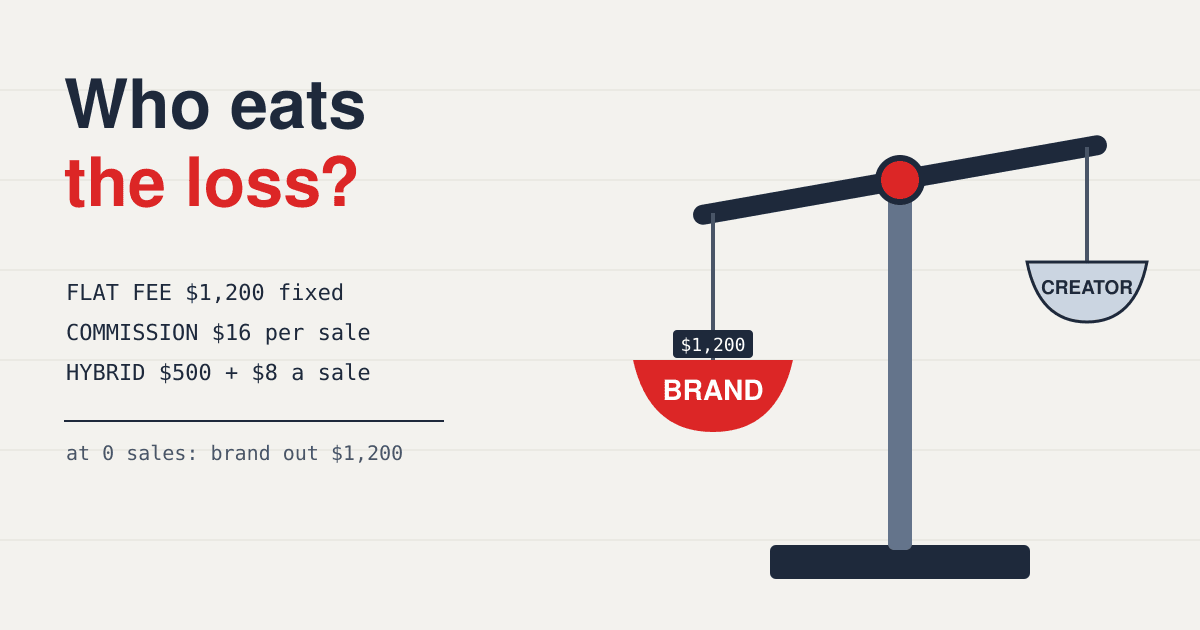
Whatever you call the deal, the payment terms settle one thing before the post goes live: if nobody buys, whose money is gone. A flat fee puts that loss on the brand, a commission puts it on the creator, and a hybrid splits it at a line you draw yourself.
- Flat fee: the brand pays for the work and carries the result. Best when the goal is reach, content or a launch, or when sales cannot be tracked to the creator.
- Commission (affiliate): the creator is paid per tracked sale and carries the result, plus the brand's checkout, the tracking and any returns.
- Hybrid: a smaller guaranteed fee plus a lower commission. The base is the brand's stake, the commission is the creator's.
- For a first partnership: a hybrid with a modest base is usually the fair start, because neither side yet has data on what this creator sells for this product.
Influencer Marketing Hub's 2026 rate guide makes the same point from the money side: two creators quoting the same total amount may be taking on very different levels of risk, depending on how the pay is structured. The rest of this page weighs that risk with numbers.
One post, three deals
The example below is invented to keep the arithmetic visible; swap in your own price and margin. A brand sells an $80 product and keeps $48 per sale after product and shipping costs, before paying the creator. It offers one creator one sponsored video under three sets of terms:
Deal A, flat fee$1,200 for the video, paid whatever happens.
Deal B, commission20% of each sale through the creator's link or code, which is $16 a sale. No fee.
Deal C, hybrid$500 guaranteed, plus 10% of each sale, which is $8 a sale.
The 20% and 10% are example rates, not a market norm. For scale, a large retail affiliate program publishes fixed commission rates by product category: 1% for grocery, 3% for beauty and toys, 10% at the top for luxury beauty, and 4% for categories it does not list; a brand selling its own product with a wide margin can pay far more than a retailer earning a slice of someone else's.
What each side ends up with
Four outcomes for the same video: it sells nothing, 25 units, 75 units or 150 units. "Creator earns" is what the creator is paid. "Brand keeps" is $48 per sale minus everything paid to the creator.
| Deal | 0 sales | 25 sales | 75 sales | 150 sales |
|---|---|---|---|---|
| A flat: creator earns | $1,200 | $1,200 | $1,200 | $1,200 |
| A flat: brand keeps | -$1,200 | $0 | $2,400 | $6,000 |
| B commission: creator earns | $0 | $400 | $1,200 | $2,400 |
| B commission: brand keeps | $0 | $800 | $2,400 | $4,800 |
| C hybrid: creator earns | $500 | $700 | $1,100 | $1,700 |
| C hybrid: brand keeps | -$500 | $500 | $2,500 | $5,500 |
Three crossing points come out of that grid, and they are the numbers to work out for your own deal before you sign:
- 25 sales is where the flat fee pays for itself ($1,200 / $48). Below it, the brand lost money on Deal A.
- 75 sales is where the creator earns the same under A and B ($1,200 / $16). Below it, the creator would have been better off with the flat fee; above it, with the commission.
- About 63 sales is where the creator earns the same under B and C ($500 / $8). A creator who expects fewer sales than that should prefer the hybrid.
Read the grid from the brand's side and the flat fee looks best when the video works and worst when it does not. Read it from the creator's side and it is the mirror image. Each deal is a bet on the same unknown, with the stake placed on a different side.
Who is out of pocket when the post sells nothing
The zero-sales column is the one to look at first, because a first partnership has no history to say it will not happen. Measured against the $1,200 the work would fetch as a flat fee:
-
Deal A, flat fee
Brand out: $1,200Creator short: $0
The brand carries the whole downside. The creator carries only delivery: making the video it agreed to make.
-
Deal B, commission
Brand out: $0Creator short: $1,200
The creator carries the whole downside, and also risks the brand cannot control for them: a slow checkout, a stock-out, a broken link or a lost code.
-
Deal C, hybrid
Brand out: $500Creator short: $700
The base is the brand's stake and the forgone part of the fee is the creator's. You choose the split when you choose the base.
A commission deal also hands the creator three risks that never show up in the rate:
- Tracking. If a buyer watches on a phone and buys later on a laptop without the code, the sale may never be credited. In Influencer Marketing Hub's 2026 survey, promo codes were the most used measurement tool at 45.9% of those answering, ahead of affiliate links at 26.0%, so many programs are still crediting creators by whatever path the buyer happens to take.
- Returns. US retail returns were projected by the NRF and Happy Returns at $890 billion for 2024. If your program reverses commission on returned orders, the creator carries those too, so say so up front.
- Timing. The same survey found 65.9% of marketers expect payback within one month, 48.4% within two weeks. A creator paid only on sales inside a short window carries every buyer who decides slowly.
Picking the model for a first partnership
Answer these in order. The first "no" usually decides it.
-
Can every sale the creator drives be credited to them, by a unique link and a unique code, with a written attribution window?
Yes Go to the next question.
No Pay a flat fee. Commission on sales you cannot see is a promise you cannot keep, and the creator will price that in or walk away.
-
Is the goal of this partnership sales inside the campaign, rather than reach, content or a launch?
Yes Go to the next question.
No Pay a flat fee for the deliverables. A commission on a reach goal pays the creator for something you did not ask for.
-
Can the creator show sales they drove for a similar product, from their own dashboard or a past brand's report?
Yes Commission or a light hybrid is fair: they know what they can sell and are choosing the bet.
No Use a hybrid. Neither side has data, so neither side should carry all of the unknown.
-
Could the brand lose the whole fixed fee without the partnership being judged a failure?
Yes A flat fee or a hybrid with a larger base is affordable; pick by the questions above.
No Keep the base small, enough to pay for the work, and let the commission carry the upside.
A workable first hybrid: set the base at what the creator's time and production cost them, which they can usually tell you, and set the commission so that at the sales you expect, the creator earns close to their usual flat rate. In the example, with 75 sales expected, $500 plus 10% pays the creator $1,100, near the $1,200 they would quote flat.
Lines to write into the agreement
Each line moves a piece of risk from one side to the other. Leaving it out does not remove the risk; it just leaves it to whoever loses the argument later.
What counts as a sale: order value before or after discount, tax and shipping; whether cancelled and returned orders are taken back, and for how many days.
Returns risk: on the creator if commission is reversed, on the brand if not.
How sales are credited: the link, the code, both, and the attribution window in days. Who wins when another channel touched the same order.
Tracking risk: shared only if both sides can see the same report.
What the creator can see: read access to a sales dashboard or a weekly report with order counts and the code's use.
Trust risk: a creator who cannot check the number carries all of it.
When commission is paid: monthly, net of the return period, with the date it is due.
Cash risk: on the creator for as long as payment waits.
How long the link keeps earning: a fixed end date, or for as long as the post stays up.
Long-tail value: to the creator if it keeps earning, to the brand if it stops.
Code leakage: whether sales through the code still count after it appears on coupon sites.
Leakage risk: on the brand if they count, on the creator if they do not.
Deliverables: the base fee buys the agreed video and dates whatever the sales are; commission never replaces the delivery terms.
Delivery risk stays with the creator under every model.
Disclosure: the post states the paid relationship, and links that earn commission are disclosed as such.
Legal risk: the FTC treats a commission as a connection to disclose.
On that last line, the FTC's Endorsement Guides FAQ covers affiliate links: earning a commission on a sale is a material connection that has to be disclosed, so a commission-only deal is still a sponsored post.
Questions buyers ask
What commission rate is normal?
There is no single rate. Work it backward from your margin: decide what you can pay per sale and still profit, then check that, at the sales the creator can realistically drive, it adds up to something close to their flat rate. If it does not, a commission-only offer is a request to work for less.
Can a creator refuse a commission-only deal?
Many will, and Influencer Marketing Hub's rate guide notes that affiliate-only pay should not automatically replace paying for the production work. A refusal is useful information: it usually means the creator does not expect the sales to cover their time.
Is a free product a payment model?
The same rate guide lists product or gifting as its own model, suited to seeding and testing new relationships. It carries no promise of a post unless the agreement says so, and the gift is still a connection to disclose if one is made.
Can we start flat and move to a hybrid later?
Yes, and it is a sound sequence: the first flat-fee post produces the sales number that tells both sides what a commission would have paid. Write in the first agreement that the code stays live and its sales are shared, so you have that number.
Should a hybrid have a cap?
A cap protects the brand's budget but takes the creator's upside, which was the reason they accepted a lower base. If you need one, set it well above your expected result, and say what happens after it, for example a lower rate rather than nothing.
Sources
- Influencer Marketing Hub, Influencer Rates: How Much Do Influencers Really Cost in 2026? (compensation models: flat fee, affiliate or commission, hybrid, gifting, retainer, usage fee)
- Influencer Marketing Hub, Influencer Marketing Benchmark Report 2026 (survey of 600+ marketers: measurement tools and payback expectations; percentages are of those answering each question)
- Amazon Associates, Standard Commission Income rates (a published retail affiliate fee schedule, used here only for scale)
- NRF and Happy Returns, 2024 Consumer Returns in the Retail Industry (projected US retail returns for 2024)
- Federal Trade Commission, FTC's Endorsement Guides: What People Are Asking (disclosure of material connections, affiliate links included)
The $80 product, $48 margin and the three deals are an invented example for the arithmetic, not data. Sources were read on 2026-11-12.