"Influencer grants Brand a worldwide, perpetual, irrevocable licence to use the Content in any media," says one line of a standard-looking creator agreement, and the fee printed beside it is the price of a single post.
What the post fee buys, and what it does not
- One post, by default. Absent an agreement, the creator keeps the copyright in what they make, and the brand gets a limited permission for the original post. InfluencerFee says so in these words; under US law a transfer of ownership is not valid unless it is in writing and signed by the owner (17 U.S.C. 204(a)).
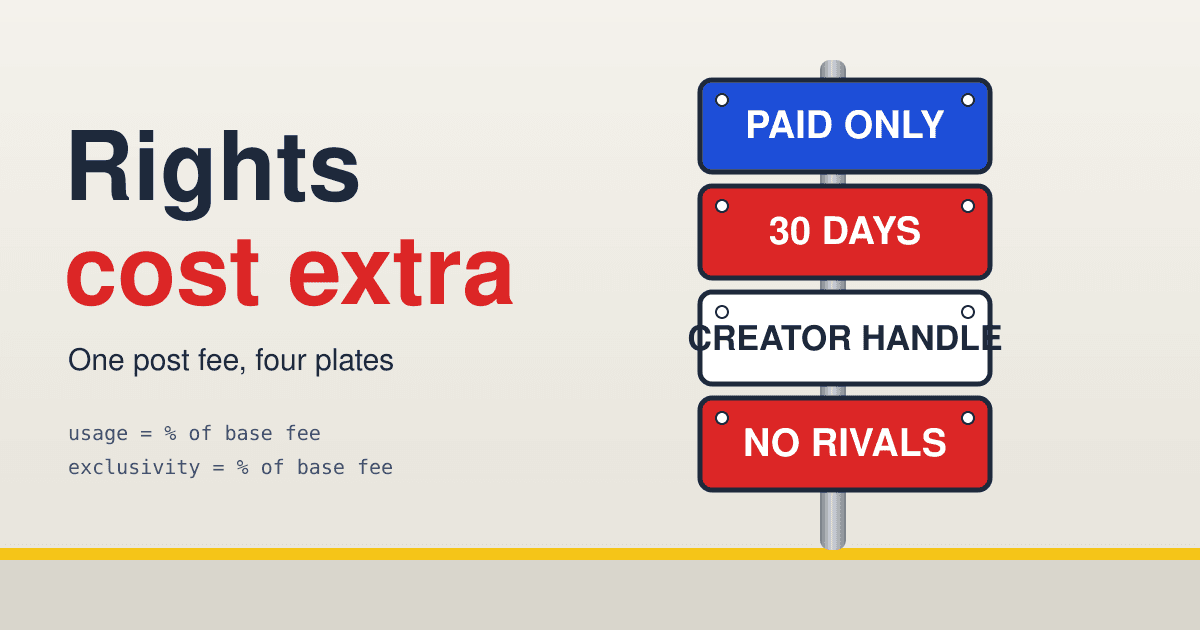
- Everything else is an add-on. Running the post as an ad, running it from the creator's own handle, putting it on a website, and keeping the creator away from rival brands are each priced as a percentage of the base fee.
- The published percentages disagree. For 90 days of paid use, one guide says 20 to 35% and another 30 to 45%. Treat any range as an opening position, then price your own plan.
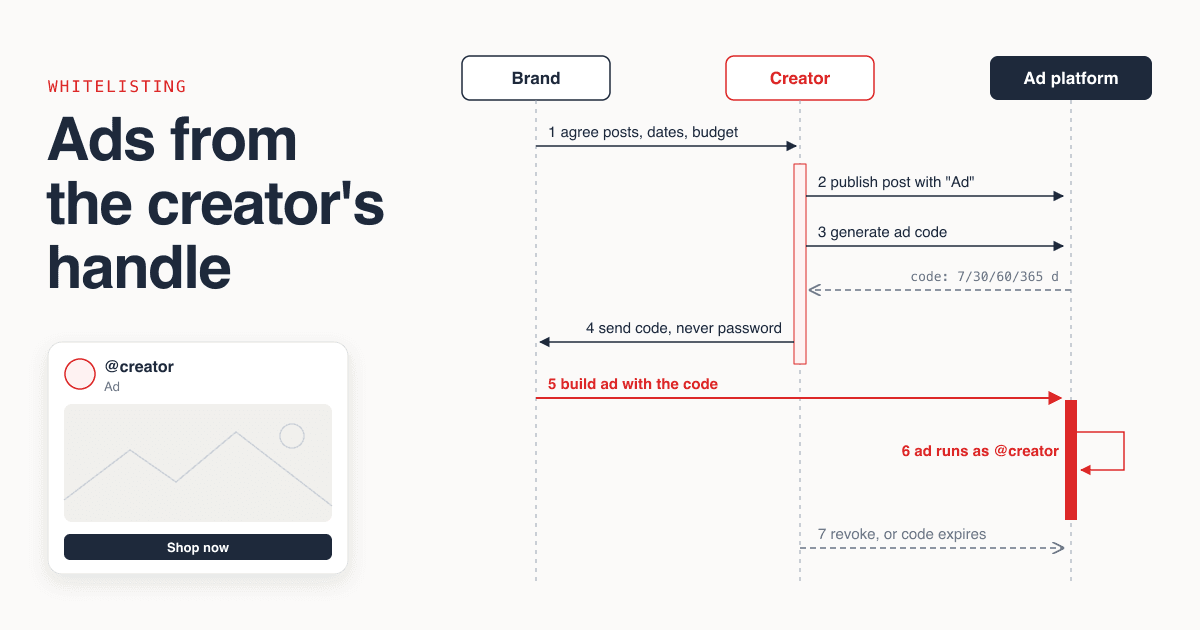
- A platform permission is not the contract. A TikTok code or a Meta partnership permission lets an ad run; only the contract says what the brand may do, for how long, and what happens at the end.
This is general information on how deals are usually priced, not legal advice. For a contract with real money in it, have a lawyer read the clauses.
Five things a usage clause can restrict
Guides on this topic sort rights along the same few lines: where the content may run, for how long, who controls the distribution and whether the creator may work for rivals meanwhile. Read as signs, each is a restriction you can set tight or leave wide open, and each has a price.
-
Channel
Where may it run?
Organic repost on the brand's own profile, a paid ad from the brand's account, a paid ad from the creator's handle, website and email, or out-of-home and broadcast. Each step up is more exposure, and the quoted premium rises with it.
Write: each channel by name; "any media" is a buyout in disguise
-
Term
How long?
Guides price 30 days, 90 days, six months, 12 months and perpetual. The term is the biggest lever on the fee, and the one most often left without a start date.
Write: a start date (first day of paid spend, not signing day) and an end date
-
Territory
Where in the world?
Not a priced line in the guides read for this post, but a normal drafting choice: a licence for one country should not quietly run in ten. Only exclusivity has a published geographic discount.
Write: the countries or regions, and that other territories are not licensed
-
Edits
Who may change it?
Cutting a 60-second video to 15 seconds is not the same as changing what the creator says. InfluencerFee advises that edits must not change the message or remove required disclosures, and that the creator's handle is credited.
Write: permitted edits (cut, resize, caption), and that the paid-partnership label stays on every version
-
Exclusivity
Who else may they work for?
A restriction on the creator, not a licence to the brand: no deals with competing brands for a period. Category, platform, geographic and first-refusal versions exist, at different prices.
Write: named competing brands, a category definition and an end date
What published guides charge on top of the post fee
All figures below are percentages of the creator's base content fee, added on top of it. They come from vendor guides, not from a regulator or a standards body, and two of them disagree on purpose in the table: that is the point.
| Add-on | InfluencerFee | Gigapay (quoting UGC Bloom and others) |
|---|---|---|
| Organic repost | Typically included | 0-15%; many creators include 30-90 days |
| Paid, brand account, 30 days | +10-20% | +15-30% |
| Paid, brand account, 90 days | +20-35% | +30-45% |
| Paid, brand account, 12 months | +40-70% | +70-100% |
| Website and email, 12 months | +15-30% | +20-35% |
| Whitelisting, 30 days | +15-25% | +25-50% |
| Perpetual buyout, all channels | +50-150% | +150-300% |
| Out-of-home or broadcast | +75-200% or more | Not listed |
The Gigapay page credits its 25 to 50% whitelisting range to InfluencerFee and Influencer Marketing Hub, while InfluencerFee's own usage page lists 15 to 25% for 30 days. Figures drift between summaries, so open the original before you quote one to a creator.
Exclusivity, from one guide
| Exclusivity | Term | Added to base fee |
|---|---|---|
| Category | 30 days | +20-35% |
| Category | 90 days | +50-75% |
| Category | 12 months | +100-150% |
| Platform only | 30-90 days | +10-20% |
| Geographic | 90 days | +25-40% |
| Right of first refusal | Contract term | +10-20% |
Source for the exclusivity rows: InfluencerFee, exclusivity pricing guide. Another summary, quoted on a vendor page and credited to Influencer Marketing Hub, puts category exclusivity at a 15 to 30% premium on total fees, so even the basis (base fee or total fee) is not settled.
A 3,500 dollar Reel, priced as the guides would
Take a creator whose base fee for one Instagram Reel is $3,500, and add the lower and upper InfluencerFee ranges, each percentage taken on the $3,500 and added, not compounded. That is how its own worked example adds a usage premium and a whitelisting premium.
-
Slip APost only
- Base fee
- $3,500
Total$3,500
One post, organic, no ads. What the first quote usually shows.
-
Slip B90 days of paid use from the brand account
- Base fee
- $3,500
- +20-35%
- $700-$1,225
Total$4,200-$4,725
The brand cuts the Reel into ads on its own account.
-
Slip CAdd whitelisting for the same 90 days
- Slip B total
- $4,200-$4,725
- +25-45%
- $875-$1,575
Total$5,075-$6,300
Ads run from the creator's handle. Ad spend is paid on top of every figure here.
-
Slip DAdd 90 days of category exclusivity
- Slip C total
- $5,075-$6,300
- +50-75%
- $1,750-$2,625
Total$6,825-$8,925
Within the $7,000 to $10,000 that one summary says such a Reel becomes.
-
Slip EExclusivity priced from lost income
- Category income, per month
- $2,000
- Months
- 3
- Recovery factor
- 0.8
Total$4,800
The opportunity-cost method in the same guide: $2,000 x 3 x 0.8. It can land above the percentage, so ask what the creator earns from the category.
Two things to read off the slips. First, one post became a line of about $6,800 to $8,900 before any media was bought. Second, the cheapest moment to ask for rights is before the post exists: InfluencerFee says some creators charge two to five times the original content rate when a brand asks for licensing afterwards.
The clocks do not run at the same speed
A deal has several time limits, set by different parties. The bars below sit on one scale of 365 days. The licence and exclusivity bars are example terms from Slip D; the platform bars are what each platform lets the creator set.
-
Paid-use licenceContract
Example: 90 days from the first day of spend. Who acts: brand, to switch ads off at the end, or to buy an extension before it.
-
Category exclusivityContract
Example: 90 days. Who acts: creator, who must not post for named rivals until the end date.
-
Spark Ads authorisationTikTok
Secondary sources say the creator picks 7, 30, 60 or 365 days (some also list 90) when generating the code; one adds that the code itself should be redeemed within 30 days. Who acts: creator, who sets it; brand, who must renew before it lapses.
-
Partnership ad permissionMeta
Meta says partners can revoke permissions at any time. Secondary reports say a content-level permission can also carry an expiry date; check your own Creator Marketing Hub. Who acts: creator, who can end it.
The grey bars are the point: a 365-day Spark authorisation inside a 90-day licence does not extend the licence, and a 90-day licence does not stop a creator revoking a Meta permission on day 20. Neither platform clock replaces a contract clause for the date, and the contract should say what happens if the creator pulls the permission early.
The platform side of this is covered in how brands run ads through a creator's account; the label that must stay on every edit is covered in which disclosure label works in the US, UK and EU.
Lines to add, split by who is signing
None of these lines is a legal template. They are the questions that a vague "usage rights" clause leaves open, written as clauses you can adapt.
If you are the brand
- Licensed channels: paid social on the brand's own accounts (named), website, email. No other channel is licensed.
- Term: 90 days from the first day of paid spend, with an option to extend by 30-day blocks at a fee agreed now.
- Edits: cut, resize and caption allowed; no change to claims, voice or meaning; the paid-partnership label stays on every version.
- Exclusivity: named competing brands only, not "any competitor", with the dates it starts and ends.
- Ending: ads switched off, and platform permissions removed, within 5 days of the end date.
If you are the creator
- Usage and exclusivity are separate fee lines, each with its own term.
- "Perpetual" and "any media" appear only in a buyout, priced as a buyout.
- Extensions are paid before the current term ends, not after the ads have kept running.
- My handle is credited on every ad, and no voice or likeness edits are made without written approval.
- The brand tells me which platform permission it will ask for, and for how many days.
Questions buyers ask
Does the post fee cover reposting on the brand's page?
Often yes. One guide calls an organic reshare typically included, another says many creators include 30 to 90 days of organic use in their rate. Write the channels and the days down rather than relying on what is usual.
Is a usage right the same as whitelisting?
No. A usage right lets the brand run the content as its own ad. Whitelisting lets the brand run ads that appear to come from the creator's handle, which preserves the creator's identity and engagement and is priced higher in the guides above.
Percent of what: the post fee or the whole deal?
The guides use the base content fee. One summary of Influencer Marketing Hub figures describes exclusivity as a premium on total fees instead. Say in the contract which base the percentage applies to.
Can the creator pull the permission early?
On Meta, partners can revoke permissions at any time. Your contract cannot change what the platform lets them do, but it can say what refund or replacement applies when they do.
Does a buyout mean the brand owns the content?
A buyout in these guides is a licence without a time limit, not a transfer of ownership. Under US law a transfer of ownership needs a signed writing, so if ownership is what you want, say so in terms, and take legal advice.
Sources and what they are
- InfluencerFee, Influencer Content Usage Rights: How to Price Licensing for Ads and Marketing (vendor guide, source of the first usage column, the worked 90-day example and the retroactive-licence warning)
- InfluencerFee, Influencer Exclusivity Pricing Guide (vendor guide, source of the exclusivity table and the opportunity-cost method)
- Gigapay, Influencer Usage Rights and Whitelisting Fees in 2026 (payments vendor, quoting UGC Bloom, Influencer Marketing Hub and others; second usage column)
- Lookfluence, Influencer Contract Benchmarks 2026 (vendor summary, the $7,000 to $10,000 figure)
- Meta Business Help Center, About partnership ad permissions (platform, permissions can be revoked at any time)
- Superscale, TikTok Spark Ads: how they work and Growi, TikTok Spark codes (secondary sources for the TikTok authorisation periods; the platform's own help page could not be read for this post)
- 17 U.S.C. 204(a), Cornell Legal Information Institute (execution of transfers of copyright ownership)
Every percentage here is a vendor's published range and none is a market standard. The two usage columns were read on 2026-11-11, and the TikTok and Meta platform details were read through secondary sources and may have changed.