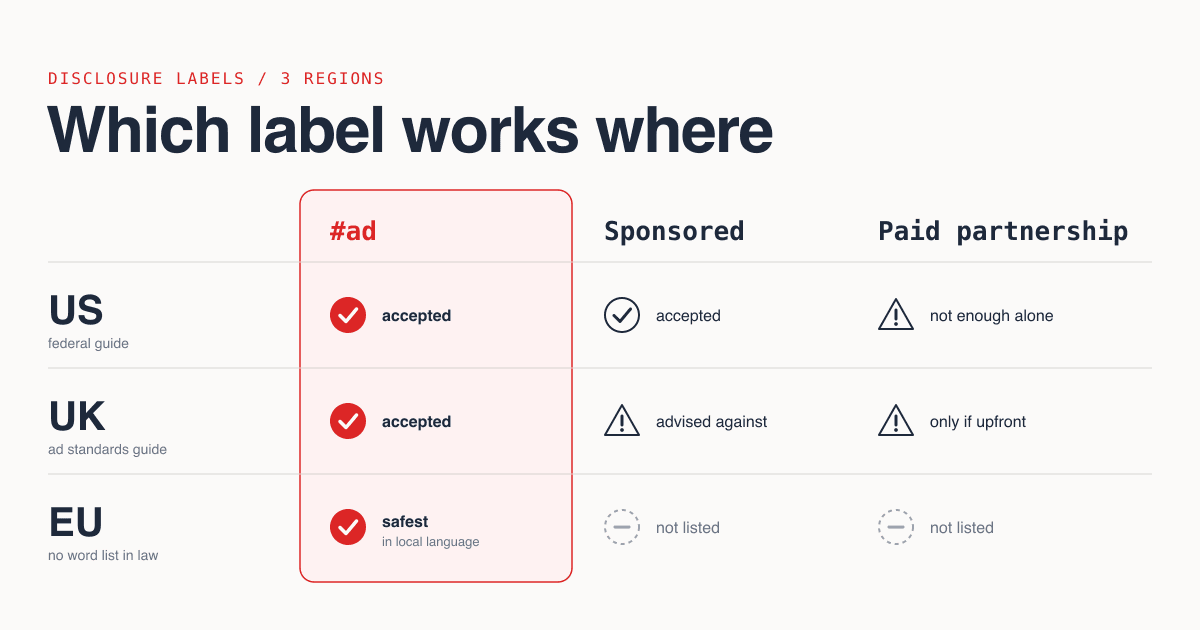
Write "Ad" at the start of every paid, gifted or affiliate post, in the first thing your audience sees. It is the one label that both the US Federal Trade Commission (FTC) and the UK Advertising Standards Authority (ASA) name as clear, while words like "collab", "spon" or a lone "thanks" fail in both places. The table shows how the common labels fare with each regulator.
| Label you might write | US: FTC | UK: ASA |
|---|---|---|
| Ad or #ad | Accepted | Accepted |
| Advertisement, Advert | Accepted ("advertisement") | Accepted, also "Advertising" and "Advertisement feature" |
| Sponsored or #sponsored | Accepted | Advised against |
| Platform tool, e.g. Instagram "Paid partnership" | Do not assume it is enough on its own | May be enough if upfront, clear and prominent |
| "Thanks to [brand] for the free product" | Often enough as a full sentence | Advised against ("Thanks to [brand] for making this possible") |
| Gifted, In partnership with, PR | Not named in the guide | Advised against |
| sp, spon, collab | Do not use | Advised against |
| Ambassador, a lone "thanks" | Do not use as stand-alone terms | Advised against ("brandambassador") |
Sources: FTC, Disclosures 101 for Social Media Influencers (2019); ASA and CAP, Influencers' guide to making clear that ads are ads (third edition, March 2023). EU law sets the duty but lists no approved words; see the EU section below.
A US creator with a large UK audience can be fine with "#sponsored" under the FTC and still fall short of the ASA guide. If your audience spans countries, use "Ad": it is the one word both guides accept, as long as it is placed where nobody can miss it.
What does "disclosure" mean in sponsored content?
Material connection: any link between you and the brand that could change how much people trust what you say, such as payment, free or discounted products, a family or work relationship, or the chance to win a prize. It must be disclosed when a significant minority of your audience would not expect it (16 CFR 255.5).
Clear and conspicuous: "difficult to miss (i.e., easily noticeable) and easily understandable by ordinary consumers". On social media and other interactive media, the disclosure "should be unavoidable" (16 CFR 255.0(f), revised in 2023).
The UK guide says the same thing in plainer words: people should be able to tell that content is advertising immediately, "without having to click or otherwise interact with it".
Do I have to disclose this post?
Work down the list. The first "yes" means the post needs a label. It sums up the checks in the FTC guide and the flowchart in the ASA guide.
- Did the brand pay you for this content? Yes: label it.
- Did you get the product, a trip, a stay, a discount, early access or a chance to win a prize? Yes: label it, even if nobody asked you to post. The FTC also counts free products unrelated to the one you mention (16 CFR 255.5).
- Does the post carry an affiliate link or a discount code that earns you commission? Yes: label it. The ASA treats affiliate content as advertising.
- Do you work for, own part of, or represent the brand? Yes: label it. That includes ambassador deals and family ties.
- Is it your own product, service or giveaway? Yes in the UK: make it clear in the post itself, not only in your bio.
- None of the above? Probably no label needed: you bought the product yourself and got nothing from the brand. If in doubt, label it.
"My review is honest" is not an exception. The FTC tells creators to disclose "even if you think your evaluations are unbiased".
How often do influencers get disclosure wrong?
Most of the time, according to a coordinated EU check. In a check published in February 2024, the European Commission and consumer authorities from 22 EU countries, Norway and Iceland reviewed the posts of 576 influencers. Nearly all posted commercial content, but only one in five systematically said it was advertising.
The same check found that 38% did not use the platforms' own labels, such as the Instagram "paid partnership" toggle, and used other wording instead: "collaboration" (16%), "partnership" (15%) or a general thank-you to the brand (11%). 358 influencers were picked out for further investigation by national authorities.
What does EU law require?
The Unfair Commercial Practices Directive gives no list of labels, but it sets two rules that cover sponsored content (Directive 2005/29/EC):
- Article 7(2): hiding the commercial intent of a practice, when it is not already clear from the context, counts as a misleading omission.
- Annex I, point 11: paid editorial content that does not make the payment clear to the reader, in words, images or sounds, is banned in every case. The directive calls it an advertorial.
Each EU country enforces these rules through its own consumer law, and some regulators publish their own labelling guidance. When you have none to hand, an explicit word for advertising in the audience's language is the safest choice. The FTC makes the same point: the disclosure should be in the same language as the endorsement.
Where should the label go in each format?
Both guides care more about where the label sits than about the exact word. The test is simple: would someone who sees only the first second, the first line or the thumbnail know it is an ad?
Easy to miss
- "Loving my new running shoes, link below! #fitness #run #morning #collab"
- Label only after "read more", or only in your bio
- "Ad" in light grey on a light photo
- Disclosure only in the video description
Hard to miss
- "Ad: Loving my new running shoes from [brand], link below"
- Label in the first line, before any hashtags
- "Ad" over the image, with enough contrast and time to read
- Said out loud and shown on screen in the video itself
| Format | Put the label here | Source |
|---|---|---|
| Feed post or caption | At the start of the text, not buried in other hashtags | ASA guide, FTC 101 |
| Story or image | Over the image, readable and on screen long enough | FTC 101 |
| Video | In the video, not only in the description; ideally said and shown | FTC 101, 16 CFR 255.0(f) |
| Live stream | Repeated during the stream for people who join late | FTC 101 |
| Title or thumbnail | "Ad" in whatever people see first | ASA guide |
| Sponsored article | In front of or above the headline | FTC native advertising guide |
Who is responsible: the creator, the brand or the agency?
If a creator forgets the label, that is the creator's problem, not the brand's.
The FTC says an advertiser "may be liable for a deceptive endorsement even when the endorser is not liable", and expects brands to guide their endorsers, monitor them and act when they slip (16 CFR 255.1(d)). The ASA guide names the creator, the brand and any agents involved as responsible.
Ticking the platform's "paid partnership" box covers everyone.
The FTC says not to assume a platform's tool is good enough, and the ASA accepts it only when the label is upfront, clear and prominent. If the tag is hidden by the image or the layout, add "Ad" yourself.
For media buyers this is practical: put the label wording and placement in the brief and the contract, ask for a screenshot of the live post, and check it before you pay.
How should publishers label sponsored articles and links?
A paid article on a website needs two labels: one for readers and one for search engines.
-
Label it for readers above the headline
The FTC's native advertising guide lists "Ad", "Advertisement", "Paid Advertisement" and "Sponsored Advertising Content" as terms readers are likely to understand, and says to place the label "in front of or above the headline".
-
Avoid soft labels
The same guide warns against "Promoted" and "Promoted Stories", and notes that "Presented by [X]" or "Sponsored by [X]" can suggest the brand only funded the piece, not shaped it. A company logo or name on its own is not likely to be enough.
-
Mark paid links for search engines
Google asks sites to mark links that are ads or paid placements with
rel="sponsored";rel="nofollow"is still accepted, but sponsored is preferred (Google Search Central, Qualify your outbound links).
Questions creators and brands ask about disclosure
Is #sponsored enough?
In the US, the word is accepted: the FTC lists "sponsored" with "ad" and "advertisement", as long as it is hard to miss. In the UK, no: the ASA guide advises against "Sponsored", "Spon" and "Sp". Use "Ad" if your audience is in both.
Do I need a hashtag?
No. The FTC calls a hashtag "fine (but not necessary)", and the ASA says the "#" is not needed if the label is prominent and clearly separate from the rest of the post.
The brand sent me a free product but did not ask for a post. Do I disclose?
Yes, if you mention the brand. The FTC says to disclose free or discounted products even when you were not asked to post, and the ASA's flowchart counts unsolicited gifts as an incentive.
Is a disclosure in my bio enough?
No. The FTC says disclosures "are likely to be missed if they appear only on an ABOUT ME or profile page", and the ASA says general disclosures separate from the content will not be sufficient.
Is this legal advice?
No. It is a summary of the official guides linked above, checked on 14 October 2026. The ASA has said its guide will be updated for the UK Digital Markets, Competition and Consumers Act 2024. For a specific campaign, ask the regulator's advice service or a lawyer.
What should go in every sponsored brief?
Copy this list into your next brief or contract, whether you buy the placement or sell it.
- The label is "Ad", in the first line, title, thumbnail or first seconds of the content.
- The label is in the same language as the post.
- Video and live content say it out loud and show it on screen; live streams repeat it.
- The platform's branded-content tool is switched on, and "Ad" is added if the tag is easy to miss.
- Affiliate links and discount codes are labelled too.
- Sponsored articles carry the label above the headline and use
rel="sponsored"on paid links. - The brand checks a screenshot of the live post before payment.
Clear labels protect the brand and the creator and they keep the audience's trust, which is what the placement was bought for. If you sell sponsored placements or creator services, you can list them on MediaProNet where media buyers look for partners.
Ready to list your website?
Submit to MediaProNet and get a free public listing with a link to your site - or upgrade to a paid plan for featured placement and priority visibility in front of relevant visitors.
Submit Your WebsiteWritten by
MediaProNet Editorial Team
The MediaProNet team writes about launching, product discovery, and distribution. Advice in these articles is editorial opinion unless a source is linked next to it.