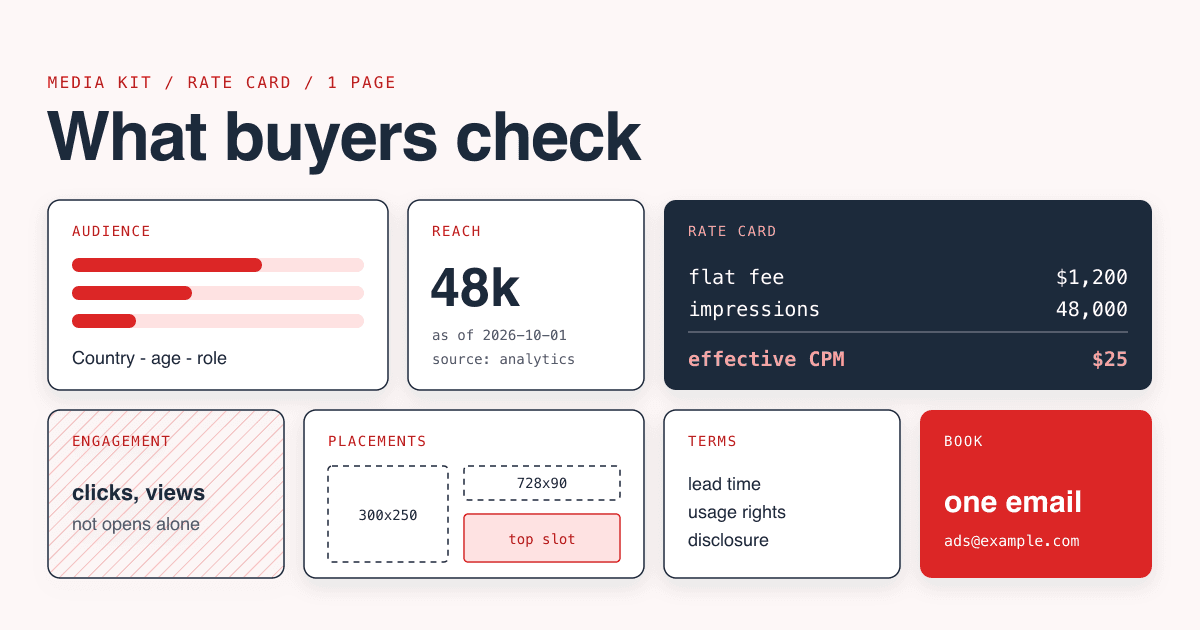
Eight parts make a media kit that an advertiser can book from without a call: who your audience is, how many of them you reach, how they respond, the placements you sell, your rates, proof from past campaigns, your terms, and one clear way to book.
Short answer
A media kit is a short document, usually one or two pages plus a rate card, that a publisher, newsletter or creator sends to advertisers. It works when every number in it has a date, the name of the tool it came from and the name of the metric, so a buyer can check it. Quote people reached and clicks, not follower counts or email opens alone, and show your price as a flat fee together with what it works out to per thousand impressions.
What are the 8 parts of a media kit?
Each tile below is one part: what to put in it, where the number comes from, and the question a media buyer is asking when they read it. Keep the order. It follows the order a buyer decides in: is this the right audience, is it big enough, does it respond, what can I buy, what does it cost, has it worked for others, what are the rules, and how do I book.
01
Audience, in one sentence
Who reads or watches you, in the words a buyer uses to plan: job, industry, country, interest. "Finance managers at mid-size companies in the UK" can be planned against; "curious people who love learning" cannot.
Buyer asks: is this my customer?
02
Reach, dated and sourced
One headline number per channel, with "as of" date, tool and metric name. For example: "41,800 active users in September, Google Analytics 4".
Source: the tool's own metric name
Buyer asks: can I check this?
03
Audience profile
Top countries, age bands and, where it matters, gender, taken from the platform's audience report for the same period as the reach number.
Buyer asks: does it match my targeting?
04
Response
Clicks per newsletter issue, views per video, saves and shares per post. A median of your last ten pieces is more honest than your best one.
Buyer asks: will people act?
05
Placements and specs
Each thing you sell, with its position, size or length, and the deadline for materials: top-of-issue sponsor slot, dedicated send, a 60-second video read, a 300x250 banner.
Buyer asks: what exactly do I get?
06
Rate card
A price per placement and the pricing model: flat fee, CPM, CPC or CPA. Next to each flat fee, write what it works out to per thousand impressions.
$1,200 flat48,000 impressions= $25 effective CPM
Example numbers, not a market rate
Buyer asks: is it priced fairly against my other buys?
07
Proof
Brands you have worked with and the results they agreed you may share, each with its date. Ask before you name a client.
Buyer asks: has this worked for someone like me?
08
Terms and how to book
Lead time, rounds of revisions, cancellation, payment terms, who may reuse the content and for how long, how the ad is labelled, and one email address or booking link.
Buyer asks: what can go wrong, and who do I write to?
Which number should you quote from each analytics tool?
Buyers compare your kit with other kits, so name the metric exactly as your tool names it. Each tool defines its metrics in its own help pages, and the definitions differ more than the names suggest.
| Tool | Metric to quote | What the tool says it counts | Watch out for |
|---|---|---|---|
| Google Analytics 4 | Active users, Views | Active users: "the number of distinct users who visited". Views: pages users saw, and "repeated views of a single screen or page are counted" (Google Analytics Help). | Views are not people. Quote users for reach, views for ad inventory. |
| YouTube Studio | Unique viewers, Views | Unique viewers: "estimated number of viewers that watched your content within the selected date range"; Views: "legitimate views" (YouTube Help). | YouTube says some audience data "may be limited" (YouTube Help). |
| Viewers, Views | Viewers: "unique accounts that have seen your content on screen at least once"; Views: times content "was played or displayed" (Instagram Help). | Account insights cover the past 90 days; demographics need reach over 100 accounts (Instagram Help). | |
| TikTok | Views, viewer demographics | Ranges of 7, 28, 60 or 365 days, or custom; gender, age and location are "based on predictive models" (TikTok Creator Academy). | Say the demographics are inferred, as TikTok does. |
| Substack | Clicks, open rate | Open rate: share of recipients who opened, "each subscriber is counted once"; opens seconds after delivery are treated as automated and left out (Substack Help). | Apple Mail can load images before anyone reads (next section). Substack says it "no longer records email opens" from subscribers in France or Italy, for emails sent after October 14, 2026 (Substack Help). |
| beehiiv | Clicks, unique open rate | Open rate is calculated "on unique opens" (beehiiv support). | beehiiv calls Apple Mail Privacy Protection "one of the most significant sources of distortion in open rate data". |
Quotes from each tool's help pages, checked on 2026-10-20. Help pages change; re-check yours before you update the kit.
Flat fee, CPM, CPC or CPA: how should you price a placement?
A placement can be sold for one flat fee or at a price per unit: per thousand impressions, per click or per action. The four models put the risk on different sides of the deal.
Flat fee
One price for one placement, whatever the result. Simple to sell; the buyer carries all the risk, so expect questions about reach.
CPM
"Cost per thousand" ad impressions, which the IAB calls an industry standard measure for selling ads on websites (IAB glossary). Price = impressions / 1,000 x CPM.
CPC
The advertiser pays "for each click on your ads" (Google Ads Help). The risk moves to you: a weak ad lowers your earnings.
CPA
The advertiser pays for each visitor who takes "some specifically defined action" beyond the click, such as a signup or sale (IAB glossary). Most risk on you; agree in writing how actions are counted.
Turn a flat fee into numbers a buyer compares
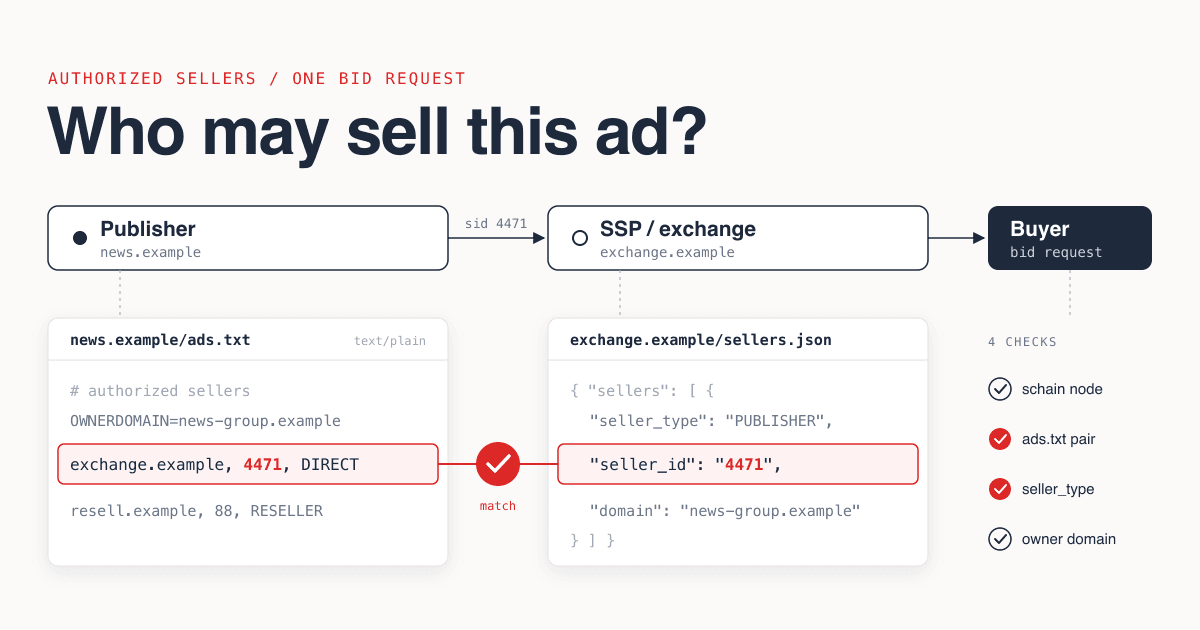
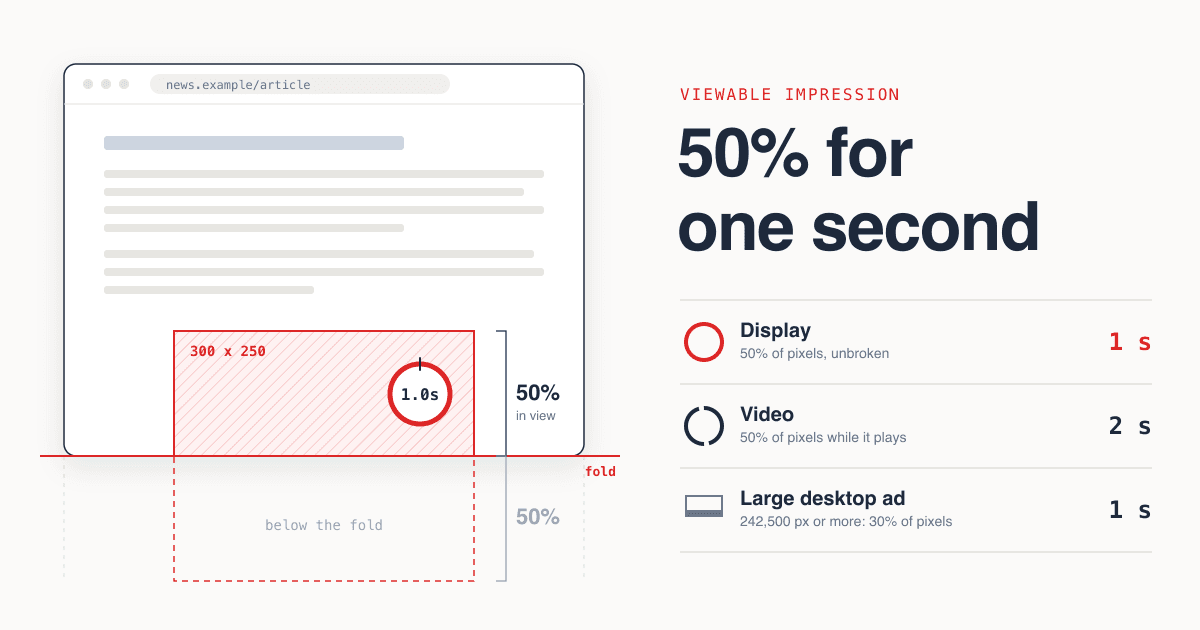
fee / impressions x 1,000$1,200 / 48,000 x 1,000 = $25fee / clicks$1,200 / 600 = $2.00For display ads, list sizes buyers already have creative for. The IAB's fixed-size portfolio recommends, among others, the 970x250 billboard, 728x90 leaderboard, 300x250 medium rectangle, 160x600 skyscraper, 300x1050 portrait and 320x50 smartphone banner (IAB New Ad Portfolio, fixed size specs). If you sell display on a website, keep its ads.txt file in order too, since buyers can check it (how ads.txt works), and expect some buyers to pay only for viewable impressions (what counts as viewable).
Which media kit numbers do buyers distrust, and why?
"A 60% open rate proves people read the newsletter."
When Protect Mail Activity is on, Apple Mail says "remote content is privately downloaded in the background when you receive a message" (Apple Support), and Apple says it "stops senders from using invisible pixels to collect information about the user" (Apple Newsroom, June 2021). An open can be counted before anyone reads. Lead with clicks.
"Followers is my reach."
Followers are who could see a post; Instagram's Viewers metric counts the unique accounts that actually saw it on screen; Instagram calls these metrics estimated (Instagram Help). Quote viewers per post, and give followers as context.
"Bought followers only make my engagement rate look worse."
In the US, the FTC rule effective October 21, 2024 makes it unfair or deceptive to buy fake indicators of social media influence that you knew or should have known were fake and that materially misrepresent your influence for a commercial purpose. Indicators include followers, subscribers, views, likes and comments (16 CFR 465.8, Federal Register, August 22, 2024).
What terms should a media kit spell out?
Terms prevent the arguments that follow a campaign: a missed deadline, a reused clip, a post that went out without a label. Write each as one line.
- Lead time. How many days before the run you need the brief and the materials.
- Revisions. How many rounds of changes the price includes.
- Cancellation and make-goods. What happens if either side moves the date, or a placement runs wrong.
- Payment. When you invoice and when payment is due.
- Usage rights. Whether the brand may reuse your content in its own ads, where and for how long. Running ads from a creator's account is a separate deal (how whitelisting works).
- Exclusivity. Whether you will turn away the brand's competitors, and for how long. Price it separately.
- Disclosure. How the ad will be labelled. See the box below.
How does a buyer check a media kit before paying?
A careful buyer goes through something like the scorecard below. Run it on your own kit first; every "no" is a question you will be asked.
- Every number has a date, a tool and a metric name.
- The dates are recent, and all numbers cover the same period.
- Reach is given in people (users, viewers), not only in followers or page views.
- Newsletter response is shown as clicks, not open rate alone.
- Demographics come from the platform's audience report, and inferred data is called inferred.
- Each placement has a position, size or length, and a materials deadline.
- Each flat fee has an effective CPM next to it.
- Past clients named in the kit agreed to be named.
- Usage rights, exclusivity and labelling are written down.
- You can send a screenshot of the analytics screen behind any number within a day.
Media kit questions
How long should a media kit be?
Short enough to read in one sitting: our advice is one or two pages for the eight parts, with the rate card as its own page, so you can change prices without redesigning the kit.
Should the rates be public?
Both work. Public rates save a round of email and filter out buyers with smaller budgets; private rates leave room to price each deal. If you publish them, give the date they are valid from.
How often should the numbers be updated?
Whenever you send the kit, check that the dates are recent. Instagram account insights only reach back 90 days (Instagram Help), so save a screenshot of each period you quote; post-level insights stay available for up to two years (Instagram Help).
Is a small audience worth a media kit?
Yes, if it is a specific one. A buyer selling to a narrow group may prefer a few thousand of exactly those people. Note that Instagram shows audience demographics only once your content reaches more than 100 accounts in the period (Instagram Help).
PDF or web page?
A web page can be updated in one place and linked from your site; a PDF is easy to attach and forward inside an agency. You can keep both; put the same date on each.
Sources
- Google Analytics Help: GA4 dimensions and metrics
- YouTube Help: YouTube Analytics metrics
- YouTube Help: audience demographics
- Instagram Help: insights on your professional account
- Instagram Help: insights for posts
- TikTok Creator Academy: analytics
- Substack Help: how opens are captured
- beehiiv support: declining open rates, a diagnostic guide
- Apple Support: protect email privacy in Mail
- Apple Newsroom: Mail Privacy Protection announced (June 2021)
- IAB: glossary of interactive advertising terms (CPM, CPA)
- Google Ads Help: cost-per-click bidding
- IAB: New Ad Portfolio, fixed size ad specifications (2019)
- FTC: Disclosures 101 for social media influencers
- YouTube Help: paid product placements and endorsements
- Instagram Help: branded content policies
- FTC: Trade Regulation Rule on the Use of Consumer Reviews and Testimonials, 16 CFR Part 465 (Federal Register, August 22, 2024)