Buy one million display impressions at a $4 CPM and you pay $4,000, but at the 2025 global display average of 67.9% viewable, only about 679,000 of them would meet the industry standard for an ad that had a chance to be seen, if the impressions the vendor cannot measure do as well as the ones it can (IAS Media Quality Report, 21st edition).
Short answer
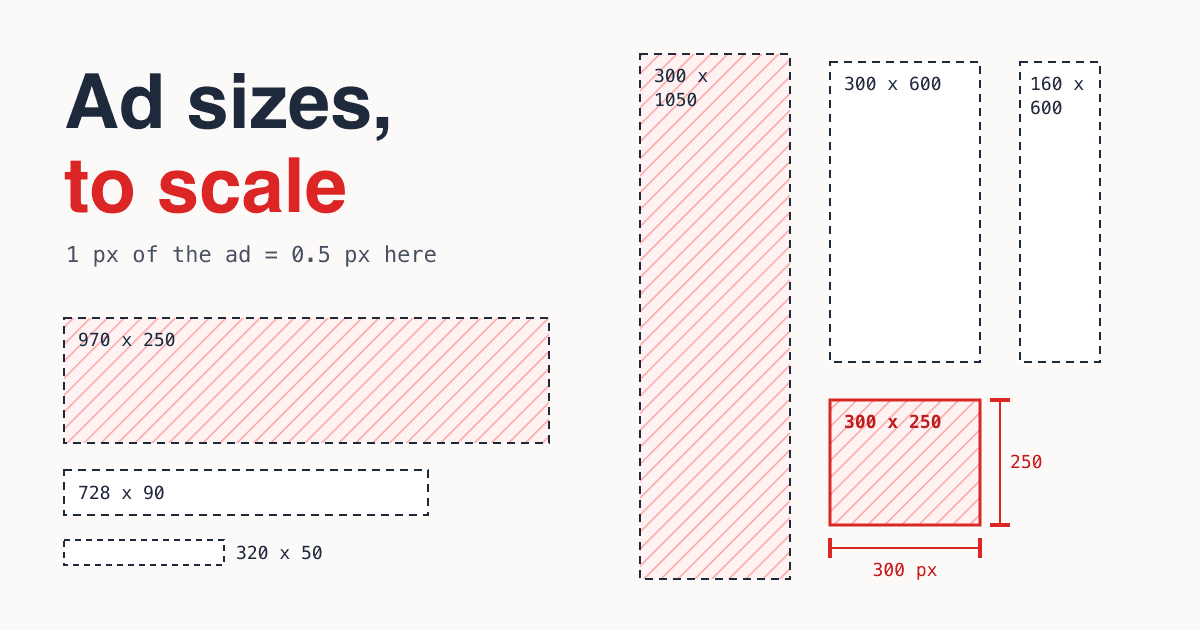
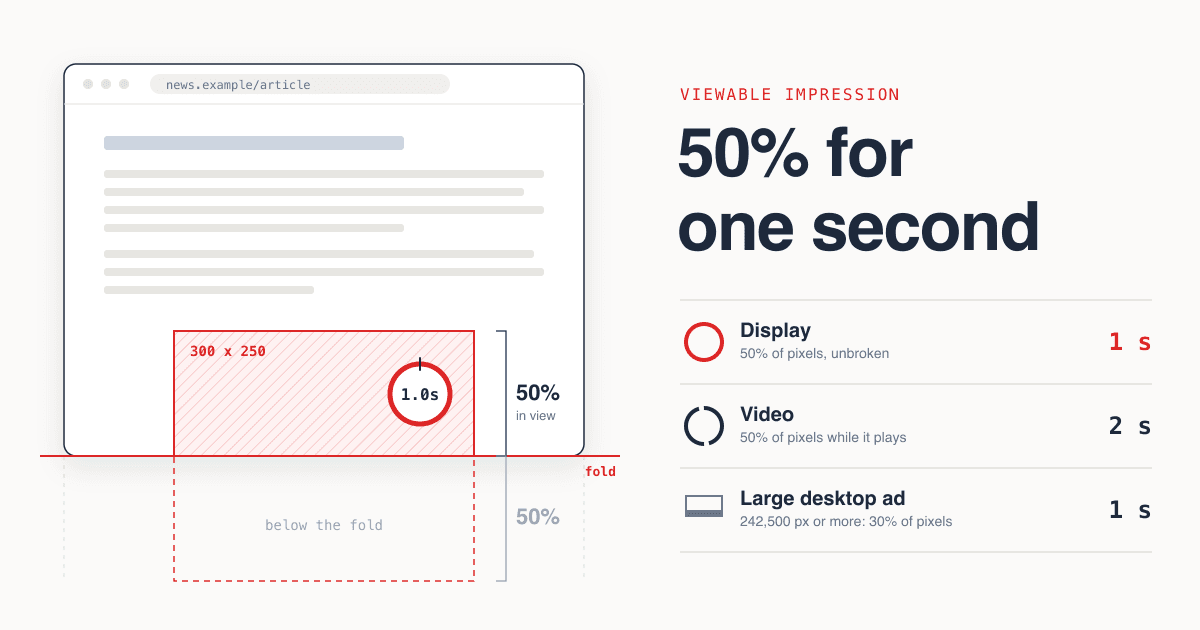
Under the Media Rating Council (MRC) standard, a display ad is a viewable impression when at least 50% of its pixels are on screen, in a browser tab or app the person has open, for at least one continuous second. On desktop, large display ads of 242,500 pixels or more (970 x 250 and up) need only 30%. A video ad needs 50% of its pixels on screen while two continuous seconds of it play. The 50% rules cover desktop, mobile web and apps alike. Viewable means the ad had an opportunity to be seen, not that a person looked at it.
What counts as a viewable impression?
The rule comes from the MRC, the US body that accredits ad measurement, written with the IAB. The desktop guideline is Viewable Ad Impression Measurement Guidelines, version 2.0 (final text dated August 18, 2015). The mobile guideline of June 28, 2016 keeps the 50% thresholds for mobile web and in-app ads, counts pixels as density-independent pixels, and has no 30% exception for large ads.
| Ad type | Pixels on screen | For how long |
|---|---|---|
| Display ad | 50% or more | 1 second, unbroken, after the ad renders |
| Large display ad on desktop, 242,500 pixels or more (970 x 250 and up) | 30% or more | 1 second, unbroken |
| Video ad | 50% or more | 2 seconds of the video played, unbroken |
Two details trip people up. The pixels must be on an in-focus tab: an ad in a background tab is not viewable for as long as the tab stays in the background. And the second must be continuous: half a second in view, a scroll away and half a second back does not add up to one.
Served, measured, viewable: which number is which?
A served impression is counted when the ad is delivered, whether or not it reached the screen. A measured impression is one a vendor could classify as viewable or not; the rest are "undetermined". The MRC's own worked example, for 1,000 rendered impressions:
- 1,000 servedrendered impressions, the full bar
- 500 measuredmeasured rate 50%
- 300 viewableviewable rate 60%
The viewable rate is viewable divided by measured (300 of 500), not by served. Read both rates together.
What does a viewable impression really cost?
When you buy on a plain CPM you pay for served impressions, so the price of what you actually wanted is higher than the sticker. Divide the CPM by the viewable rate:
cost per 1,000 viewable = CPM / viewable rate
The formula assumes the impressions a vendor could not measure behave like the ones it could; if many are undetermined, the real cost can be higher. With a $4 CPM, the same budget buys very different amounts of viewable reach. Use this to compare a CPM offer with a viewable CPM (vCPM) offer on equal terms. In Google Ads, vCPM bidding charges for impressions measured as viewable; Google says "a small portion of served impressions might be charged", and vCPM is not available for Search Network campaigns.
- $10.00 Example: a weak placement
- $5.89 2025 global display average (IAS)
- $4.44 Example: a strong placement
How viewable is the average ad?
- 67.9%Global display viewability in 2025 (desktop and mobile web), up 1.9 points over the yearSource: IAS Media Quality Report, 21st edition (2026)
- 79.7%Global video viewability in 2025 (desktop and mobile web), 11.8 points ahead of displaySource: IAS Media Quality Report, 21st edition (2026)
- 56.1%Share of ads served that were not measured viewable, in Google's 2014 study of its display platforms (Google and DoubleClick)Source: Google, 5 factors of viewability (2014)
IAS measures to the MRC standard above. In plain words: in 2025, roughly one display ad in three that IAS could measure never met the 50% for one second bar.
Where on the page do ads get seen?
Google's 2014 study is old, but it is one of the few public breakdowns by position and size. Its finding: "The most viewable position is right above the fold, not at the top of the page" (Google, The Importance of Being Seen, 2014). Average viewability was 68% above the fold and 40% below it, so neither side is a guarantee.
Average viewability by ad size, 2014
Vertical units led; the common 300 x 250 trailed at 41.0%. Source: Google, 2014.
Is 50% for one second the only standard?
No. It is the industry minimum, and some buyers set a higher bar in their own deals.
MRC standard
Display: 50% of pixels for 1 second.
Video: 50% of pixels while 2 seconds play.
GroupM, as reported in 2017
Display: 100% of pixels for at least 1 second.
Pre-roll and mid-roll video: 100% in view, 50% complete, started by the user with sound on.
Source: MarTech, August 2017. Press coverage of the agency's standard at the time; agree the exact definition in writing with each buyer.
Does viewable mean someone saw the ad?
MythA viewable impression proves a person saw the ad.
FactThe MRC calls it an "opportunity to see". Nobody's eyes are measured.
MythAbove the fold is always viewable.
FactIn Google's 2014 data, above-the-fold ads averaged 68%, and many below-the-fold ads were viewable.
MythEvery vendor will report the same viewable count.
FactVendors can disagree. Where counts differ, the MRC guideline asks all parties to the deal to talk it through and resolve it.
What should buyers and publishers check?
If you buy media
- Ask which definition the report uses: the MRC minimum or a stricter one.
- Check that the vendor is MRC-accredited for viewability in that environment: desktop, mobile web or in-app, display or video.
- Read the measured rate next to the viewable rate.
- Compare offers on cost per 1,000 viewable impressions, not on CPM.
If you sell placements
- Test a unit just above the fold before paying for the top slot.
- Try a vertical size next to your 300 x 250.
- Quote your viewable rate with its measured rate and vendor, so buyers can compare like with like.
Questions buyers ask about viewability
Is a viewable impression the same as an impression?
No. An impression is counted when the ad is served. A viewable impression is the subset that met the pixel and time rule. The MRC notes that not all served impressions had the opportunity to be seen.
Does the rule change for mobile apps?
Mostly no. The MRC mobile guideline of 2016 uses the same 50% and one second for display and two seconds for video, for mobile web and in-app, with pixels counted as density-independent pixels. The one difference: it has no 30% exception for large ads.
What is a good viewability rate?
There is no official target. For context, IAS measured 67.9% for display and 79.7% for video worldwide in 2025. Compare a placement with those averages, measured by the same vendor.
Do I pay for ads nobody could see?
On a plain CPM, yes: you pay per served impression. With vCPM bidding in Google Ads you pay for impressions measured as viewable, though Google says a small portion of served impressions might be charged.
Why is the 970 x 250 rule different?
Half of a very large ad is a lot of screen. On desktop, for ads of 242,500 pixels or more, the MRC counts a viewable impression at 30% of pixels on screen for one continuous second. The mobile guideline has no such exception.
Sources
- MRC, Viewable Ad Impression Measurement Guidelines v2.0 (August 18, 2015)
- MRC, Mobile Viewable Ad Impression Measurement Guidelines (June 28, 2016)
- MRC, accredited digital services
- IAS, Media Quality Report, 21st edition (2026, 2025 data)
- Google, 5 factors of viewability (December 2014)
- Google, The Importance of Being Seen, infographic (2014 data)
- Google Ads Help, viewable CPM and bidding on impressions
- MarTech, GroupM viewability standards (August 2017)