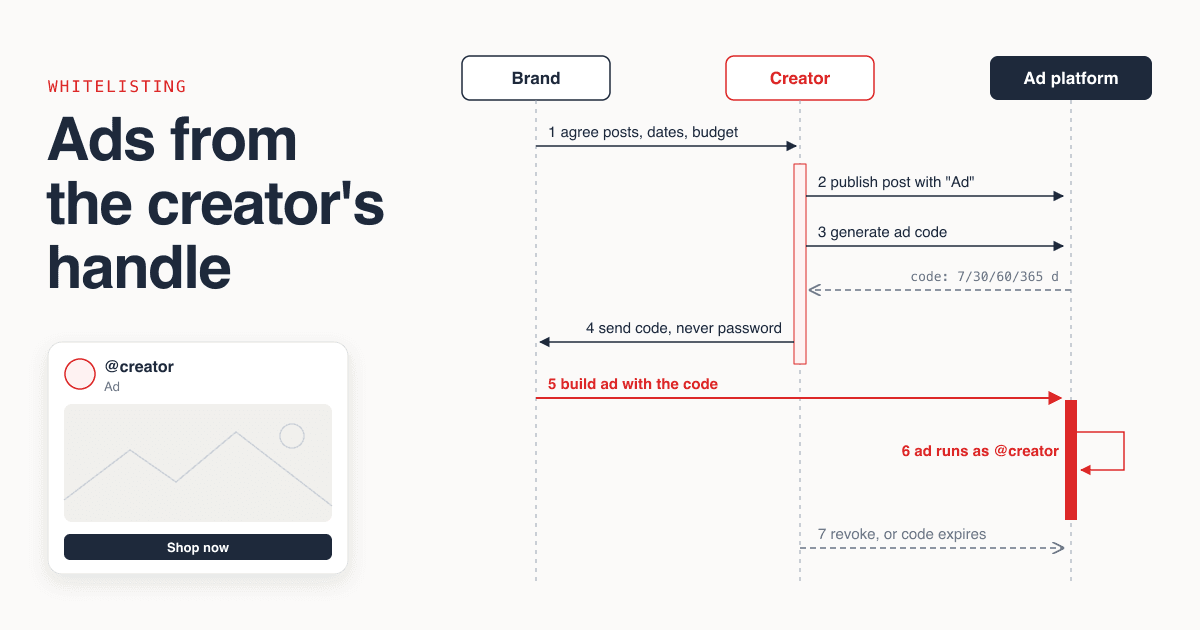
A sponsored post reaches the people who follow the creator; a whitelisted ad of that same post reaches whoever the brand pays to target, and it still shows the creator's name at the top.
Influencer whitelisting means a creator gives a brand permission to run paid ads with the creator's post and handle. On TikTok the creator sends a Spark Ads code that lasts 7, 30, 60 or 365 days. On Instagram and Facebook the creator shares a partnership ad code or gives the brand permission for partnership ads. On YouTube the creator links a video to the brand's Google Ads account until they remove the access. In every case, keep a clear "Ad" disclosure on the post: US and UK rules expect the paid link to be obvious.
Stop 1
What does influencer whitelisting mean?
Influencer whitelisting is an arrangement in which a creator lets a brand put money behind the creator's content and run it as an ad that appears under the creator's account. The term comes from the influencer industry, not from any platform. None of the platform help pages cited here uses the word; each platform sells the same idea under its own product name.
- Whitelisting, allowlisting
- The industry names for the arrangement. "Allowlisting" is the same thing; some teams prefer the newer word.
- Spark Ads
- TikTok's format: "a native ad format that allows you to leverage organic TikTok posts and their features in your advertising" (TikTok Ads help).
- Partnership ads
- Meta's format on Instagram and Facebook, called branded content ads until May 2023: they "allow advertisers to amplify content from a creator or other partner's handle" (Instagram for Business, 1 May 2023).
- Creator partnerships boost
- YouTube's format, in which "advertisers can promote YouTube creator videos in ad campaigns", served "from the creator's YouTube channel" (Google Ads help).
- Usage rights
- Separate from all of the above: the right to edit and reuse the creator's content in the brand's own ads, under the brand's name. A platform permission does not grant it; the contract does.
Stop 2
How is a whitelisted ad different from a sponsored post?
The content can be identical. What changes is who pays for the reach, who picks the audience and where the results show up.
Sponsored post
- The brand pays the creator; the creator posts.
- Reach is the creator's own audience and the platform's organic feed.
- The creator sees the results; the brand gets a screenshot or a report.
- It ends when the post stops getting views.
Whitelisted ad
- The brand also pays the platform for media.
- Reach is any audience the brand targets in its ad account.
- The brand sees ad results in its own ad manager, next to its other ads.
- It runs as long as the permission and the budget last.
On TikTok and YouTube the paid engagement also counts on the creator's post: TikTok says "all of the Spark Ads post engagement will be attributed to the original organic post" (TikTok), and YouTube says "views from ad campaigns contribute to your video's total view count" (YouTube Help). YouTube Analytics splits views, likes, shares and comments into organic and paid, so a creator can still report organic numbers honestly.
Stop 3
How does the permission work on each platform?
Every platform gives the creator the key. The brand never needs the creator's password: the creator grants and ends access from their own app.
TikTok Spark Ads code: the 4 periods a creator can choose
- 7days
- 30days
- 60days
- 365days
Swipe the table sideways to see every column.
| TikTok Spark Ads | Meta partnership ads | YouTube creator partnerships boost | |
|---|---|---|---|
| What the creator grants | An authorization code for one post | Permission for one post (content level) or for the whole account (account level) | A link between one video and the brand's Google Ads account |
| Where the creator does it | On the post: three dots, Ad settings, turn on Ad authorization, Generate | On the post: Options, Partnership label and ads, turn on Get partnership ad code, then copy or share the code | In YouTube: Share access code, then send the link to the brand |
| How long it lasts | 7, 30, 60 or 365 days, chosen by the creator | No end date stated by Meta; a code can be used by up to 2 advertisers at a time | No end date stated by YouTube; the creator can remove access "at any time" |
| How it ends | The chosen period runs out. A post must be un-authorized as a Spark Ad before the creator can delete it | The creator can revoke "at any time". Turning a code off blocks new ads only; running ads are stopped one by one in the Professional dashboard. Removing account-level permission pauses running ads | The creator removes access "at any time"; the video may still run in other ad contexts |
| How the ad shows, and where engagement counts | Engagement goes to the original organic post | The header shows both handles or the creator's only; ranking uses signals from both accounts | Served from the creator's channel; ad views count in the video's total views, split into organic and paid |
Sources: TikTok Spark Ads and Spark Ads for Smart+; Meta partnership ad permissions, partnership ad code, ad identities and stopping partnership ads; YouTube brand partner access and Google Ads creator partnerships boost. Platform menus change; check the help page before a launch.
Stop 4
How does a whitelisting deal run from start to finish?
Agree the terms in writing
Which posts, which platforms, for how long, the media budget cap and the fee. Do this before the creator generates any code.
The creator publishes the post with its disclosure
"Ad" or the platform's paid partnership label, in the post itself, so the disclosure is there when the post becomes an ad.
The creator grants access
A Spark Ads code, a partnership ad code or a YouTube link, as in the table above. Meta also offers account-level permission (Meta); ask for post-level unless the deal needs more. On YouTube, link the video only: linking the whole channel does not give creator partnerships boost access, and once a channel is linked, none of its videos can be linked one by one (Google Ads help).
The brand builds the ad
In its own ad account: audience, budget, placement and call to action. The organic post stays as the creator published it. Meta lets the brand "edit your content for ads" while the original post stays the same (Meta). On TikTok, an ad made from an authorization code keeps the post's display name and text: they "cannot be edited" in Ads Manager (TikTok).
Results are shared both ways
The brand sees ad metrics in its ad manager; the creator sees the combined numbers on the post. Agree who reports what, and how often.
Access ends on the agreed date
The TikTok code runs out with its period. On YouTube and Meta the creator removes access. Put the end date in the contract either way.
Stop 5
What should a whitelisting agreement cover?
The platform switch only says who may run the ad. Everything else is between you and the creator, so write it down.
- Posts: the exact posts or videos, by link.
- Platforms and placements: TikTok only, or also Instagram, Facebook, YouTube.
- Term: start and end date, matched to the TikTok period you ask for.
- Media budget: a cap on spend behind the creator's name, and countries or audiences that are off limits.
- Fee: paid on top of the posting fee, as a flat amount for the term.
- Comments: who answers and moderates comments on the ad. On Meta both sides can hide comments and the creator can unhide them.
- Edits: what the brand may change in the ad version (Meta allows edits on the ad side; TikTok keeps the post's text), and whether it may cut the video into new versions under its own name (that needs usage rights).
- Exclusivity: whether the creator may work with competitors while the ad runs.
- Data: which ad results the brand shares with the creator.
- Disclosure: the creator keeps the "Ad" label on the post for the whole term.
Stop 6
Does a whitelisted ad still need an "Ad" label?
Yes. Paying to show the post more widely does not remove the need to say it is paid, and the brand shares the responsibility.
US: FTC
The Endorsement Guides require that a connection the audience would not expect "must be disclosed clearly and conspicuously" (16 CFR 255.5). Their example of a brand reposting an athlete's post says the brand "should clearly and conspicuously disclose its relationship to the athlete in its repost" if the original disclosure is missing or does not carry over. The FTC also tells businesses: "Your company is ultimately responsible for what others do on your behalf" (FTC business guidance).
UK: ASA
The ASA prefers labels that "explicitly call out the content as 'advertising' e.g., 'Ad'" (ASA, recognising ads on social media). It warns that even "Promoted" or "Sponsored" posts "could break the rules if they misleadingly imply that they've been placed by someone other than the advertiser", and that when a channel is not clearly the brand's, it expects "the marketer to make clear that the content is advertising by some other means" (ASA, brand-owned and paid social). A whitelisted ad runs from the creator's channel, so this is the case that applies. The ASA does not name whitelisting itself; that reading is ours.
YouTube adds one label for you: "Once brand partner access is shared, a "Paid promotion" label will be added to your content" (YouTube Help).
Not legal advice. For the full label rules per country, see our guide to disclosure labels in the US, UK and EU.
Stop 7
Is whitelisting worth it for the brand and for the creator?
Brands are moving money this way. IAB counts "amplified sponsored content" inside its US creator ad spend figure, next to direct sponsored posts (IAB, Creator Economy Ad Spend and Strategy Report, November 2025):
- $37BUS creator economy ad spend projected for 2025
- +26%Year-over-year growth, about 4x the media industry's 5.7%
- 48%Of ad spenders call creators a "must buy"
IAB does not report the amplified share on its own, so these numbers cover all creator ad spend, not whitelisting alone.
The platforms report their own tests. Read them as vendor numbers, not independent research:
Swipe the table sideways to see every column.
| Platform says | Compared with | Data |
|---|---|---|
| 53% higher click-through rate, 19% lower cost per action (Meta) | Campaigns with business-as-usual ads only, against campaigns that add partnership ads | Meta, published May 2023 |
| 30% higher completion rate, 142% higher engagement rate, 43% higher conversion rate, 4% lower CPM (TikTok) | Non-Spark In-Feed Ads | TikTok internal data, Q4 2020 to Q2 2021 |
For the brand
Gains
- The ad reads as the creator's voice, not as a brand ad.
- Targeting, budget and results sit in the brand's own ad account.
- A post that already did well organically can be scaled.
Costs
- A fee on top of the posting fee, plus the media spend.
- The creator can end access, and a post can disappear.
- The ad's comments are shared ground: on Meta the creator can unhide what the brand hides.
For the creator
Gains
- A second fee for content already made.
- On TikTok and YouTube, the paid views and engagement count on the post.
- On YouTube, linking does not let the brand change or delete videos.
Costs
- The name is shown to people who never chose to follow it.
- A badly targeted or overrun ad can tire the creator's own audience.
- On YouTube and Meta, the access has no end date unless the creator removes it.
Stop 8
Questions people ask about whitelisting
Does the brand get my login or password?
No. On TikTok you send a code, on YouTube you share an access link, and on Instagram and Facebook you share a partnership ad code or grant permission in the app. None of them hand over your account, and Google states that linking "doesn't let the advertiser add, delete, or modify videos" on your channel (Google Ads help).
How long does a TikTok Spark Ads code last?
The creator picks 7, 30, 60 or 365 days when generating it (TikTok Ads help). Ask for the shortest period that covers the campaign and write the same end date in the contract.
Can the creator stop a whitelisted ad early?
On YouTube the creator can remove brand access "at any time" (YouTube Help); that ends the creator partnerships boost, though the video may still be promoted in other ad contexts. Channels in the YouTube Partner Program can also turn on video ad control, so ads from an unlinked Google Ads account stop running (Google Ads help). On TikTok, a post has to be un-authorized as a Spark Ad before the creator can delete it (TikTok). On Instagram and Facebook the creator can revoke permission "at any time", but turning off a used code only blocks new ads: running ones are stopped in the Professional dashboard, under Partnership ads, Active ads (Instagram Help). Agree in the contract what happens to the fee if access ends early.
Is whitelisting the same as buying usage rights?
No. Whitelisting lets the brand promote the creator's post under the creator's name, with only the ad-side edits the platform allows (on Meta, some; on a TikTok code-based Spark Ad, not the text). Usage rights let the brand reuse or edit the content in its own ads, under the brand's name. Google tells advertisers that "you're responsible for securing sufficient rights to use the video as an ad" (Google Ads help); the platform permission does not settle that for you.
Does the platform's paid partnership label satisfy the FTC?
Not by itself. In its 2023 update the FTC warned that a platform's built-in disclosure tool might not be "an adequate disclosure" (FTC, 29 June 2023). Check that the label is easy to notice on the ad as people see it, and put "Ad" at the start of the caption if in doubt.
Stop 9, end of the line
Sources
- TikTok Ads help: Spark Ads
- TikTok Ads help: How to create Spark Ads for Smart+ campaigns
- Instagram for Business: Branded content ads are now partnership ads (1 May 2023, archived copy)
- Meta Business Help: About partnership ad permissions
- Instagram Help: Get a partnership ad code
- Instagram Help: identities in the header of a partnership ad
- Instagram Help: Stop an advertiser from running partnership ads
- Google Ads Help: link a YouTube channel to Google Ads
- TikTok Creative Center: Spark Ads Creative Playbook (2024)
- YouTube Help: brand partner access to your videos
- Google Ads Help: Creator partnerships boost
- 16 CFR 255.5, FTC Endorsement Guides: disclosure of material connections
- FTC: FTC's Endorsement Guides, what people are asking
- FTC: updated Endorsement Guides announced (29 June 2023)
- ASA: Recognising ads, social media
- ASA: Recognising ads, brand-owned and paid social media (2023)
- IAB: Creator economy ad spend to reach $37 billion in 2025 (November 2025)