An attribution window is the number of days after an ad click or an ad view during which an ad platform will still count a later purchase as its own conversion.
What an attribution window decides
- It is a time limit, set per platform. A click or a view starts a clock. If the purchase lands before the clock runs out, the platform reports a conversion. If it lands after, the same purchase is invisible to that platform.
- Every platform runs its own clock. Meta's default is 7 days after a click and 1 day after a view. Google Ads defaults to 30 days after a click. LinkedIn's default is 90 days for both. None of them looks at what the others claimed.
- So one order can be counted several times. Add up the conversions in three dashboards and the total can exceed the orders in your shop without any platform breaking its own rule.
- The window is a setting, not a fact about your customers. Change it and the reported number changes, while sales stay exactly where they were.
Read the window like the date-due slip in a library book: the stamp says until when this borrower may still hold the sale, and several borrowers can hold a stamp for the same book.
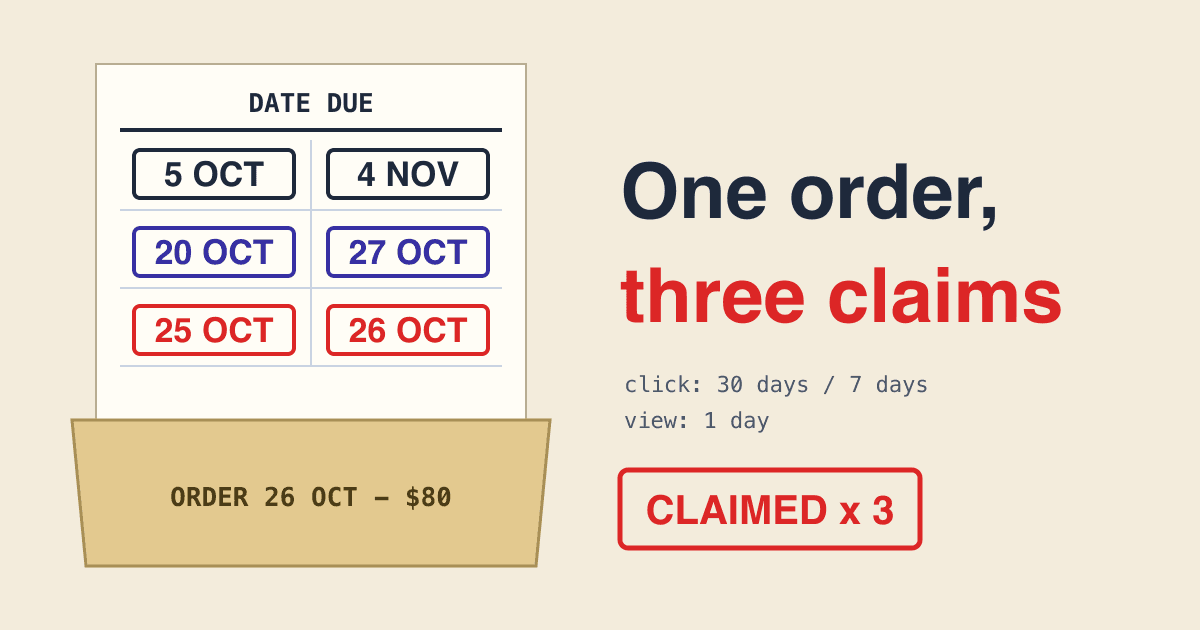
One $80 order, and who claims it
The order below is a constructed example, not a customer record. The dates are chosen so that each platform's published default applies; the rules are the platforms' own and are linked in the table further down. It assumes each platform's tag is on the shop and can recognise the shopper.
-
5 Oct
She clicks a search ad
Google Ads starts a click clock. Its default click-through window is 30 days, so it may claim a purchase up to 4 November.
-
20 Oct
She clicks the link in an Instagram ad
Meta starts a click clock. Its default is 7 days after a link click, so it may claim a purchase up to 27 October.
-
25 Oct
A TikTok ad plays in her feed at 21:00; she does not tap it
TikTok starts a view clock. Its default view-through window is 1 day, so it may claim a purchase made within the next 24 hours.
-
26 Oct
At 10:00 she clicks a sponsor link in a newsletter and buys, $80
The shop records one order. An analytics report on a last-click model gives it to the newsletter, the last thing she clicked.
On a narrow screen, swipe the table sideways to see every column.
| Who | Touch | Age at purchase | Default window | Claims the order? |
|---|---|---|---|---|
| Google Ads | Click, 5 Oct | 21 days | 30 days, click | Yes |
| Meta | Link click, 20 Oct | 6 days | 7 days, click | Yes |
| TikTok | View, 25 Oct | 13 hours | 1 day, view | Yes |
| Newsletter sponsor | Click, 26 Oct | Minutes | Last click in analytics | Yes |
| Shop | - | - | - | 1 order, $80 |
Three ad dashboards each show one conversion worth $80, which is $240 of reported revenue on $80 of sales, and the newsletter's publisher can fairly say the buying click was theirs. Nobody cheated. Each party answered a different question: did a purchase follow my ad within my window?
Now move one thing
-
AShe buys two days later, on 28 October
The Meta click is now 8 days old and the TikTok view is 3 days old. Both clocks have run out. The Google click is 23 days old.
Claims: Google Ads only
-
BSame order, tighter settings
Meta is set to 1-day click and TikTok view-through is switched off, both options the platforms offer.
Claims: Google Ads only
-
CA fourth platform showed her an ad on 1 August
She never clicked it. At LinkedIn's default of a 90-day view window, an impression 86 days before the order is still inside the window.
Claims: four platforms
The shopper, the ads and the $80 are identical in all three versions. Only the clocks moved.
The dates do not line up either
Google Ads counts a conversion on the day of the click that led to it unless you pick the "by conversion time" columns, so this order appears under 5 October there. Microsoft Advertising states the same click-time basis, and reports a view-through conversion at the time of the impression. The shop has the order on the 26th. A day-by-day comparison of platform conversions against orders will never match, even where the monthly totals happen to.
Default attribution windows on ten ad platforms
Each row was read from the platform's own help or documentation page on 2026-11-11. Bars share one scale of 90 days, with marks at 30, 60 and 90. A default applies only until someone changes it, so check the setting in your own account before quoting any of these.
-
Meta
Click7 days
View1 day
-
Google Ads
Click30 days
View1 day
-
Microsoft Advertising
Clicknot stated; up to 90
View1 day
-
TikTok
Click7 days
View1 day
-
LinkedIn
Click90 days
View90 days
-
Pinterest
Click30 days
View1 day
-
Snapchat
Click28 days
View1 day
-
X
Click30 days
View1 day
-
Reddit
Click28 days
View1 day
-
Amazon Ads
Click14 days, last touch
View14 days, last touch
On a narrow screen, swipe the table sideways to see every column.
| Platform | Default | What you can change | Read from |
|---|---|---|---|
| Meta | 7-day click, 1-day view, 1-day engagement. A click here means a link click; other clicks fall under engagement, with a note that some accounts still use the earlier definitions during rollout. | Click: 1 or 7 days. View: 1 day. | Results, attribution settings |
| Google Ads | 30-day click, 1-day view-through, 3-day engaged view. | Click: 1 to 90 days, depending on the conversion source. View-through: 1 to 30 days. | Conversion windows |
| Microsoft Advertising | View-through: 1 day for UET-based goals. The default click window is not stated on the pages read. | Click: up to 90 days. | Conversion goals, view-through conversions |
| TikTok | 7-day click, 1-day view for Pixel and Events API advertisers, per a 2022 TikTok post. | Per ad group. Click: 1, 7, 14 or 28 days. View: off, 1 or 7 days. Locked once the ad group is published. | Ad group settings, 2022 post |
| 90-day click, 90-day view, recommended for most conversions. | 1, 7, 30 or 90 days; 180 or 365 days for some conversions sent by API or file. | Conversion windows | |
| Conversion insights shows 30-day click and 1-day view when no window was selected. | Options are not listed on the pages read. The reporting page recommends 30 days for both clicks and views. | Conversion insights, reporting | |
| Snapchat | 28-day click, 1-day view: the window Snapchat recommends, and its default. | Options are not listed on the page read. | Attribution window |
| X | 30 days after an engagement, 1 day after a view. | 1, 2, 3, 5, 7, 14 or 30 days; the view window can also be off. A change rewrites past conversion data. | Website conversions |
| 28-day click, 1-day view, when both clicks and views are counted. | 1, 7 or 28 days. The view window cannot be longer than the click window. | Web attribution | |
| Amazon Ads | 14-day last-touch in standard campaign reporting, per a 2022 Amazon page. | From 1 January 2026 some view-based formats use a shorter window whose length the notice does not give. | 2022 page, 2026 notice |
Two rows deserve a second look. If you remember LinkedIn as 30-day click and 7-day view, open the page: it now gives 90 and 90 as the default. And Meta announced in October 2025 that from 12 January 2026 its Ads Insights API would stop returning the 7-day view and 28-day view windows, while keeping 28-day click, so an old spreadsheet built on those columns cannot be rebuilt today.
Your analytics tool has a window too. In Google Analytics 4 the default lookback is 30 days for first-visit and first-open events and 90 days for every other key event. Its last-click model credits the last channel the customer clicked through, or viewed with engagement on YouTube, so a social ad that was seen but never clicked gives that report nothing to credit, while the ad platform still counts its view.
Four things besides the window that move the count
What counts as a click
Meta counts link clicks; any other click on the ad, or five seconds of video play, is an engagement with its own 1-day window. X starts its 30 days from an engagement, which is wider than a click on a link. The same word on two dashboards can describe two different actions.
What counts as a view
The platform pages read here define a view-through conversion from an impression of the ad. The industry standard asks for more: the Media Rating Council's Outcomes and Data Quality Standards (final, September 2022) says a base of viewable impressions is generally required for attributing outcomes to ad exposure, and that the window must be disclosed before the campaign runs. More on that base in what counts as a viewable impression.
Whose other ads are excluded
Google Ads leaves a person out of view-through conversions if they interacted with any of your other Google ads, and Microsoft does the same inside its own network. That is tidy inside one platform. No help page read for this post describes checking another company's clicks.
Whether the ad caused anything
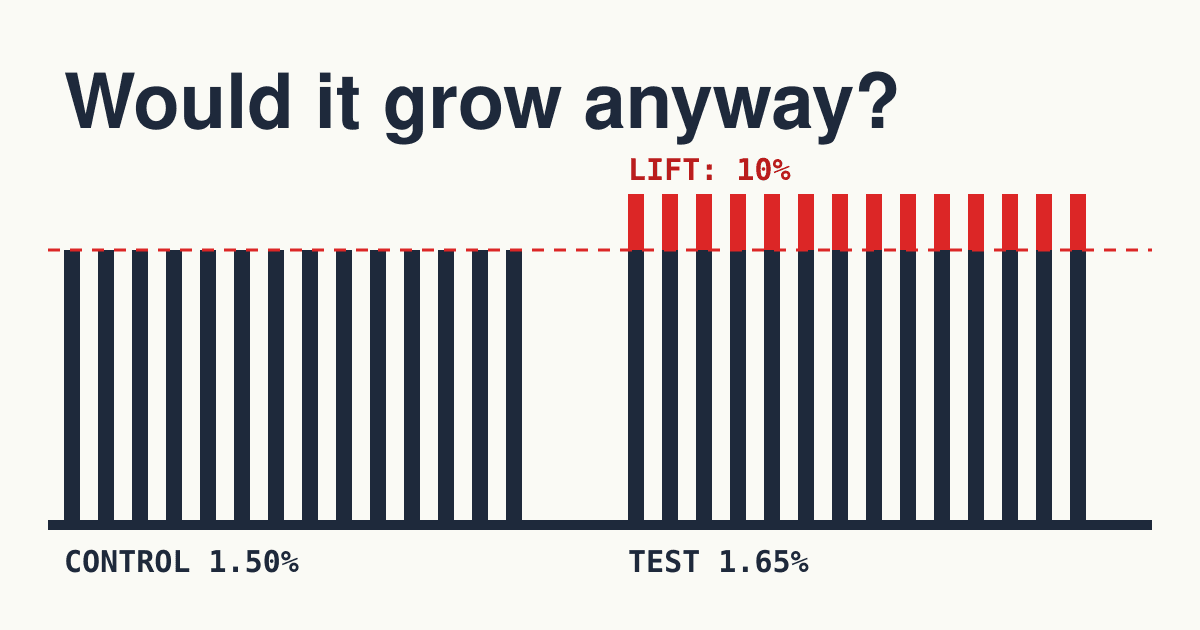
A window answers "did a purchase follow the ad", not "would the purchase have happened anyway". In 15 US Facebook experiments covering 500 million user-experiment observations, Gordon, Zettelmeyer, Bhargava and Chapsky (working paper, April 2018) compared observational estimates with randomised ones and found that in half of the studies the estimated lift in purchases was off by a factor of three, mostly too high. That study tested statistical methods, not window lengths, but the lesson carries: counting buyers who saw an ad is not measuring what the ad did. The causal test is a holdout, covered in incrementality testing.
A sheet to reconcile claims against orders
The figures in this sheet are made up to show the arithmetic. Fill it with one month of your own numbers: orders from the shop or the order system, and conversions from each ad platform with clicks and views in separate columns.
On a narrow screen, swipe the table sideways to see every column.
| Source | Window in use | After a click | After a view | Total claimed |
|---|---|---|---|---|
| Google Ads | 30-day click | 150 | 0 | 150 |
| Meta | 7-day click, 1-day view | 140 | 70 | 210 |
| TikTok | 7-day click, 1-day view | 45 | 75 | 120 |
| All platforms | - | 335 | 145 | 480 |
| Orders in the shop | - | - | - | 400 |
Claim ratio480 / 400 = 1.2
- Start from orders, not dashboards. The order system is the only count that cannot exceed reality. Everything else is a claim on it.
- Write the window beside every number. A conversion count without its window is like a price without a currency. Screenshot the setting on the day you export.
- Split clicks from views. In the sheet, 145 of 480 claims follow a view alone. Report them, but never in the same column as clicks.
- Compare like with like. Before ranking platforms, read each at the narrowest window they share. Six of the ten above list a 1-day or a 7-day click option, and Microsoft accepts any length up to 90 days.
- Track the ratio, not the gap. A ratio of 1.2 means at least 20 claims per 100 orders are overlaps or orders that an ad only brushed past. If it jumps one month, a setting changed or a new channel started overlapping.
- Tag what the platforms cannot see. Newsletter, podcast and creator placements have no dashboard of their own in this sheet; they show up through tagged links, set out in UTM tags for newsletter, podcast and creator buys.
Attribution terms to write into a deal
Whenever money depends on a conversion count, as in a cost-per-acquisition buy, an affiliate programme or a creator's bonus, the window is a price term. The MRC standard asks for it to be disclosed up front. A form to copy, with example values; it is general information, not a legal template.
- Conversion event
- A completed order on the advertiser's shop, net of cancellations within 14 days
- Click window
- 7 days from a click on the partner's tracked link
- View window
- None. Views are reported for information and not paid
- What counts as a click
- A click that lands on the advertiser's site with the partner's tag
- Two partners, one order
- The last tagged click inside its window is paid; no order is paid twice
- Count of record
- The advertiser's order system, with a monthly export sent to the partner
- Date basis
- Orders are reported on the day of purchase
- Discount codes
- A code counts only when no tagged click exists for the order
If you sell the placement, the same lines protect you: a 1-day window on a newsletter read over a weekend, or a rule that pays only the last click, quietly moves your sales to whoever advertises at the checkout. How a per-sale price converts into the others is worked through in CPM vs CPC vs CPA.
Questions buyers ask
What does "7-day click, 1-day view" mean?
The platform counts a conversion if the purchase happens within 7 days of a click on the ad, or within 1 day of the ad being shown without a click. It is Meta's stated default and the default TikTok announced for Pixel and Events API advertisers.
Do ad platforms double count conversions?
A platform does not see what another platform claimed. Google Ads and Microsoft say they exclude a person from view-through conversions when that person interacted with another of your ads on their own network; across platforms nothing is removed, so the same order can sit in several dashboards. The double counting happens when you add the dashboards together.
Which attribution window should I use?
One that roughly matches how long your buyers take to decide, and the same one for every platform you intend to compare. A longer window is not more accurate; it only lets the platform claim more of the orders that would reach you anyway.
Why do Meta and Google Ads not match Google Analytics?
They use different windows, different date bases and different credit rules. An ad platform can count a view; the last-click report in Google Analytics 4 credits the last channel clicked. Neither is wrong, and neither is your order count.
Does changing the window change past numbers?
It depends on the platform. X says a change updates conversion data retroactively. LinkedIn says a change does not affect the number of historic conversions. TikTok locks the setting once an ad group is published. Note the date of any change next to your reports.
Sources, all read on 2026-11-11
- Meta Business Help Center: Results (default setting) and About attribution models and attribution settings (click, view and engagement definitions); Meta for Developers, Ads Insights API metric availability updates, 16 October 2025
- Google Ads Help: conversion windows and Understand your conversion tracking data (click-time reporting, view-through exclusions)
- Google Analytics Help: lookback windows and attribution models
- Microsoft Advertising Help: conversion goals, view-through conversions, conversion reporting time
- TikTok Ads Help: Attribution settings at the ad group level; TikTok for Business, flexible attribution windows, 23 June 2022
- LinkedIn Marketing Solutions Help, conversion windows; Pinterest Business Help, Conversion insights and reporting overview; Snapchat Business Help, attribution window; X Business Help, website conversions campaigns; Reddit Ads Help, Web Attribution Overview
- Amazon Ads: Amazon Marketing Cloud custom attribution, 25 March 2022, and View attribution updates for Amazon Store ads, 1 January 2026
- Media Rating Council, final version of September 2022, sections 2.2.1.1 and 2.3.4.5: Outcomes and Data Quality Standards
- Working paper dated 12 April 2018: Brett R. Gordon, Florian Zettelmeyer, Neha Bhargava and Dan Chapsky, A Comparison of Approaches to Advertising Measurement: Evidence from Big Field Experiments at Facebook
Where a page gave no default, the table says so instead of filling the gap. Platform pages carry no version history, so a default quoted here can change without notice; the setting in your own account is the one that counts.