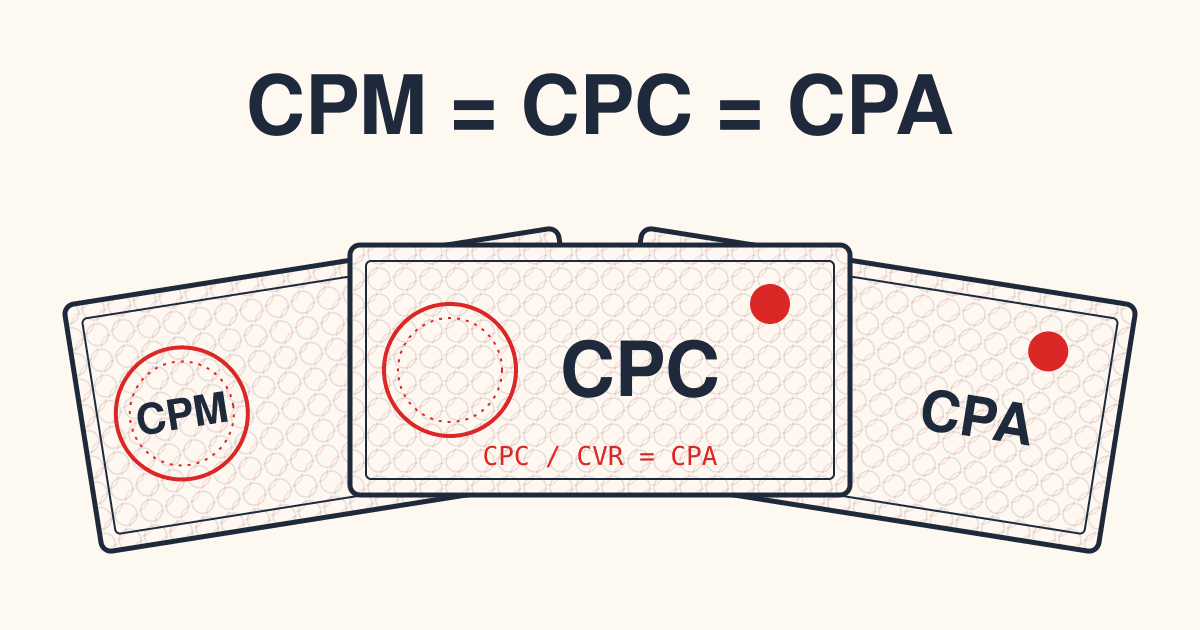
No ad price is cheap or expensive on its own, because a CPM, a CPC and a CPA each buy a different thing: a thousand impressions, one click, or one finished action.
The short answer: convert every quote into one unit before you compare. Your own click-through rate (CTR) and conversion rate (CVR) are the exchange rates. Then buy CPM when you can judge the placement and want reach, CPC when you want visits, and CPA when your tracking can prove who caused the sale and the seller will accept the risk.
Three notes on the counter
Each pricing model is a note with different terms printed on it. What changes between them is less the price than who pays when the ad underperforms.
CPM
Cost per thousand impressions
You pay for: one thousand views of the ad, whether or not anyone reacts.
Who carries the risk: you. A dull creative or a weak placement costs the same as a good one.
CPC
Cost per click
You pay for: each click on the ad, so views without a click are free.
Who carries the risk: shared. The seller carries the click rate; you carry what the visitor does next.
CPA
Cost per action
You pay for: one agreed action, such as a sale, a lead or an install.
Who carries the risk: the seller, which is why a fixed CPA quote usually looks high next to the others.
Do not confuse a fixed CPA quote with Target CPA bidding in Google Ads. That is a bid strategy: it sets bids to reach your desired average, and Google says some conversions will cost more than the target and some less. The risk stays with you.
The cross-rate table
Currency desks publish a grid that shows every currency against every other. Ad prices fit the same grid. Find the note you hold in the left column, then read across to the note you want. CTR and CVR go in as decimals, so 0.6% is 0.006.
| You hold | To CPM | To CPC | To CPA |
|---|---|---|---|
| CPM | same | CPM ÷ (1000 × CTR) | CPM ÷ (1000 × CTR × CVR) |
| CPC | CPC × CTR × 1000 | same | CPC ÷ CVR |
| CPA | CPA × CTR × CVR × 1000 | CPA × CVR | same |
The bottom-left cell is the one to memorise, because it gives your ceiling. Take the most you can pay per action and multiply: at a $60 target, a 0.6% CTR and a 2.5% CVR, the highest CPM that still works is 60 × 0.006 × 0.025 × 1000 = $9. Any CPM quote above that misses your target at those rates.
Other notes change through the same grid. A cost per lead (CPL) or cost per install is a CPA with a named action. A flat sponsorship fee becomes a CPM with fee ÷ impressions × 1000. A cost per view (CPV) becomes CPV × view rate × 1000, so $0.03 at a 30% view rate is a $9 CPM.
Three quotes cashed at one rate
Say one audience comes with three offers: $9 CPM, $1.40 CPC and $65 CPA. A small test gave you a 0.6% CTR and a 2.5% CVR. Run each one per 1,000 impressions, which means 6 clicks and 0.15 conversions.
- Quote A
- $9.00 CPM
- Per 1,000
- $9.00
- Per click
- $1.50
- Per action
- $60.00
- $10,000 buys
- 167 actions
- Quote B
- $1.40 CPC
- Per 1,000
- $8.40
- Per click
- $1.40
- Per action
- $56.00
- $10,000 buys
- 179 actions
- Quote C
- $65.00 CPA
- Per 1,000
- $9.75
- Per click
- $1.63
- Per action
- $65.00
- $10,000 buys
- 154 actions
All three examples use invented prices, and yours will differ. At these rates B wins, but only by a small margin, and the margin rests on two rates that come from one small test.
You can check the math against published data. WordStream and LocaliQ's 2025 Google Ads benchmarks, as summarised here, list a $5.26 average CPC, a 7.52% CVR and a $70.11 cost per lead. The grid gives 5.26 ÷ 0.0752 = $69.95, within 16 cents of the published figure. The same report's 6.66% CTR implies a CPM of about $350 for those search ads, which is why a high CPM says little alone: search reaches people at the moment they are looking.
When the rate moves
An exchange rate does not hold still, and neither does a CTR. Halve each rate in turn and watch the cost per conversion. A fixed price stays fixed only in the unit you bought it in.
Quote A, $9 CPM
Quote B, $1.40 CPC
Quote C, $65 CPA
Read the extra $9 on quote C as an insurance premium. It pays off once your CVR falls below 1.40 ÷ 65 = 2.15%, a small drop from 2.5%. Quote A, meanwhile, beats quote B only if your CTR climbs above 9 ÷ 1.40 ÷ 1000 = 0.64%. Those break-even points are what you take into a negotiation: they tell you which rate you are really betting on.
Two limits apply. Cost per conversion is not volume: under quote C a lower CVR keeps your unit price, but the seller may stop running the ad when it no longer earns them enough. And a test on a small sample is a rough rate, so widen your margin until you have more conversions behind it.
Counterfeit checks for each note
Each model pays for one signal, so each attracts its own fakes. Check the note you are holding.
CPM: impressions nobody saw
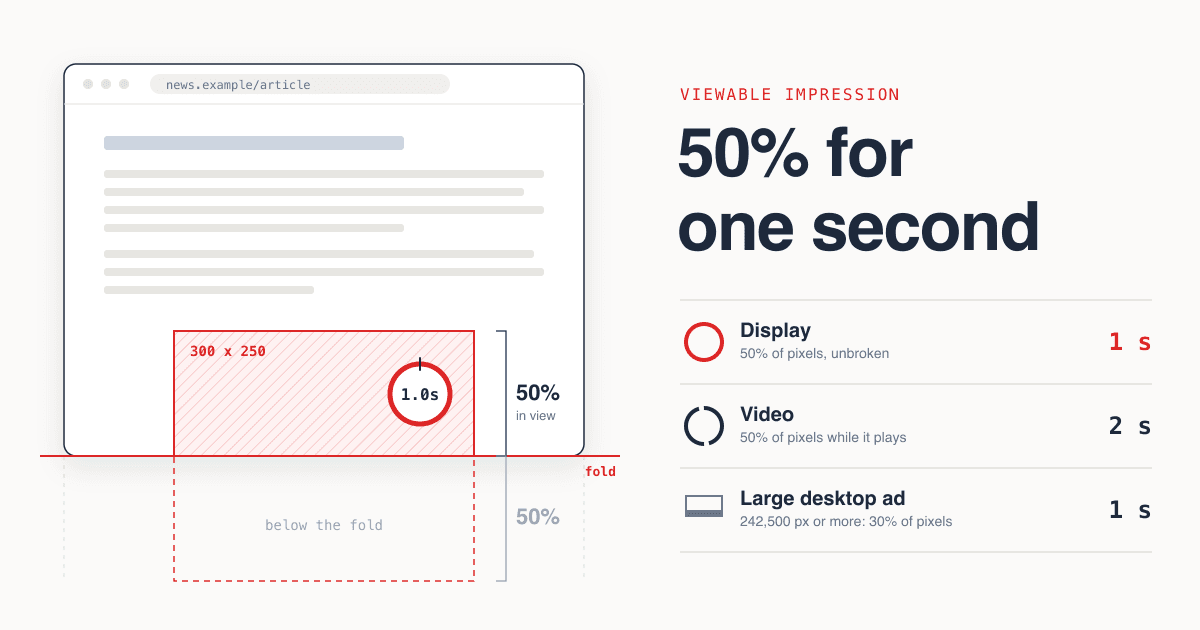
A served impression can sit below the fold or load for a bot. The ANA's Q2 2025 programmatic benchmark still put lost media value at $26.8 billion a year. Test: buy or report on a viewable basis, then convert your CPM into the viewable price.
CPC: clicks that mean nothing
Google's invalid traffic list includes bots and accidental clicks on ads placed too close to navigation buttons. Real people skew the count too: a 2009 comScore and Starcom study found 8% of US internet users made 85% of display ad clicks. That data is old, so treat it as a warning, not a current figure. Test: tag each buy with UTM parameters and judge clicks by what happens after them.
CPA: credit for a sale it did not cause
The tracker records who touched a sale last, not who caused it. In the best-known case, an eBay affiliate seeded visitors with tracking cookies to collect commission on sales that affiliate had not generated, and was sentenced to five months in federal prison over an alleged $28 million. Test: write the attribution window into the deal, exclude your own brand terms, and compare sales in periods with and without the partner.
The other side of the counter
Publishers and creators run the same grid in the other direction, with effective CPM (eCPM) as their home currency. Google defines it as total earnings ÷ impressions × 1000.
- A publisher with a $6 floor gets offered $40 per sale. With a 0.5% CTR and a 2% CVR on that placement, the offer is worth 40 × 0.005 × 0.02 × 1000 = $4 eCPM. Holding the floor means asking for $60 per sale, or passing.
- A creator with 40,000 views a video compares a $1,000 flat fee with $0.50 per click. The fee is a $25 CPM. The click deal at a 1.5% click rate pays $300, or $7.50 per thousand views.
Two prices for the same impression can also differ because someone sits between them. YouTube says CPM is measured before its revenue share and RPM after it, and RPM also counts views with no ad, so a creator's RPM runs lower than the advertiser's CPM. Programmatic buying has the same gap on a longer chain, which is what the ISBA and PwC supply chain study set out to trace. When you quote a buyer, state which side of the fees your number sits on.
Which note to carry
| Your situation | Carry | Why |
|---|---|---|
| You want an audience to know the name, and clicks are not the point | CPM | You pay for exposure, and a frequency plan sets how much |
| You trust your landing page and want visits you can test | CPC | The seller carries a weak CTR; you keep control of the page |
| You have accurate conversion tracking, and a margin that sets your top price | CPA | Your cost per sale is fixed, for the volume a seller agrees to |
| You have no data on this audience yet | Small CPM or CPC test | You need real rates before any conversion means anything |
| You are buying a creator or newsletter slot | Flat fee, converted to CPM | Compare it with past delivery, not with the seller's best issue |
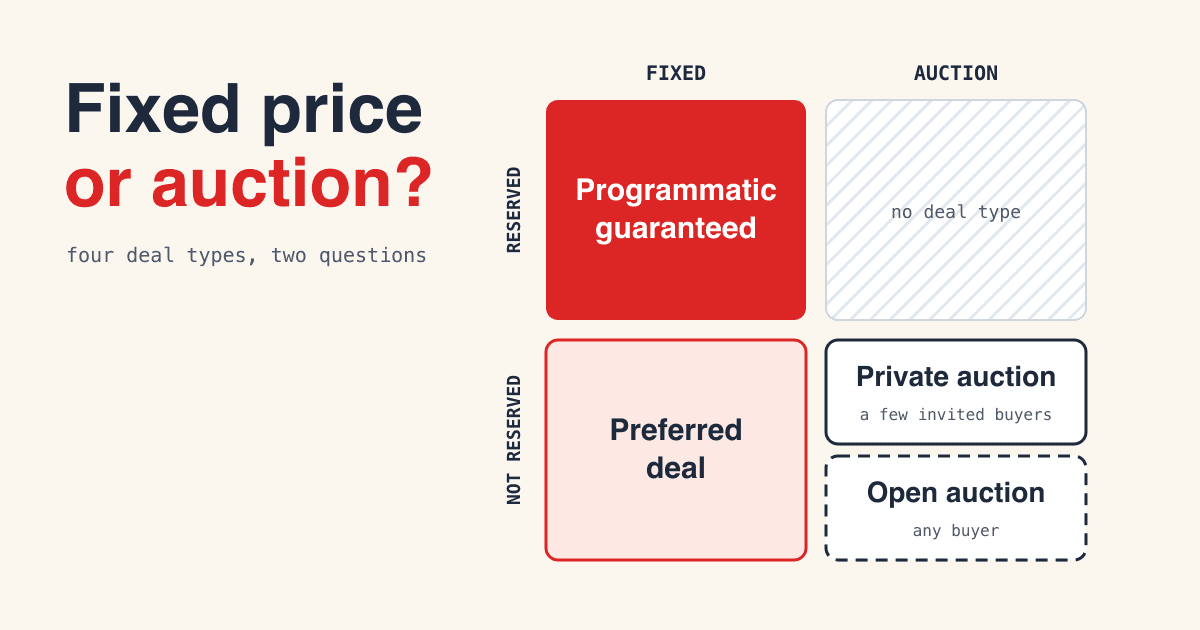
Buying a programmatic deal is usually priced in CPM, so the ceiling from the cross-rate table is the number to bring.
Frequently asked questions
How do I convert CPM to CPC?
Divide the CPM by 1000 times the CTR. A $9 CPM at a 0.6% CTR is 9 ÷ (1000 × 0.006) = $1.50 per click.
What is a good CPM?
One below your ceiling: target CPA × CTR × CVR × 1000. There is no universal good number, since the same CPM can be a bargain on one audience and a loss on another.
Is CPA always the safest choice for a small budget?
Only if a seller accepts it and your tracking works. A true fixed CPA offer is often priced above what the same audience costs on CPM or CPC, and a small buyer may not get one at all.
What is the difference between CPM and eCPM?
CPM is a price agreed before the ad runs. eCPM is calculated afterwards from what was actually spent or earned, so it can express a CPC or CPA deal in CPM terms.
Does Target CPA in Google Ads mean I pay only for conversions?
No. Google describes it as a strategy that finds a cost-per-click bid each time your ad can appear. It aims at an average; it is not a fixed price per action.
Sources
- Google Ads Help: Cost-per-thousand impressions (CPM)
- Google Ads Help: Cost-per-click (CPC)
- Google Ads Help: About Target CPA bidding
- Google Ads Help: Target CPA bidding, definition
- Google Ads Help: About cost-per-view (CPV) bidding
- Google Ads Help: About invalid traffic
- Google AdMob Help: Understand eCPM fluctuation
- YouTube Help: Understand ad revenue analytics
- WordStream: Google Ads Benchmarks 2025
- 360OM: summary of the 2025 benchmark figures
- ANA: Q2 2025 Programmatic Transparency Benchmark, press release, August 14, 2025
- ISBA: second Programmatic Supply Chain Transparency Study, headline findings
- comScore: updated Natural Born Clickers study, October 1, 2009
- Business Insider: Shawn Hogan sentenced in eBay affiliate marketing case, 2014