Media Buying
Programmatic Guaranteed, Preferred Deal, Private Auction or Open Auction: Which Deal to Ask For
The four ways to buy ad space programmatically, in the order a seller offers each impression: what each deal reserves, how it is priced, who may bid, and what to send a seller when you ask for one.
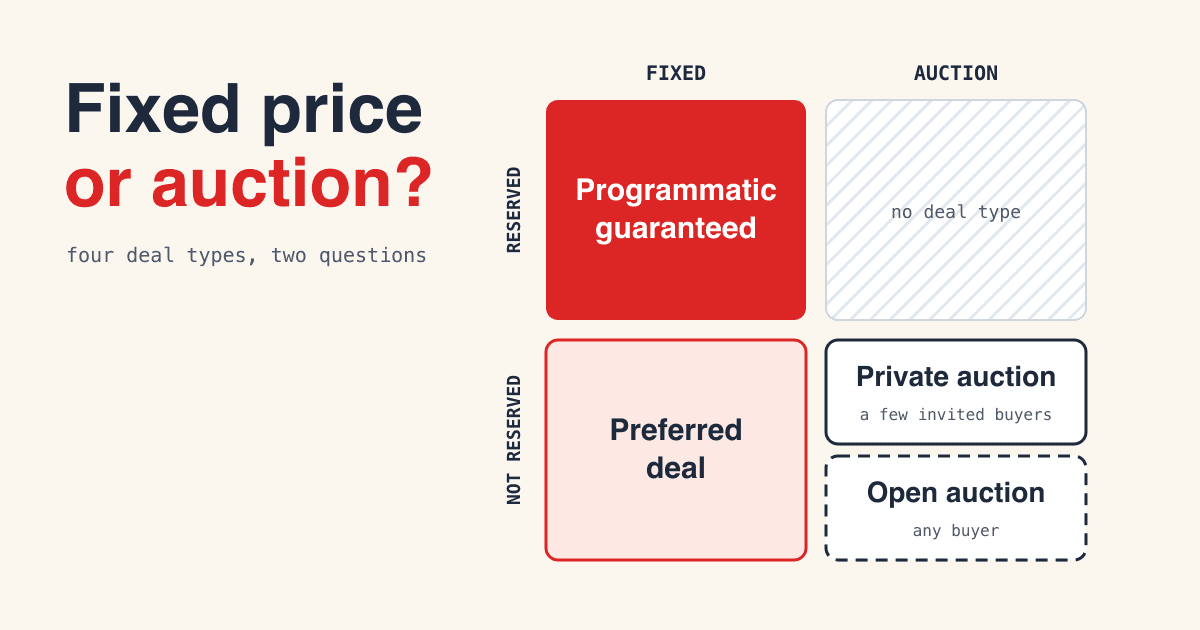
Ask for programmatic guaranteed when you need a set number of impressions at a set price, a preferred deal when you want first look at a fixed price without committing to volume, and a private auction when you want to bid against a short list of invited buyers instead of the whole market.
Everything else is the open auction. Every deal is identified by a deal ID: for a preferred deal or a private auction you usually add that ID to your buying platform and target it in a line item, while a guaranteed deal is usually accepted as a proposal.
Who gets an impression first?
When a page loads, the seller's ad server offers the slot to its buyers in a fixed order of priority. A deal type is, above all, a place in that line. The order below is the one the IAB's 2013 paper on programmatic transactions calls typical (IAB, 2013). Google Ad Manager describes the same top of the line, guaranteed and then preferred deals, and lets a private auction either go first or compete with the open auction (Preferred Deals overview; Private Auctions overview).
-
1Programmatic guaranteedreserved, fixed price, one buyer
Served at the same priority as a direct-sold campaign. The impressions are set aside for one buyer, and that buyer is expected to bid on them.
-
2Preferred dealnot reserved, fixed price, one buyer
The buyer gets the first chance to buy at the agreed price. If they pass, the impression moves down the line.
-
3Private auctionnot reserved, floor price, a few invited buyers
Invited buyers bid against each other above a floor. Most publishers put this above the open auction; some let the two compete, and some skip the open auction altogether.
-
4Open auctionnot reserved, floor price, any buyer
Any buyer connected to the exchange can bid. Usually the highest valid bid above the floor wins; Google Ad Manager ranks bids by the highest net bid.
The IAB puts it plainly: guaranteed deals "have the highest priority within programmatic transactions equal to direct sales", and "most publishers place their Invitation-Only Auction above the Open Auction in priority" (IAB, Programmatic and Automation - The Publishers' Perspective). Google's Ad Manager Help gives preferred deals "a fixed priority value that is typically higher than Private Auction and the Open Auction", with Sponsorship and Standard line items generally serving ahead of them (Preferred Deals overview). Those two are the line item types a programmatic guaranteed deal runs on (Ways of transacting in Ad Manager).
What are the four programmatic deal types?
The IAB's 2013 paper sorts every programmatic sale by three questions: is the inventory reserved, is the price fixed or set by auction, and how many buyers may take part (IAB, 2013). Each answer pattern is one deal type. The names differ by platform, which is why the second column matters when you talk to a seller.
| Deal | Other names | Reserved? | Price | Who can bid | Buyer must buy? |
|---|---|---|---|---|---|
| Programmatic guaranteed | Automated guaranteed, programmatic reserved, programmatic premium | Yes | Fixed | One buyer | Yes: a guaranteed deal means "the bidder must bid on the deal" |
| Preferred deal | Unreserved fixed rate, first right of refusal; in DV360, non-guaranteed fixed deal | No | Fixed | One buyer | No |
| Private auction | Invitation-only auction, private marketplace (PMP), closed auction; in DV360, non-guaranteed auction | No | Auction above a floor | A few invited buyers | No |
| Open auction | Real-time bidding (RTB), open exchange, open marketplace | No | Auction above a floor | Any buyer | No |
Reserved inventory is ad space "put aside for a specific advertiser for an agreed price", and a fixed price is a flat price the buyer pays "rather than the highest bidder in an auction environment" (IAB, 2013). A floor is the lowest price a seller will accept in an auction. A deal ID is "a unique string of characters that are used as an identifier for buyers and sellers", passed in the bid request (IAB, 2013); OpenRTB's guidance says to treat it as a "targeting token" (OpenRTB implementation guidance, 7.3).
Which deal should a buyer ask for?
Start from what the campaign cannot do without: a fixed number of impressions, a known price, or access to a seller's inventory before the open market sees it. Each deal trades one of these for flexibility.
Programmatic guaranteed: when the impressions must run
A contracted number of impressions at a fixed price, booked "even months ahead of time - even if your creative is not ready" (DV360 Help).
The right to skip impressions: Microsoft's exchange expects bidders to answer guaranteed deals "at near 100%" (Microsoft Learn). Pacing is the publisher's call (DV360 Help).
Preferred deal: when you want first look, not a commitment
"An initial, or 'preferred,' opportunity to bid at the negotiated price", and "buyers aren't required to buy the inventory" (Google Ad Manager Help).
Any promise of volume. The seller can still sell the same inventory in a guaranteed campaign "for a better price" (Google Ad Manager Help), and a guaranteed line item can serve ahead of you.
Private auction: when you want a smaller crowd
Inventory the seller opens only to invited buyers, without a back-and-forth proposal: in Google Ad Manager, private auctions "don't require a negotiation process", and the publisher sets the floor and invites you (Google Ad Manager Help).
A fixed price. It "is an auction and buyers will be expected to bid on inventory" (IAB, 2013), so you still compete with the other invited buyers.
Open auction: when reach and price matter more than placement
No setup with the seller, and in Google Ad Manager the winner "is never charged more than the bid it submits" (Google Ad Manager Help).
Priority and a relationship: "usually there is no direct relationship with the buyer" (IAB, 2013). You see only what the deals above you left.
What does a deal look like in a bid request?
In OpenRTB 2.6, the protocol exchanges use to ask buyers for bids, every deal on an impression sits in a pmp object, the "private marketplace container for direct deals" (OpenRTB 2.6). Despite the name, it carries guaranteed and preferred deals too, not only private auctions. Here is one impression offered under three deals; the IDs, seat and prices are made-up examples, not market rates.
"pmp": {
  "private_auction": 1,
  "deals": [
    { "id": "pg-sports-q4", "guar": 1, "at": 3,
      "bidfloor": 18.00, "bidfloorcur": "USD",
      "wseat": ["seat-1234"] },
    { "id": "pd-sports-firstlook", "at": 3,
      "bidfloor": 12.00, "wseat": ["seat-1234"] },
    { "id": "pa-sports-invite", "at": 1,
      "bidfloor": 6.50,
      "wseat": ["seat-1234", "seat-5678"],
      "wadomain": ["example.com"] }
  ]
}- "private_auction": 1
- Only the listed deals may bid on this impression; 0 means "all bids are accepted", open auction included.
- "guar": 1
- A guaranteed deal: "the bidder must bid on the deal".
- "at": 3
- A fixed price: "the value passed in
bidflooris the agreed upon deal price". Withat1 or 2,bidflooris only the minimum bid. - "wseat" and "wadomain"
- The buyer seats and advertiser domains allowed to bid. Leaving a list out means no restriction of that kind: "Omission implies no seat restrictions".
Two of those fields are why a deal can quietly fail. If your seat is not in wseat, your bids are not allowed. If you bid on a fixed-price deal below its bidfloor, the bid does not count: Google's help says the impression "may become available on the Private Auctions or Open Auction" when the buyer "fails to place a valid bid above the negotiated CPM fixed price" (Preferred Deals overview).
What to send a seller when you ask for a deal
A seller can only set up a deal your platform will see if it has these details. Copy the form, fill in the right column, and send it with your first message. Before you send it, check that the seller is listed as authorized in the site's ads.txt; our guide to ads.txt and sellers.json shows how.
Deal request
- Deal type
- Preferred deal (fixed price, no volume commitment)
- Flight dates
- 1 to 30 November
- Formats and sizes
- Display 300 x 250 and 728 x 90See our list of standard display ad sizes.
- Price
- Fixed CPM for guaranteed and preferred deals; floor CPM for a private auctionSay the currency: OpenRTB defaults to USD.
- Volume
- Guaranteed deals only: the number of impressions to reserveAd Manager calls it the contracted quantity.
- Buying platform and seat ID
- Your DSP and the seat the deal is open toOn OpenRTB exchanges this ends up in
wseat. - Advertiser domain
- example.comOn OpenRTB exchanges this ends up in
wadomain. - Targeting and measurement
- Sections, countries, devices; the viewability or verification you will report onAgree on one definition first, such as a viewable impression.
Index Exchange tells its sellers to "share the deal ID with your buyer so they can respond to your bid requests" (Index Exchange). For a preferred deal or a private auction, add the deal ID to your platform and then to the line item's targeting. A guaranteed deal works differently in Display & Video 360: you accept it in Negotiations, and its insertion order is set up for you (DV360 Help). In Display & Video 360, a line item with no inventory source targeting buys "open auction inventory on all enabled exchanges by default", and: "Deals are only targeted when you add the deal itself or deal group to targeting." (DV360 Help). The deal ID itself "cannot be changed once saved", so copy it exactly (DV360 Help).
Programmatic deal questions
Is a PMP the same as a private auction?
Usually, yes: the IAB lists "private marketplace" as another name for the invitation-only auction (IAB, 2013). But in OpenRTB the pmp object holds every kind of deal, so a seller who says "PMP" may mean any deal with an ID. Ask whether the price is fixed or a floor.
What happens when a guaranteed buyer does not bid?
The seller's commitment depends on the buyer answering. OpenRTB says the bidder "must bid on the deal" (OpenRTB 2.6), and Microsoft's exchange says buyers who accept "are compelled to bid" whenever the deal ID arrives (Microsoft Learn). Passing on guaranteed impressions is one common way a deal underdelivers.
Can two preferred deals target the same inventory?
Yes. In Google Ad Manager, when two preferred deals at the same CPM are eligible for the same request, it "chooses the winning buyer randomly" (Google Ad Manager Help).
Do private auctions use first-price or second-price bidding?
It depends on the exchange. OpenRTB lets each deal override the request's auction type (1 = first price, 2 = second price plus), and a request with no type set defaults to 2 (OpenRTB 2.6). Google Ad Manager picks the highest net bid and never charges the winner more than its bid (Google Ad Manager Help).
Why is my deal live but not spending?
Three causes covered in this article: the deal is not added to the line item's targeting, your seat is not on the deal, or your bids are under the fixed price or floor. Check those three first.
Sources
- IAB, Programmatic and Automation - The Publishers' Perspective (September 2013, PDF)
- IAB Tech Lab, OpenRTB 2.6 specification
- IAB Tech Lab, OpenRTB implementation guidance, section 7.3 PMP and Direct Deals
- Google Ad Manager Help, Ways of transacting in Ad Manager
- Google Ad Manager Help, Programmatic Guaranteed vs. Preferred Deals
- Google Ad Manager Help, Preferred Deals overview
- Google Ad Manager Help, Private Auctions overview
- Google Ad Manager Help, Auction model
- Display & Video 360 Help, Programmatic Guaranteed deals
- Display & Video 360 Help, Add an inventory source
- Display & Video 360 Help, Inventory source targeting
- Microsoft Learn, Programmatic Guaranteed Deals for Bidders
- Microsoft Learn, DV360 buying guide
- Index Exchange Knowledge Base, Create a programmatic guaranteed deal (open beta)
Continue Reading
More articles you might enjoy
Programmatic
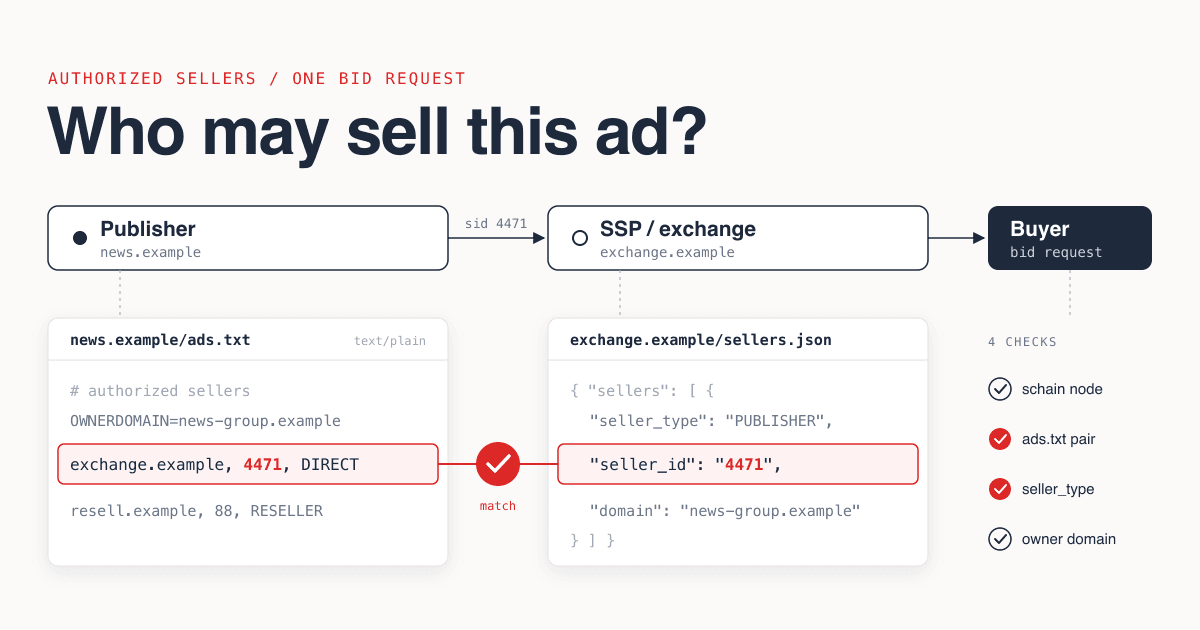
ads.txt and sellers.json: How Publishers Declare Who May Sell Their Ad Space, and How Buyers Check It
ads.txt lists the ad companies allowed to sell a website's ad space; sellers.json and the SupplyChain object show who is behind each seller account. The line format, DIRECT vs RESELLER, the crawler rules, and the four checks a buyer runs on one bid request.
Media Buying
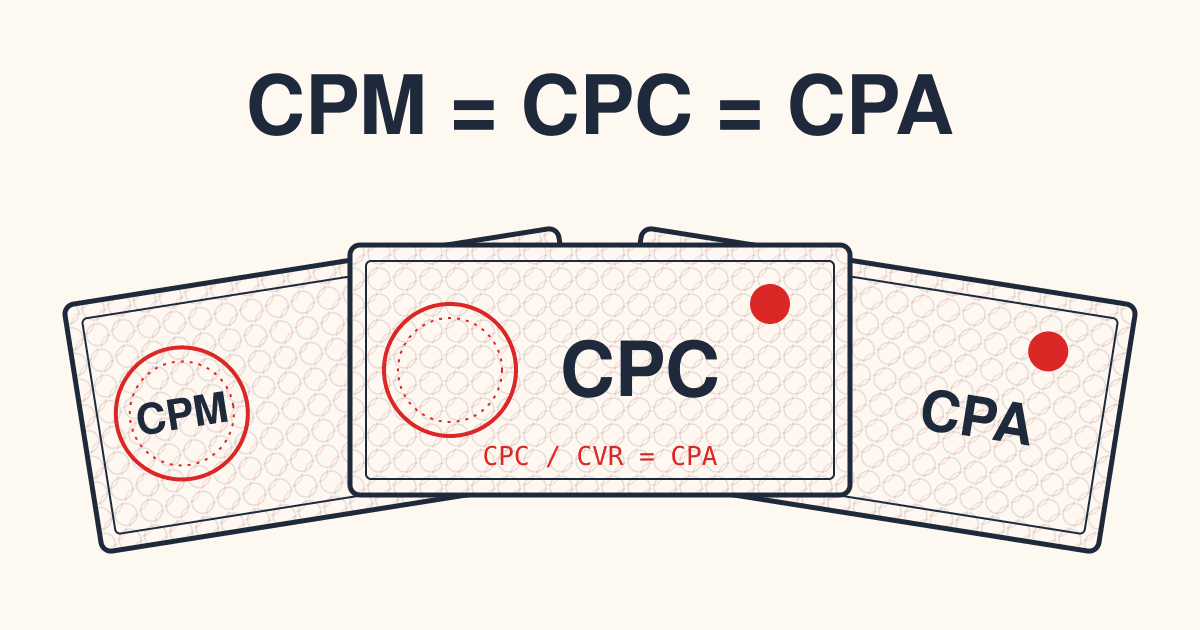
CPM vs CPC vs CPA: Convert Any Media Price Into the Others Before You Buy
CPM, CPC and CPA quotes cannot be compared until they share one unit. Here is the cross-rate table that converts each into the others, with worked examples and break-even points.
Media Buying
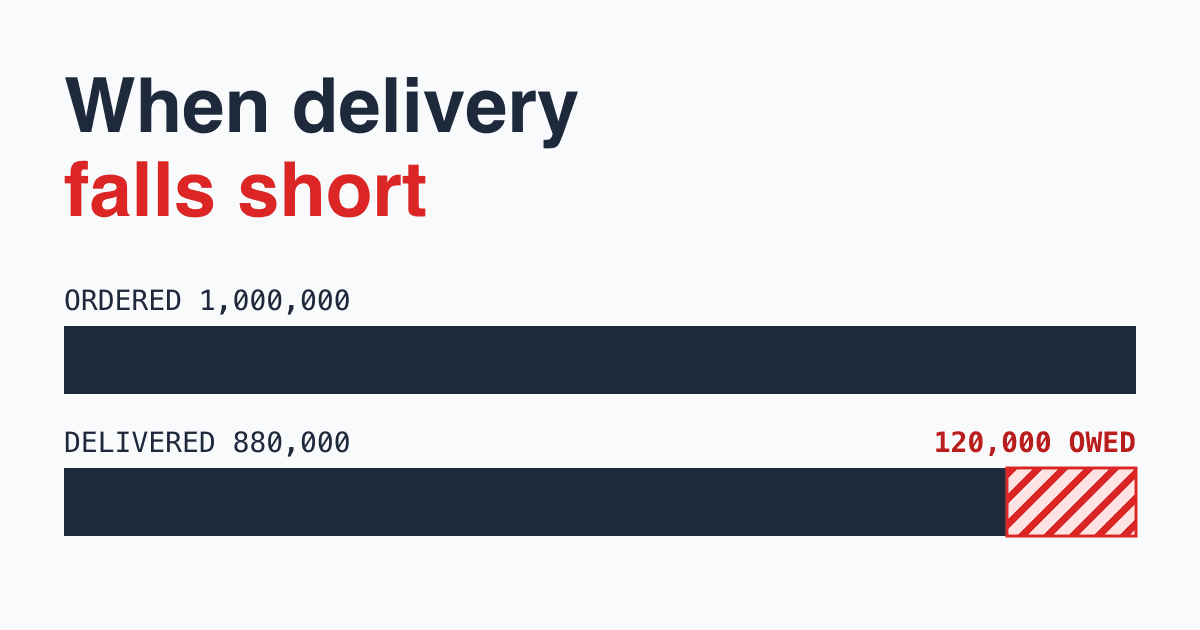
Insertion Order: What Goes on the Form, and Who Pays When Delivery Falls Short
What an insertion order says, when it starts to bind, and who pays when delivery, creative or payment goes wrong under the 4A's/IAB Version 3.0 terms, with worked numbers.