If a campaign delivers 12% short, the insertion order and the terms attached to it decide whether the buyer gets a rerun, a credit or a refund, or, on a CPC deal, nothing at all.
Short answer: an insertion order (IO) is the agreed order that fixes what a seller will run, at what price, between which dates and up to what budget. Before you sign, check the five core items, find out which standard terms are attached, and write anything that should differ on the IO itself, and say that it overrides those terms.
This post reads the public 4A's/IAB Standard Terms and Conditions, Version 3.0 ("the standard terms"). The worked cases and deadlines apply to Version 3.0 only. Newer IAB terms for direct buys came out in May 2026, and sheet 3 shows where they differ. This is a reader's guide, not legal advice. Your own IO may change any of it.
What is an insertion order?
The phrase has two meanings, and search results mix them. One is a contract between two companies. The other is a folder inside a buying platform. This post is about the contract.
| The contract | The platform object | |
|---|---|---|
| What it is | A "mutually agreed" order under which a media company delivers ads (Terms, Definitions) | In Display & Video 360, a container that "contains a set of line items" for one campaign (DV360 Help) |
| Between | Buyer and seller | Nobody: it is a setting in one buyer's account |
| Sets | Deliverables, price, spend limit, dates, ad server | Shared budget and dates, pacing, frequency caps, default targeting |
| If it goes wrong | Makegood, credit, refund or cancellation | You edit the setting |
What goes on an insertion order?
The standard terms list five items each IO specifies "as applicable" (Section I(a)), then name optional ones: reporting, special scheduling or placement, and data ownership. Other sections only work if the IO says something, so those boxes matter as much. The sample below uses boxes 1 to 5 for the core items and letters for the rest.
- 1 Deliverable
- 300 x 250 display, 1,000,000 guaranteed impressionsType and amount. "Guaranteed" switches on makegoods.
- 2 Price
- $10.00 CPMOne price per deliverable.
- 3 Maximum spend
- $10,000.00The ceiling for the whole order.
- 4 Flight
- Nov 1 to Nov 30 (30 days)Start and end dates.
- 5 Third-party ad server
- Example AdServe, [email protected]Name and contact, if one tracks the ads.
- A Reporting
- Weekly, by day and creativeWeekly is also the default if the seller serves. Section IV(b)
- B Placement limits
- Run of site, no gambling pagesCategories added to the adjacency list. Section II(d)
- C Billing basis
- Actual delivery, calendar monthOr flat fee, or prorated. Section III(a)
- D Cancellation
- CancelableSilence means cancelable. Section V(a)
- E Short rate
- NoneApplies only as far as the IO says. Section V(c)
- F Custom work
- NoneNeeds its own line item. Section V(a)
- G Invoice reference
- IO 2026-1101The invoice must quote what the IO asks for. Section III(a)
- H Terms
- 4A's/IAB Version 3.0Named here, or they do not apply.
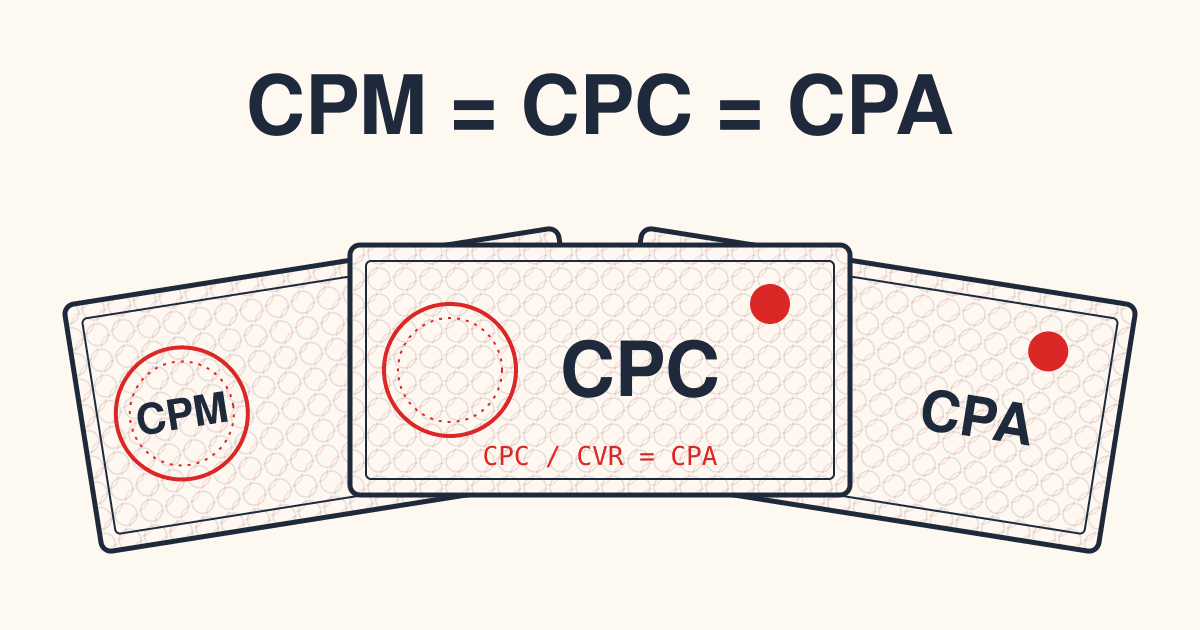
A price like box 2 can come in any unit. If two quotes use different ones, convert them first. The numbers in boxes 1 to 4 return in the worked cases below.
When does an insertion order start to bind?
Under the standard terms, acceptance happens at the earlier of two moments: written approval by both sides, or the first ad impression (Section I(b)). "Written" includes email. So a campaign that goes live on an unsigned IO can count as accepted, unless the IO says otherwise. Later changes need written approval from both sides (Section I(b)-(c)).
When documents disagree, the IO beats the terms (Section XIV(d)). Parties who want changes are urged to use an addendum (Education Guide), and an addendum sets its own rank. The agency PMG's public one reads "first, the IO; second, this Addendum; and third, the IAB Terms and Conditions" (PMG addendum):
- The IOWhat both sides wrote for this deal
- The addendumOne party's standing changes, if accepted
- The standard termsThe default for everything left unsaid
Three limits of the standard terms
- They are voluntary. No agency or publisher is required to use them (Education Guide). An IO that does not name them does not get them by default.
- They are written for agency buys. The opening says they are "not meant to cover" direct advertiser buys with publishers, or a publisher's deal with a network (Terms, opening). A direct buyer needs other terms: the IAB's Direct Buy Addendum (below), or a company's own set, like the "Direct Advertiser Buys" terms Expedia Group publishes (Expedia Group).
- They are old. Version 3.0 was finalized on February 22, 2010 (IAB), and a 2018 addendum added terms for TV long-form video (4A's/IAB addendum). In March 2023 the ANA, 4A's and IAB announced a task force to overhaul the terms (IAB). On May 20, 2026 the IAB said final versions of a new set are "available for industry use": Direct Buy Addendum v1.0, General Terms v1.1 and Order-Specific Terms for IOs v1.0 (IAB).
How do the May 2026 terms differ from Version 3.0?
The new set does not attach itself to a deal. The IAB says it is for "voluntary use" (IAB), and the General Terms apply to an order that incorporates them (General Terms opening). So check which set your IO names. These are the differences that change the cases below. We read the final addendum and General Terms, but we could not get the final Order-Specific Terms, so read those yourself.
| Version 3.0 | May 2026 set | |
|---|---|---|
| Written for | Agency buys | Direct buys by an advertiser, an agency or another representative (Addendum section 2) |
| IO against terms | The IO wins | The order ranks first (General Terms section 3), but its own terms beat the addendum only where it expressly says so (Addendum opening) |
| Shortfall warning | At least 14 days before the end, on campaigns of 14 days or more | "As soon as it becomes known" (Addendum 15(a)) |
| No makegood agreed | The agency may take a credit, or a refund if prepaid | Credit, refund and other remedies are listed, but both sides must agree (Addendum 21(a)) |
| Billing count | Set by which server is certified | Named on the order; if not, the server that renders the ad (Addendum 18(b)) |
| Counts differ by over 10% | The agency picks the outcome | Both sides must agree, then dispute resolution (Addendum 18(d)) |
| Cancellation notice | 7, 14 or 30 days | By default 5 business days, 10 business days or 30 days; other choices are on the form (Addendum 17(a)) |
| Time to cure a breach | 10 days | 30 days (General Terms 6(b)) |
| Client does not pay | The agency owes only what has cleared from the client | Left to the specific terms (General Terms 5(k)). We found no clause on it in the addendum, so write it on the IO |
Some rules carry over: acceptance at written approval or the first impression (Addendum 3(b)), no makegoods on CPC, CPL or CPA (Addendum 15(b)), the 10% limit on extra delivery with a third-party ad server (Addendum 16(a)) and the daily charge for late creative (Addendum section 12).
What does the buyer get when delivery falls short?
Under Version 3.0, a makegood first. If none can be agreed, a credit or refund for anything already charged or prepaid. That holds only for guaranteed deliverables. An IO on the May 2026 terms may end differently (sheet 3). Cases 1, 2 and 4 use the sample order: 1,000,000 impressions at a $10.00 CPM.
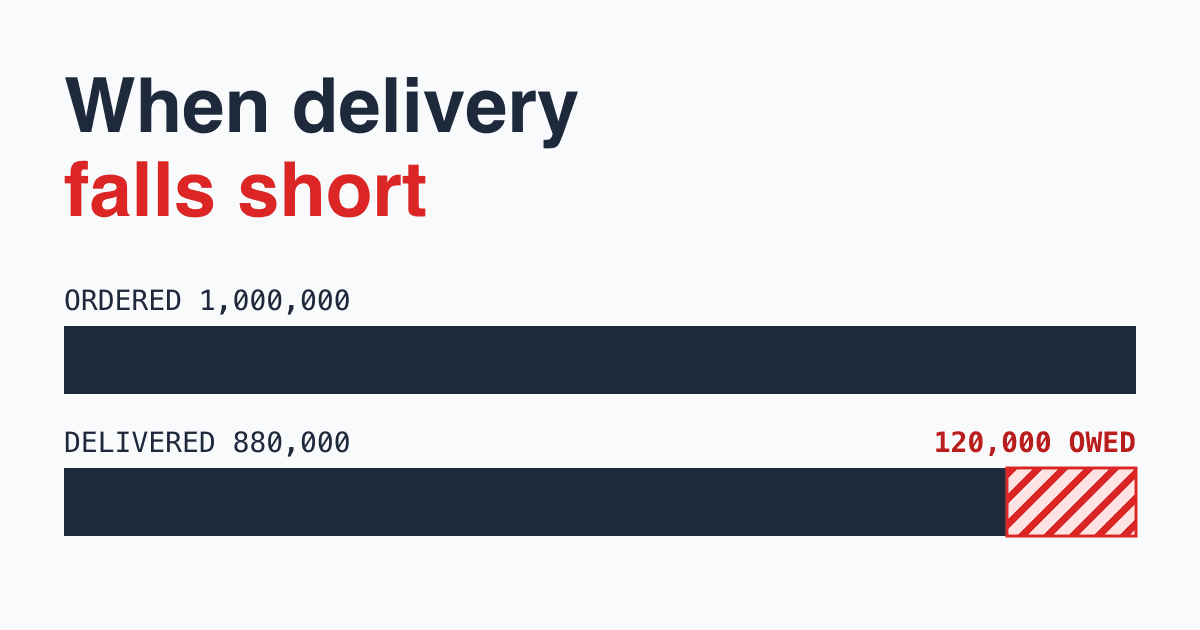
Case 1: the seller delivers 880,000
- Ordered
- 1,000,000 = $10,000
- Delivered
- 880,000 = $8,800
- Short by
- 120,000 = $1,200
If the seller believes a shortfall is likely, it must warn the buyer as soon as possible, and no later than 14 days before the end date on a campaign of 14 days or more (Section VI(a)). Both sides then try to agree a makegood flight. If they cannot, the agency may take a credit for the under-delivered part it was charged for. If the campaign was prepaid and the buyer is reasonably current on other bills, it may take a refund instead (Section VI(b)). A makegood cannot run past the end date without the agency's written consent, so a seller cannot quietly extend the flight. On the sample's actual-delivery billing, if no makegood runs, the buyer simply pays $8,800.
Case 2: the two ad servers disagree by more than 10%
- Other count
- 1,000,000
- Billing count
- 850,000 = $8,500
- Pay count + 10%
- 935,000 = $9,350
Decide first which count bills. It is an ad server certified to the IAB/AAAA guidelines. If both are, it is the third-party server, provided it gives the seller an automated daily report. If neither is certified, or that report is missing, it is the seller's server (Section XIII(b)). This count is the "Controlling Measurement".
When it is the lower one and the gap passes 10% over the invoice period, both sides try to reconcile. If that fails, the agency picks: treat the gap as under-delivery, with any makegood measured by the third-party server, or pay the billing count plus 10% (Section XIII(d)). The clause does not say which count the 10% is measured against; here the gap passes 10% either way. The gap is not a rare event: Google says variances of up to 20% are common when an ad server delivers line items hosted by a third party (Ad Manager Help).
Case 3: the order was CPC, CPL or CPA
Then there is no under-delivery remedy, unless the IO adds one. For these deliverables "guaranteed delivery, even delivery, and makegoods are not available" (Section VI(c)). If the seller sends half the clicks you hoped for, you pay for half the clicks and the campaign is simply smaller.
Case 4: the seller delivers too much
Extra delivery is free to the buyer: the seller cannot charge above the guaranteed or capped level. With a third-party ad server, the seller may not go more than 10% over without the agency's written consent, so 1,100,000 here. Without one, it may run as many bonus units as it likes, unless the IO says otherwise. Permanent or exclusive placements run their full period unless the IO sets a cap (Section VII).
Free impressions still cost a buyer money when a third-party server charges per impression. Put a cap on the IO. Once the agency reports the cap reached, the seller must try to stop. Within 48 hours it may serve any further ads itself, or else it carries the extra serving charges above the 10% margin (Section VII(a)).
What protects the seller if the buyer pulls out or pays late?
Under Version 3.0: notice periods, a daily charge for late creative, and one right to demand payment in advance. The weakest point is collection: unless the IO says otherwise, an agency is not on the hook for money its client never paid. The May 2026 terms change some of this (sheet 3).
Case 5: the buyer cancels
Unless the IO is marked non-cancelable, the advertiser may cancel without penalty on written notice (Section V(a)). The notice depends on what was sold:
- Non-guaranteed (CPC, CPL, CPA, some CPM)7 days
- Guaranteed (including CPM)14 days
- Flat fee or fixed placement (roadblocks, share of voice, some sponsorships)30 days
Short notice costs the days it falls short by. The terms' own example: cancel a guaranteed buy 8 days before the first impression and the advertiser owes the first 6 days. On the sample order, if delivery is even, that is 6 of 30 days, or $2,000. Custom work provided or finished before the cancellation takes effect stays payable, within 30 days of the invoice, and must sit on its own line of the IO. The terms give the seller no matching right to cancel without cause.
Case 6: the creative arrives late
- Full order
- $10,000 over 30 days
- One day's charge
- $333.33
- 3 full days late
- $1,000.00
If materials are not in by the start date, the seller starts charging that day, pro rata on the guaranteed part of the IO, for each full day they are missing (Section IX(b)). The IAB's guide gives the same sum at a smaller scale: a $10 IO over 10 days costs $1 per late day (Education Guide). If materials miss the seller's own published deadline, the seller no longer has to guarantee full delivery.
Case 7: the agency's client does not pay
The agency pays 30 days after it receives the invoice, unless the IO sets a schedule. If that passes, the seller may give notice and go to the advertiser directly five business days later (Section III(b)). The agency owes the money only "to the extent proceeds have cleared" from the advertiser. For the rest, the advertiser alone is liable (Section III(c)). The IAB's guide calls this "the sequential liability clause" (Education Guide).
Three rights help a seller. It can ask for written confirmation that the agency acts for this advertiser, ask whether the advertiser has paid the agency in advance, and require advance payment if the agency's or advertiser's credit is or becomes impaired (Section III(c)). Use the first two before the flight, not after the invoice is late.
Which deadlines does the contract set?
These are the Version 3.0 deadlines, and the May 2026 terms may set others. Most of the short ones fall on the seller, and most run from a notice or a start date. Cancellation notice is on sheet 5. Lines marked "try to" are "commercially reasonable efforts" duties in the terms, not hard limits. Each bar shows the length of that period, on a log scale so that 1 day and 90 days fit on one line.
- 24 hoursSellerTry to fix an ad that breaks the adjacency list, once told. Section II(d)
- 1 dayEitherWhoever holds the billing count gives the other side access to its statistics after launch, as available. Section XIII(c)
- 2 business daysSellerTry to say the inventory is gone, after getting the signed IO. Send final specs after acceptance. Confirm delivery has begun after the start date. Try to flag damaged creative. Section I(b), II(c), IV(a), IX(d)
- 5 business daysSellerFix a missing or wrong report after notice, or risk nonpayment for that activity. Section IV(c)
- WeeklySellerReport delivery by day, if the seller serves the campaign. Section IV(b)
- 10 daysEitherCure a material breach after written notice, or face termination. Section V(b)
- 10 business daysSellerTry to warn of a site change that alters the audience, or the ad's size or placement. Section II(b)
- 14 days before the endSellerWarn of likely under-delivery, at the latest. Section VI(a)
- 30 daysBuyerPay after receiving the invoice, unless the IO sets a schedule. Section III(b)
- 90 daysSellerSend all invoices after the last deliverable. Section III(a)
What should you write on the IO before you sign?
Anything the default gets wrong for your deal. These are the lines Version 3.0 leaves open, or the gaps worth closing. If your IO uses the May 2026 terms, check each line against them. Have counsel read anything large.
If you are buying
- Name the terms and version. A direct buy can use the IAB's Direct Buy Addendum. A reference to the General Terms means the current version unless the order says otherwise (General Terms section 1).
- Define the impression. Served or viewable? The gap is large, and the standard terms bill on the deliverable the IO names.
- Agree the makegood now. Terms may be set "on the IO" (Section VI(b)): same placement, same audience, inside the flight.
- Set an impression cap if a third party bills you per impression.
- Name the billing count. Then nobody works it out after the invoice.
If you are selling
- Mark what is non-cancelable. Otherwise the notice periods apply.
- State any short rate. It applies only "to the degree stated on the IO" (Section V(c)).
- Split custom work onto its own line. The guide discourages folding it into a CPM (Education Guide).
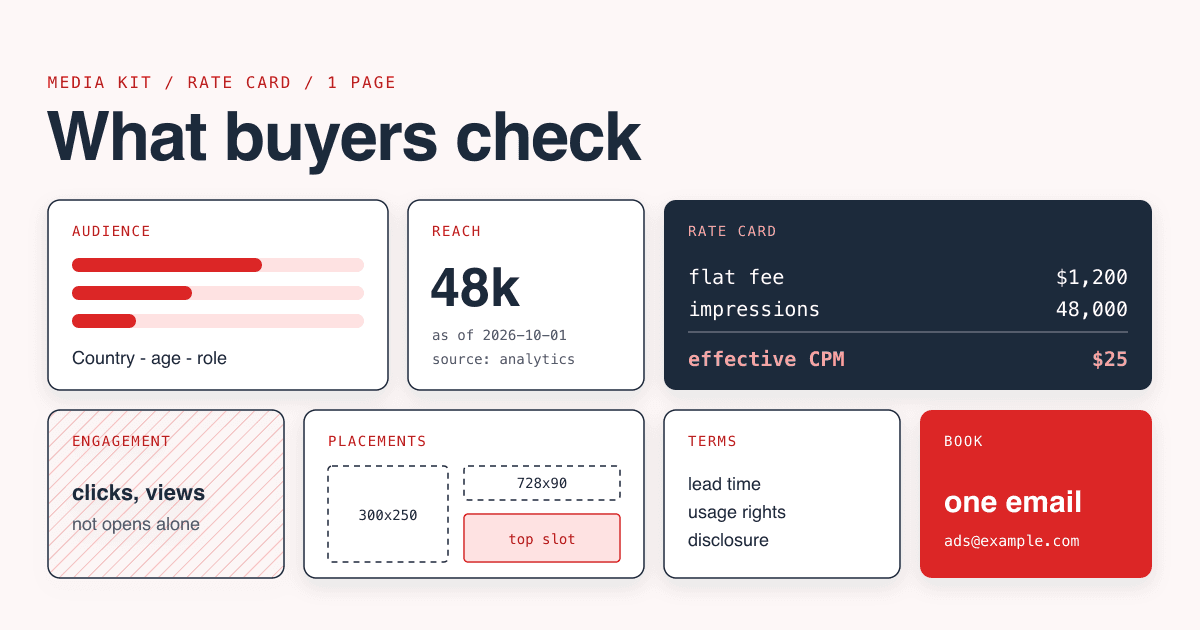
- Send your ad policies by email; a URL in the email is fine. The advertiser's indemnity for breaking them covers only policies provided at least 14 days before the breach (Section X(b)). Publish your creative deadline there too. Your media kit is a good home for both.
- Ask for a payment schedule on any new client.
Creators and newsletters: what the terms leave out
Version 3.0 warns that it "may not fully cover sponsorships" and similar content deals, though it can serve as a basis for the media part (Terms, opening). It is silent on how long a brand may reuse a post and on running it as an ad. The May 2026 set goes further: the IAB says its Order-Specific Terms address "cancellation, sponsorships, custom content, and upfront deals" (IAB), and the addendum lists newsletters among flat-fee buys, with 30 days' notice by default (Addendum 17(a)). We found nothing on reusing a post in the addendum. If that is part of the deal, write it down separately. Our guide to whitelisting covers the permissions. State the cancellation notice you want, too.
Common questions about insertion orders
Is an insertion order legally binding?
Version 3.0 treats each IO, with the terms, as "the entire agreement" on its subject, and leaves the governing law and courts as blanks for the parties to fill in (Section XIV(c)-(d)). Whether a given IO holds up depends on that law and its wording, so ask a lawyer about a real dispute.
Who sends the insertion order first?
Under the standard terms, the agency signs it and the seller then has two business days to try to say if the inventory is gone (Section I(b)). In a direct deal it can go either way. Version 3.0 does not cover that case. The May 2026 addendum uses the same step: the buyer signs, and the seller has two business days to try to flag unavailable inventory (Addendum 3(b)).
What is a makegood?
Extra delivery that replaces what a campaign was owed. The terms call it a "makegood flight" and use it for under-delivery, a missed ad (Section VI(b)), adjacency breaches (Section II(d)) and late reports (Section IV(c)).
What is a short rate?
A rate adjustment when a canceled buy no longer earns the rate it was booked at. One publisher's terms say a cancellation "will result in adjustment of the rate" to reflect the space actually used (Workforce terms). Version 3.0 sets no amount: a short rate applies only as stated on the IO. The May 2026 definitions call short rates "retroactive rate adjustments" tied to pricing tiers or volume commitments (Appendix 1).
Do programmatic buys need an insertion order?
A programmatic guaranteed deal in Display & Video 360 brings the platform object: you accept the deal and its insertion order is set up for you (DV360 Help). Whether a signed contract sits behind a programmatic buy depends on the seller and the buyer's platform agreements, so ask.
Is an insertion order the same as an invoice?
No. The IO comes before the campaign and says what will run. The first invoice goes out after the first month's delivery or within 30 days of the end of the IO, whichever is earlier, and bills on the basis the IO sets (Section III(a)).
Sources
- 4A's/IAB Standard Terms and Conditions for Internet Advertising for Media Buys One Year or Less, Version 3.0
- 4A's/IAB Education Guide to the Standard Terms and Conditions, Version 3.0, released February 2010
- IAB and 4A's Release Finalized "Standard Terms and Conditions Version 3.0", February 22, 2010
- IAB/4A's Standard Addendum for Digital Video Advertising in TV Long Form Video, March 2018
- Ad Industry Launches Effort to Revise New Standard Terms & Conditions for Digital Advertising, IAB, March 15, 2023
- IAB Releases Direct Buy Addendum to Terms and Conditions for Public Comment, IAB, February 12, 2026
- Standard Advertising Services Terms & Conditions: New Terms as of May 2026, IAB, May 20, 2026
- IAB Direct Buy Addendum to the General Terms and Conditions, Version 1.0, May 2026
- IAB General Terms and Conditions for Digital Advertising Services, Version 1.1, May 2026
- Appendix 1: Definitions, Version 1.1, IAB, May 2026
- Create an insertion order, Display & Video 360 Help
- Programmatic Guaranteed deals, Display & Video 360 Help
- Investigate report discrepancies, Google Ad Manager Help
- Addendum to IAB Standard Terms and Conditions, PMG
- Standard Terms and Conditions (Direct Advertiser Buys), Expedia Group
- Online Advertising Terms and Conditions, Workforce