We use analytics cookies to see how the site is used. They are only set if you accept. Accepting also turns on session recording (pages viewed, clicks and scrolls) so we can fix problems; what you type stays hidden. Read the privacy policy
Cold Pitching a Sponsor: Whose Inbox, the Five-Line First Email and Three Follow-Ups
How a publisher, newsletter or creator finds the brand that already pays for audiences like theirs, works out which person holds the budget, writes a first email that fits on a phone screen, and spaces three follow-ups before stopping.
StationPublisher
WorkedSponsor
ModeEmail
Calls1 + 3
By MediaProNet Editorial TeamPublished Reviewed
04916
Days from the first email to the last follow-up
EntryCallModeNotes
The brands most likely to say yes to your sponsorship are the ones already paying for one somewhere else, and their names sit in the ad slots of the newsletters, podcasts and channels your own readers follow. Cold pitching works when it starts there: a short list of brands with a proven habit, the one person at each who controls that money, a first email of about five lines, and a follow-up plan written before anything is sent.
Short answer. Pitch brands you have seen sponsor something similar. Send to the person whose budget pays for it (the founder at a small brand, the partnerships or influencer marketing manager at a bigger one, the media buyer when an agency books it). Write one specific offer with a price and a date, end with a question that can be answered in a word, and plan three follow-ups in the same thread over about two weeks. Then stop, and try a second contact or a later quarter. Your media kit is the link, not the email.
Who gets the email: find the person who owns the budget
A sponsorship pitch fails most often before it is written, by landing with someone who cannot say yes. Two steps fix that: first build a list of brands that already buy, then find the right name inside each.
Brands that already buy
Ad slots near you. Read the last ten issues or episodes of five publications your audience also follows and write down every sponsor. A brand that pays a similar audience is the warmest lead you will find.
Ad libraries. The Meta Ad Library and Google's Ads Transparency Center show the ads a brand is running now. A brand spending on paid social for your audience has a budget line you can ask for a share of.
The brand's own site. Pages called partners, creators, affiliates or press often name a contact or a form. If there is a form for creator partnerships, use it as well as the email.
Which person, by kind of company
Small brand, under about 20 staff
Founder or head of marketing
Often one person decides and pays. Their name is on the about page, the podcast they guested on or the company's profile on a professional network.
Growing brand with a marketing team
Partnerships, influencer or creator marketing manager
The team that already books creators and newsletters. Search job titles with "partnerships", "influencer" or "creator" at the company.
Large brand
Brand manager for the product line, or its agency
Big brands buy through agencies. Ask the brand side who books sponsorships for that product, then pitch the named media buyer at the agency.
Brand that pays only on sales
Affiliate or performance manager
If the brand runs an affiliate program, a flat fee pitch usually goes to a different budget. Offer a flat fee first and mention you can take a hybrid deal.
Have a second name ready at each company. In a 2019 study of 12 million outreach emails by Backlinko with Pitchbox, messages sent to more than one contact at the same organization got 93% more responses than messages to a single person, with diminishing returns at five or more contacts. Those were mostly link-building pitches, not sponsorship pitches, so read the figure as direction, not a forecast. Contact the second person only after the first sequence ends without an answer, never in the same week: two colleagues comparing identical emails is how a pitch gets marked as spam.
The first email, line by line
The whole first email should read on a phone without scrolling. Every line has one job; if a line does not do one of the five jobs below, cut it. The example uses made-up figures for a made-up newsletter.
Subject Your recipe box in front of 14,200 home cooks
Hi Dana,
I saw your recipe box sponsor the Sunday Dinner Letter last week, so I think my readers are a fit for you too.
The Weeknight Pan is a weekly newsletter for 14,200 home cooks who plan the week's dinners on Sunday (subscribers on 1 November, from our email platform).
One idea: a 120-word spot I write in my own voice, at the top of the 8 January issue, the week people restart meal planning, for $650.
Would a January slot be worth a look, or is someone else the right person for this?
Sam Ortiz, editor, The Weeknight Pan. Media kit: example.com/kit. 12 Example Street, Springfield. Not for you? Reply "no" and I won't write again.
Why you. One proof that you looked: the place you saw them advertise, a product launch, a campaign. A first name and a specific reason are what separate a pitch from a mass mailing. In the Backlinko data, personalized subject lines got 30.5% more responses and personalized message bodies 32.7% more.
Who you reach. One audience number with its date and the tool it came from, plus one line on who those people are. Opens and follower counts invite doubt; the media kit can carry the rest.
One offer. A format, a date and a price. A buyer can forward a priced offer to the person who approves it; "let me know if you'd like to work together" gives them nothing to forward.
One question. Something answerable in a word, plus the routing question. "Or is someone else the right person" turns a wrong address into a referral instead of silence.
Signature. A link to the kit instead of an attachment, a postal address and a plain way to say no (see the sending rules below).
The subject line
Name their product and your audience, and keep it between about 36 and 50 characters: the length band that drew the most responses in the Backlinko study. The sample above is 45. "Partnership opportunity" and "Quick question" say nothing a busy buyer can sort by, and a subject that promises something the email does not contain is unlawful under US law when it misleads about the content.
What stays out
Attachments. A link to the kit is lighter and does not trip attachment filters.
The full rate card. One priced offer gets a reply; a menu of eight gets "we'll review internally".
More than one ask. A call, a kit review and a discount in one email means no answer to any of them.
"Hope this finds you well" and a paragraph about yourself. The buyer cares about their customers, who are your readers.
Three follow-ups, then stop
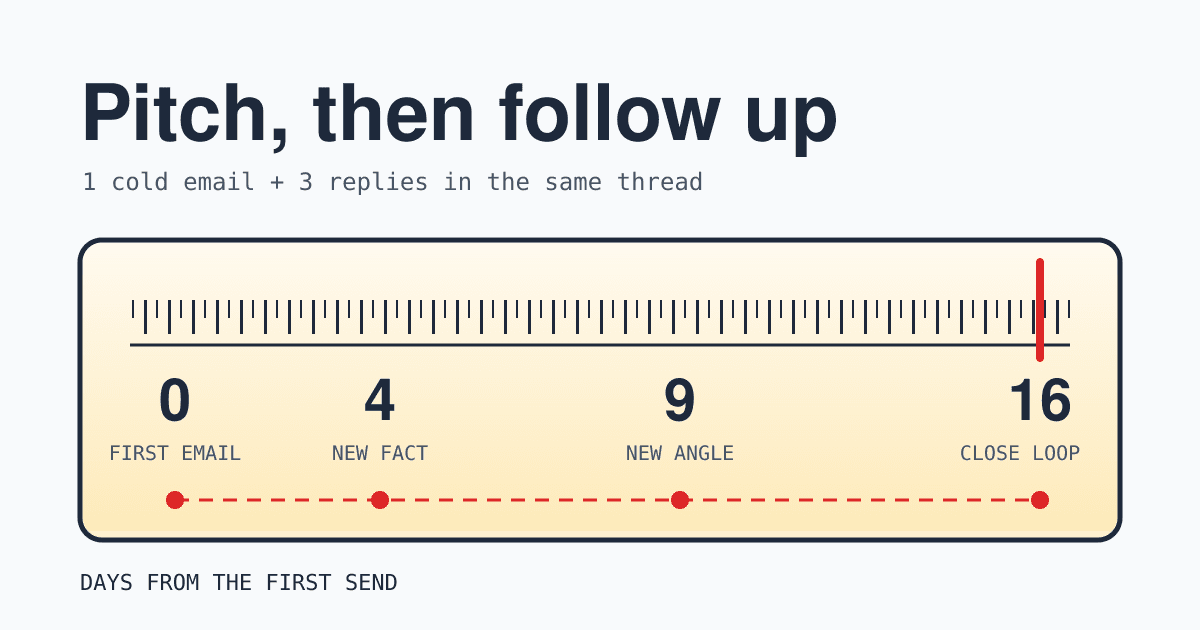
Silence after the first email is the normal result, not a no. Across the 12 million emails in the Backlinko study, only 8.5% got any response; one follow-up raised replies by 65.8%, sending three or more messages gave the best response rate, and sequences that reached several contacts several times did 160% better. The spacing below is our working plan, not a number from that study: wide enough not to nag, short enough that the buyer still remembers the first email.
Day 0
The first email
As above. Send it on a weekday morning in the buyer's time zone; Backlinko found weekday emails beat weekend ones by 23.3%.
Day 4
Follow-up 1: reply in the same thread, add one new fact
(Example figures.) "Dana, one thing I left out: our last sponsor's link got 410 clicks from one issue (from the platform's click report). Still worth a look for 8 January?"
Replying in the thread keeps the first email underneath, so the buyer reads one conversation instead of two strangers.
Day 9
Follow-up 2: a different angle
"Two January spots are left, the 8th and the 22nd. Happy to hold one until Friday if a date helps."
Only say a slot is limited if it is. A new angle can also be a short idea for the ad itself, or a smaller test at a lower price.
Day 16
Follow-up 3: close the loop
"I'll stop here so I'm not crowding your inbox. If sponsorships come up later in the year, the kit stays at example.com/kit. Is there someone else I should ask?"
A polite last message often gets the reply the first three did not, because it asks for nothing but a name.
Later
After the sequence
No reply: try the second contact at the same company with the same four steps, or wait a quarter and pitch again with new numbers. Marketing budgets are often set per quarter, so a "no" in November can be a "yes" for February. Plan seasonal pitches early; the Q4 calendar post shows which weeks fill first.
Keep a log, even a spreadsheet: brand, contact, day of each send, reply, next date. Without it, follow-ups slip or go out twice, and you lose the "not now, try in March" replies that are the best leads you will get.
Reading the reply and the next move
"Send me your rates."
Send the kit link, two concrete dates and the one price you already offered. Ask which date suits them. Do not open with a discount.
"Not this quarter."
Ask which month they plan the next one, put it in the log and write again two weeks before it, with fresh numbers.
"Our agency handles this."
Ask for the name of the person there, then pitch them, opening with "Dana at the brand suggested I write to you".
"We only do affiliate deals."
Decide whether a commission-only test is worth one issue to you. If it is, cap it at one placement and agree the tracking link before it runs.
"No thanks."
Thank them in one line and close the entry. Do not argue and do not put them in the next round.
"Remove me."
Remove them from every list at once and never write again. US law allows at most 10 business days to honor that request; there is no reason to take more than one.
When a deal is agreed, put the format, date, price, label and approval steps in writing before the issue goes out, and label the spot as an ad: the disclosure label guide says which word to use where.
Sending rules that keep you out of the spam folder
A cold pitch is one person writing to another, so send it that way: from your own mailbox on your own domain, one email at a time, never from your newsletter platform to an imported list.
Authenticate your domain. Since 1 February 2024 Gmail requires every sender to Gmail accounts to set up SPF or DKIM, and to keep the spam rate reported in Postmaster Tools below 0.3%. A handful of people clicking "report spam" on a small pitch list can push you past that.
Follow the US rules for commercial email.15 U.S.C. 7704 bans subject lines likely to mislead about the content, requires a valid physical postal address and a clear way to opt out, and gives you 10 business days to stop after someone opts out. A sales pitch counts as commercial email.
Check the rules where your buyer is. Rules on unsolicited business email differ between countries, notably in the EU and UK. This post is not legal advice; if you pitch at volume, check the law that applies to you.
Questions publishers ask about sponsor pitches
Should I attach my media kit?
Link it. A link is lighter, always shows the current numbers and lets you see whether it was opened if your host reports views.
Should I quote a price in the first email?
Yes, for one specific placement. A priced offer can be forwarded and approved; "rates on request" adds a round trip before the buyer can even decide whether you are in budget.
Pitch the brand or the agency?
Start with the brand unless you know an agency books for it. The brand can tell you who books; the agency rarely knows a small publisher exists until the brand names you.
How many follow-ups is too many?
Three after the first email, over about two weeks, then stop. In the Backlinko data three or more messages did best, but past the third you are spending goodwill you may need next quarter.
My audience is small. Is it worth pitching?
Yes, to brands of the same size. Pitch a specific audience at a price that fits a small test budget, and say what the buyer gets: one placement, its date and the click report afterwards.