If an ad says 20% off trail running shoes and the click lands on a homepage slider of rain jackets, the shopper now has to do the searching the ad promised to spare them. Message match is the fix for that moment: the page a paid click opens repeats, in its first screen, the specific promise that earned the click, so the visitor sees at once that they arrived where the ad said they would. This page is about that one join between an ad and its destination, not about whether a landing page is well written in general.
The short answer
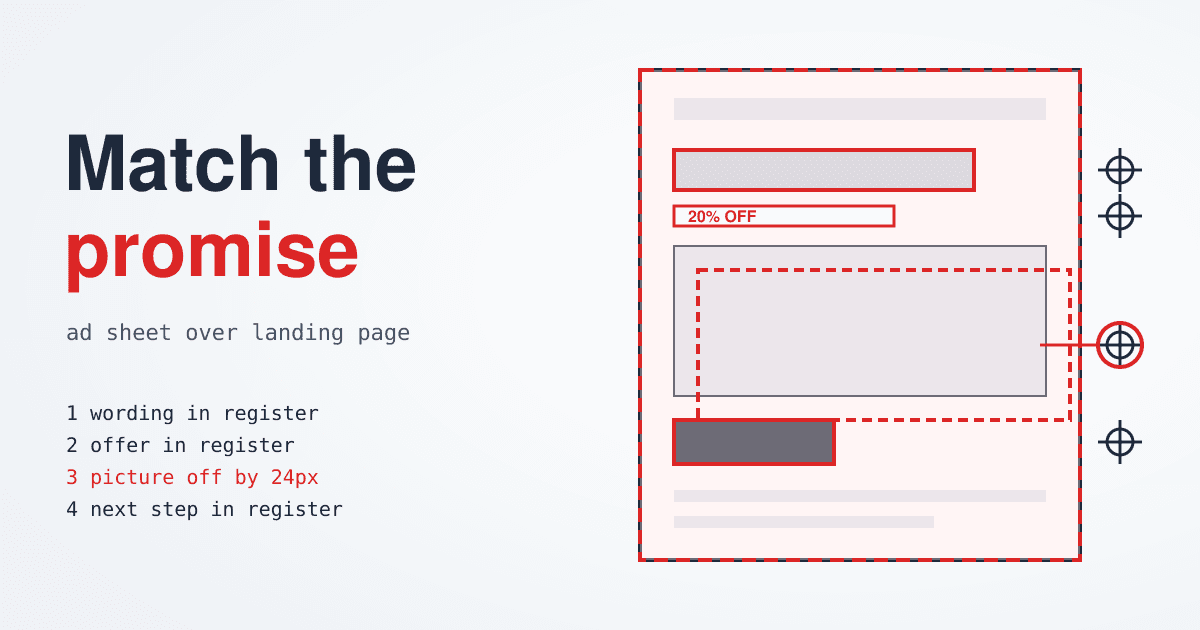
Lay every ad over the page it links to and check five things line up: the wording of the promise, the offer terms, the picture, who it is for, and the next step. Give each distinct promise its own destination, even if that is only a filtered category page. Then compare clicks with page loads and conversion rate per ad, so you can tell a slow page from a page that broke the promise.
- 3parts of a Google Ads Quality Score; one of them is landing page experience, "how relevant and useful your landing page is to people who click your ad"
- 90 daysthe window Google compares your landing page experience against other advertisers on the exact same search
- 7 daysthe minimum warning Google gives before suspending an account over its destination requirements
The five promises an ad makes and the page has to keep
A printer checks that the colour plates of a job line up by looking at small crosshairs printed on each one; if the crosshairs sit on top of each other, the plates are in register. Treat an ad and its landing page the same way. Google's own advice for a weak landing page score says it directly: "Keep messaging consistent from ad to landing page. Ensure the page follows through on the ad's offer or call to action." Its glossary adds that landing page experience covers, among other things, "the expectations users have based on the ad they clicked". Those expectations break down into five marks.
-
Wording
Ad says the subject in a few words: "trail running shoes", "payroll for teams under 20".
Page shows the same subject in the headline of the first screen, in the visitor's words, not the brand's internal name for it.
Out of register when the headline is the company slogan and the subject only appears halfway down.
-
Offer terms
Ad says a number or condition: 20% off, free returns, 14-day trial, from $9 a month.
Page shows the same number, the same condition and any limit on it (end date, minimum order, which items) next to the price.
Out of register when the discount needs a code nobody gave them, or applies only to some sizes the ad did not mention.
-
Picture
Ad says a product, a person or a scene in the creative.
Page shows that product or a clearly recognisable version of it, above the fold on a phone.
Out of register when the ad shows the blue model and the page opens on the black one, or on a lifestyle photo with no product at all.
-
Audience
Ad says who it is for, often through targeting rather than words: a city, a job title, a plan size.
Page shows copy, prices and options for that reader: the right currency, the local branch, the small-team plan selected.
Out of register when a London audience lands on a US page with dollar prices, or a freelancer lands on the enterprise demo form.
-
Next step
Ad says what the click leads to: shop, book, download, get a quote.
Page shows that action as the main button, one tap away, with nothing else asking for attention first.
Out of register when the ad says "download the guide" and the page asks for a sales call, or opens a newsletter pop-up before the form.
Matching is about the promise, not the string of words. Google says so in the same help page: "the word-for-word phrase from a search term doesn't need to be on your landing page", and its example is a search for "South Chicago Chihuahua-friendly budget hotels" that does not need a headline saying exactly that. What it needs is hotels in South Chicago, on a budget, that take small dogs, visible without hunting.
Three ads laid over their pages
Each example below is invented to show the check, one per kind of paid click. The middle line is the page as it often is; the last line is the same page brought into register. None of the fixes needs a new page design, only the right first screen.
Search ad, retail
Ad "Waterproof trail shoes, 20% off this week. Free returns."
Page as found Homepage: seasonal banner for jackets, a menu, then a grid of 40 bestsellers.
Page in register The trail shoe category filtered to waterproof, a strip under the headline saying "20% off at checkout until Sunday, free returns within 30 days", sizes in stock first.
Three of the five marks were missing: wording, offer terms and picture. The visitor would have had to find the category, guess whether the discount applied and trust that returns were free.
Social video ad, software
Ad "Run payroll for a team of 8 in 10 minutes. Try it free for 14 days."
Page as found Pricing page with four plans, the enterprise plan highlighted, and a "Book a demo" button at the top.
Page in register A page headed "Payroll for small teams", the small-team plan preselected, a short version of the 10-minute claim with what it covers, and "Start 14-day free trial" as the only button.
Audience and next step were out of register: a small-team ad landed on a page built for the largest buyer, and the trial it promised was a demo request.
Podcast host-read ad, subscription
Ad "Go to the address in the show notes and use code TRAIL for your first box half price."
Page as found Homepage with a code box hidden in the basket, two steps after picking a plan.
Page in register A page that greets listeners of the show by name, shows the half-price first box with the code already applied, and states what the box costs after the first one.
Offer terms and wording drifted: the listener heard a code and a price, then had to remember the code and find where it goes. A page per show also keeps the tracking clean (the UTM guide below covers the tags).
Notice the pattern: the broken pages were not bad pages. Each one would be fine for a visitor who arrived with no promise in mind. Message match fails when a page built for everyone receives a click that was bought for one reason.
How many landing pages a paid account needs
One per distinct promise, not one per ad. If five ads in a group all say "waterproof trail shoes, 20% off", they share a page. If one of them says "free returns" and the rest do not, it can still share the page as long as the page shows returns. A new page is needed when the five marks above would point to different things.
The cheapest way to keep this honest is a match sheet: one row per ad group or ad set, filled in before the campaign launches and checked again whenever an offer changes.
| Ad group | Promise in the ads | Final URL | First screen must show |
|---|---|---|---|
| Trail, waterproof | 20% off this week, free returns | example.com/trail?waterproof=1 | waterproof trail shoes, the 20% and its end date, returns line |
| Trail, wide fit | wide sizes in stock | example.com/trail?fit=wide | only wide-fit models, a size filter already open |
| Road, brand search | official store, next-day delivery | example.com/road | the road range, delivery cut-off time |
| Retargeting, basket | your basket is waiting, 10% off | example.com/basket | their basket with the 10% applied and the code shown |
Three Google Ads rules shape what can go in the URL column. Its policy says your landing page and display URL must share the same domain, and the Destination mismatch policy lists the cases that get an ad disapproved: a display URL on one domain with a final URL on another, keyword insertion in the domain part of the display URL, a final URL that redirects to a different domain, and a tracking template that sends people to a different page from the final URL (its example is a final URL of a category page with a tracking template that opens a product page). So vary the page by path and parameters on your own domain, and make sure what the visitor sees is the page you declared.
Keyword insertion can put the keyword that triggered a search ad into its text, which helps the wording mark on the ad side. It does nothing for the page. If one ad group covers twenty different products through inserted keywords, it needs twenty destinations, or it needs splitting, which is what Google's advice on ad relevance recommends anyway: split ad groups whose keywords "can't be easily addressed by the same ad".
How to tell a broken promise from a slow page
Two different failures sit between a paid click and a sale, and they need different fixes. The first happens before the page is on screen; the second after.
- Clicks against page loads. Meta reports landing page views, "the number of times a click on an ad resulted in the successful loading of a destination web page", and says to compare them with link clicks "to understand how many times people may have clicked on your ad but left before your website loaded". A wide gap there is speed, redirects or a broken tag, not message match: the visitor never saw the page.
- The landing page status in Google Ads. Add the Landing Page Exp. column at keyword level. Each part of Quality Score is rated "Above average", "Average" or "Below average" against other advertisers whose ads showed for the exact same search over the last 90 days. Google calls Quality Score a diagnostic, not an input to the auction and not a number to optimise, so use the status to find which keywords to check, not as the result.
- Conversion rate per ad, on the same page. Google suggests conversion rate as a proxy for good landing page experience. Line up ads that share a destination. If one ad converts far worse than its siblings on the same page, the page is not the problem in general: that ad promises something the page does not show.
- Lay the two over each other. Open the ad and the page side by side on a phone, the way the visitor saw them, and run the five marks. Write which mark is off on the match sheet, change one thing, and compare the next period against the last.
A worked reading, with invented numbers. An ad set gets 1,000 link clicks and 700 landing page views: 300 people, 30%, left before the page loaded, and no copy change will reach them. Of the 700 who saw it, ad A converts 4% and ad B 1.5% on the same page. B's creative leads with free returns; the page mentions returns only in the footer. Move the returns line under the headline and watch B's rate, not the average.
To know whether a better match made extra sales rather than moving them between ads, test it against a holdout: the incrementality testing guide sets one up. And before reading any of these numbers, check which attribution window each platform used, explained in the attribution window guide.
Where a mismatch stops being a conversion problem
Most mismatches cost money quietly. Two kinds can cost the account or break advertising law, and both concern the offer terms mark.
Prices in shopping ads
Google Merchant Center asks you to submit an amount and currency that match the price on your landing page and the checkout pages, to show that price prominently, and not to use "View price in cart". Its crawler compares your feed with the page, and its help on mismatched product prices warns that a difference "may lead to an account suspension". It also lists the usual causes: a feed that updates slower than the site, structured data still holding the base price or currency, and a sale price with the wrong effective dates or time zone.
Do: update the feed on a schedule that matches how often prices change, and check sale dates in the right time zone before a promotion starts.
Bait offers
The US Federal Trade Commission's Guides Against Bait Advertising describe bait advertising as "an alluring but insincere offer to sell a product or service which the advertiser in truth does not intend or want to sell", and add that the law is violated "if the first contact or interview is secured by deception", even when the true facts come out later. Not having enough of the advertised item to meet expected demand, unless the ad says supply is limited, is one of the signs it lists.
Do: pause ads the day an advertised item or offer runs out, and put any real limit (stock, dates, regions) in the ad as well as on the page. This is a summary of the guide, not legal advice; other countries have their own rules.
Google's destination requirements also say the page has to be crawlable by its ad crawlers, "so we can make sure that users are led to an ad destination that reflects the ad they have clicked on". A page that hides its offer behind a login, or shows a different price to the crawler than to people, fails the check that message match is meant to pass.
Questions media buyers ask
Can paid traffic go to the homepage?
For a brand-name search, often yes: the promise is the brand itself. For any ad that names a product, an offer or an audience, the homepage is out of register on at least one mark, so send it to the page that shows that thing first.
Does the page headline have to repeat the ad headline?
No. Google says the exact search phrase does not need to appear on the page. Repeat the subject and the offer in plain words so the visitor recognises them; the exact wording can differ.
Do I need a new page for every creative test?
Only when the test changes the promise. Two creatives that differ in colour or hook but make the same offer share a page. A creative that adds a new offer, such as free shipping, needs that offer visible on its destination.
What about creator and sponsorship traffic?
The same five marks apply, and the creator is part of the wording: listeners and viewers expect to see the name of the show or channel and the code they were given. A dedicated page per partner also gives cleaner numbers, set up with the UTM tags guide.
Sources
- Google Ads Help, About Quality Score for Search campaigns: the three components, the status scale and the 90-day comparison.
- Google Ads Help, 5 ways to use Quality Score to improve your performance: consistent messaging, the word-for-word note, conversion rate as a proxy, splitting ad groups.
- Google Ads Help, Landing page: same-domain rule and what landing page experience covers.
- Google Ads policies, Destination requirements and Destination mismatch: crawlability, mismatch cases and the 7-day warning.
- Google Ads Help, About keyword insertion for your ad text.
- Meta Business Help Center, Landing page views: definition and the comparison with link clicks.
- Google Merchant Center Help, Price and How to fix: Mismatched product price.
- US Federal Trade Commission, Guides Against Bait Advertising, 16 CFR Part 238.
All sources read on 2026-11-12. The shops, offers and numbers in the examples are invented to show the method.