"If performance begins to drop as your frequency numbers rise, your target audience may be experiencing ad fatigue," reads Meta's help page on frequency (Meta, Frequency). That line is the core test for a worn-out ad, and it leaves out the hard parts: which numbers to compare, what else makes them fall, and when to replace the ad. Ads do not expire on a date; they wear as the same people see them again, so the useful comparison is this week against the ad's first steady week, not against the calendar. This post lists the readings that show wear, the four things that look like wear and are not, a sum for how long a creative should last at your budget, and a routine for replacing it without breaking delivery.
Frequency, the number behind most of it, is impressions divided by reach: the average number of times each person reached saw the ad (Meta, Frequency). If you want the background on caps and targets, the reach and frequency post covers it; this one is about the creative itself.
Five wear bars to read every week
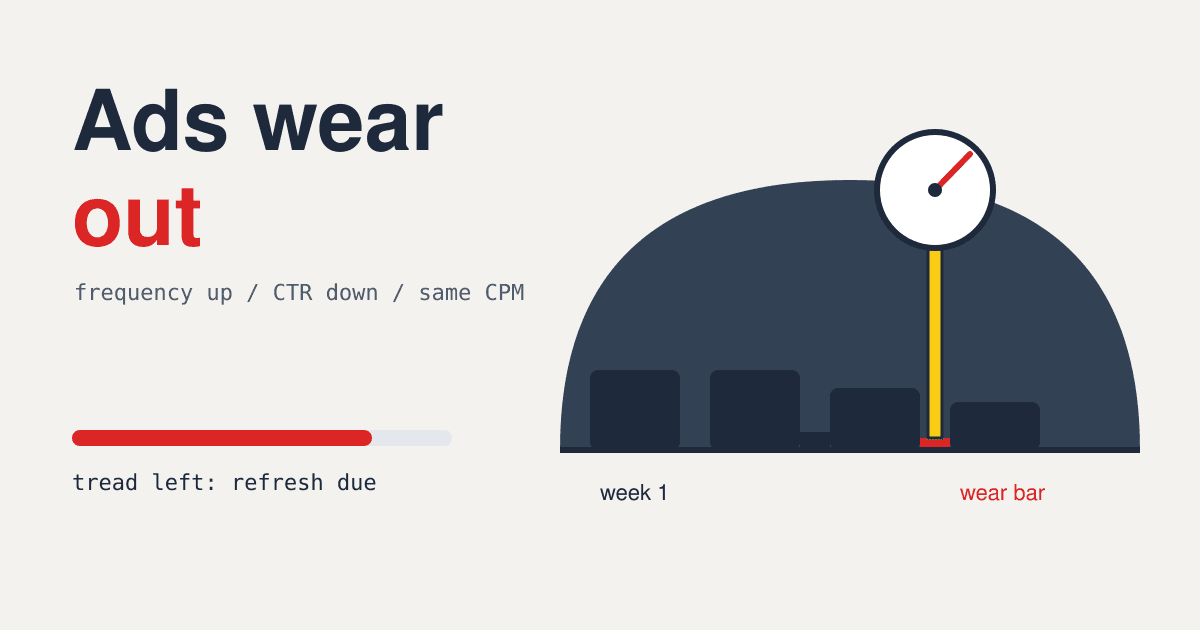
Tyres carry small raised bars in the grooves; when the tread is level with them, the tyre is done. An ad has the same kind of marks. Read them weekly, on the same day, against the ad's first steady week (its baseline). One bar on its own is a reason to watch. Two that agree for two weekly checks in a row are a reason to swap.
Four things that look like wear and are not
A swap fixes one thing: people tired of one ad. Each of these produces the same falling numbers and needs a different fix.
-
Auction pressure
What you see CPM jumps and cost per result follows.
The check Did CPM rise for new ads and old ads alike, in the same week? Seasonal demand lifts prices for everyone; the Q4 calendar post lists the weeks when it does.
Then Keep the creative. Change bids or budget, or wait out the peak.
-
A learning reset
What you see Results turn unstable and cost per result rises right after a change.
The check Meta says ad sets in the learning phase "are less stable and usually have a higher CPA", and usually leave it after about 50 results in the week after the last significant edit (Meta, learning phase). Any change to ad creative, adding a new ad to the ad set and pausing the ad set for 7 days or longer all count as significant edits (Meta, significant edits).
Then Wait a week before you read the bars again. Do not swap a second time to fix the first swap.
-
An audience used up
What you see Frequency climbs because reach has stopped growing.
The check Is reach almost flat week on week while the budget holds? Then the same pool is being served again and again.
Then A new creative to the same small pool buys a little time. Widening the audience is the real fix, which is why Meta names targeting as the other lever.
-
Too few numbers
What you see A bad week on a small ad.
The check Count the impressions and results behind the reading. Meta does not even show relevance diagnostics under 500 impressions.
Then Pool two or three weeks before you call it. A swap on noise resets learning for nothing.
How many weeks a creative lasts: the sum
You can estimate wear before launch. Frequency is impressions divided by reach, so if you know roughly how many people your audience can reach and how many impressions your budget buys, you know how fast frequency rises. The numbers below are an example, not a benchmark; put in your own.
Weekly budget buys600,000impressions
People the audience reaches200,000people
Frequency added per week3600,000 / 200,000
Variants to start with3 or moreone per weekly exposure
The last line follows a rule Google gives for its Target frequency campaigns: add "at least as many creatives as your Target frequency number, if not more, to avoid creative fatigue" (Google Ads, Target frequency). It is written for YouTube, but the logic carries: if each person sees you three times a week, three different ads mean each one is seen about once.
Two things change the sum. Reach usually still grows in the first weeks, so frequency rises more slowly than the example at the start and faster once the audience is used up. And the brand matters: in two experiments, repeated ads attributed to an unfamiliar brand lost effectiveness, while the same ads attributed to a familiar brand wore out later (Campbell and Keller, Journal of Consumer Research, 2003). A new brand should plan more variants, or check more often.
A refresh cadence: the service log
No platform help page or study used here gives a fixed number of days after which an ad is worn; the readings decide. What you can fix is the routine: when you look, what counts as a trigger, and how you change ads without making the numbers worse.
| When | What to do | Why |
|---|---|---|
| Before launch | Load all the variants from the sum at once, in the same ad set. | Adding an ad later is a significant edit that puts the ad set back into learning (Meta). |
| First week | Do not judge. Note CTR, CPM, cost per result and frequency once delivery is stable: that is the baseline. | Ad sets usually settle after about 50 results in the week after a significant edit (Meta). |
| Every week, same day | Read the five wear bars against the baseline. Rule out the four look-alikes. | Wear is a trend, and a weekly rhythm gives every reading a full week of data. |
| Two bars agree, two checks running | Swap: add the replacement batch together, pause the worn ad, write the date down. | One batch means one learning reset instead of several. |
| Every swap | Pause, do not delete. Move the worn ad to a bench list with its baseline and its retirement date. | In one model of wearout, an ad's quality falls while it runs without a break and recovers during weeks off air, so bursts of advertising can build more awareness than a flat schedule (Naik, Mantrala and Sawyer, Marketing Science, 1998). |
| After a rest | Bring a benched ad back as if new, with a new baseline week. | In a field study and experiments, annoyance from heavy repetition faded over time while memory of the brand held (Kronrod and Huber, International Journal of Research in Marketing, 2019). |
| Heaviest viewers | Where the platform allows, cap frequency for the people who see the ad most. | Profiling and capping heavy viewers improved deployment by as much as 15% in one study (Chae and others, 2019). |
Meta also counts pausing an ad set for 7 days or longer as a significant edit, so rest individual ads inside a running ad set rather than parking the whole ad set.
Questions buyers ask about worn ads
How often should I refresh my ads?
When two wear bars agree for two weekly checks, not on a fixed date. None of the sources here gives a universal number of days, and wear depends on budget, audience size and how well known the brand is.
What frequency is too high?
There is no single ceiling. Meta says frequency "may average 1 to 2 per ad set or may be much higher", depending on budget, audience size and schedule (Meta). Watch whether results fall as it rises, not the number on its own.
Is it the ad or the landing page?
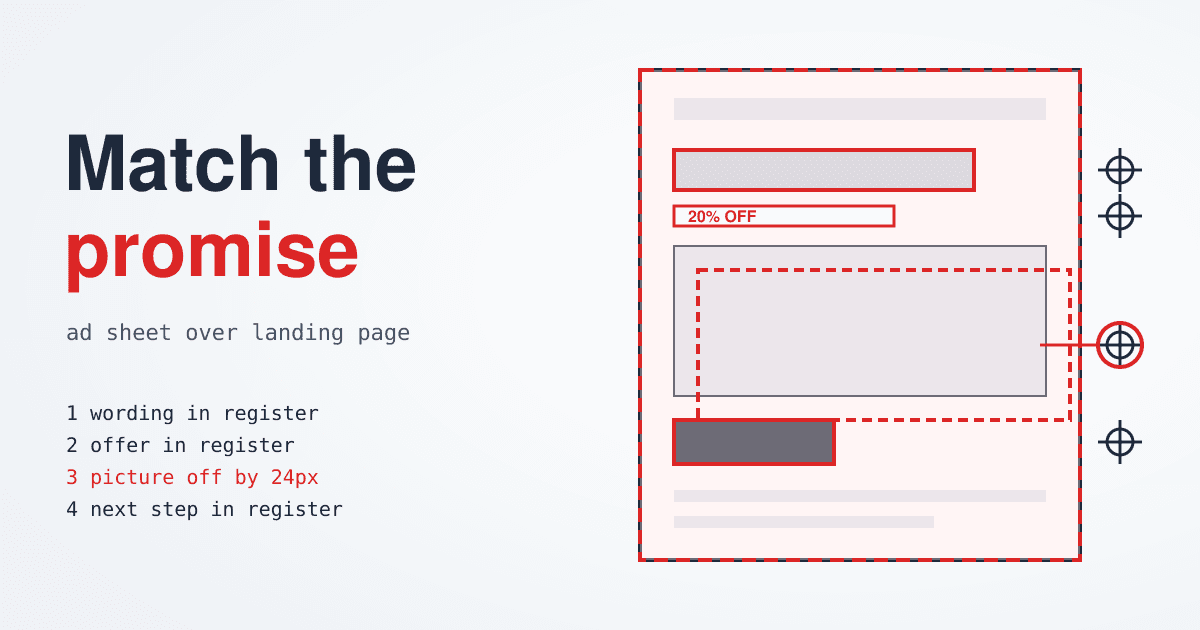
Compare CTR with the conversion rate after the click. Falling CTR with a steady conversion rate points at the ad; both falling points at the page or the offer first.
Should I delete a worn-out ad?
Pause it and keep it on a bench list. Research on wearout suggests annoyance fades with time off, so a rested ad can come back later, judged against a new baseline.
Does a new headline count as a new creative?
For the platform, yes: Meta treats any change to ad creative as a significant edit that restarts learning. For the audience, a small change may still look like the same ad, so plan real variants, not edits.
Sources
- Meta Business Help Center: Frequency
- Meta Business Help Center: About ad relevance diagnostics
- Meta Business Help Center: About the learning phase
- Meta Business Help Center: Significant edits and learning phase
- Google Ads Help: About Target frequency
- Chae, Bruno and Feinberg, "Wearout or Weariness? Measuring Potential Negative Consequences of Online Ad Volume and Placement on Website Visits", Journal of Marketing Research, 2019
- Campbell and Keller, "Brand Familiarity and Advertising Repetition Effects", Journal of Consumer Research, 2003
- Naik, Mantrala and Sawyer, "Planning Media Schedules in the Presence of Dynamic Advertising Quality", Marketing Science, 1998
- Kronrod and Huber, "Ad wearout wearout", International Journal of Research in Marketing, 2019
Platform pages were read on 2026-11-12; the papers are cited from their published abstracts. The worked sum uses example numbers, not a benchmark.