Ask the retailer's media team for its measurement methodology before you ask for its rate card. A retail media network sells advertising on a store's own website, app and screens, and often its shopper data on other sites too, and then reports the sales it says the ads produced, using the till and loyalty records that only the retailer can see. That last part is the selling point, and it is also the part to question, because the seller of the ad is also the one marking the homework.
Shelf talker: the short answer
Onsite placements (sponsored products, search and display on the retailer's own pages) sit next to the buy button, and the retailer counts them. Offsite placements use the retailer's shopper data to reach people on other publishers, and the counting may belong to that publisher. Either way, the closed-loop report links ad exposure to purchases, but attributed sales are not the same as sales the ads caused. Before budget moves, get the attribution window, the click and view split, the halo rule, the share of extrapolated sales and an incrementality test in writing.
- +12.1%forecast 2026 growth of US commerce media spend (IAB 2026 Outlook)
- 12%of networks that can activate and measure across onsite, offsite and in-store without seams (Forrester for Koddi, 2025)
- 30 daysdefault post-view and post-click lookback in the European standard (IAB Europe, 2024)
Onsite: ads on the retailer's own shelves
Onsite inventory is everything the retailer shows on its own properties: sponsored product listings in search results, banners on category and product pages, and placements in the app and in order emails. The shopper is already in a buying session, which is why these units tend to sit closest to a measurable sale.
The catch is who counts. The joint IAB/MRC Retail Media Measurement Guidelines (January 2024) note that retailers' own restrictions mean "providing onsite viewability tagging for each advertising partner is generally not possible", and ask retailers to provide the metrics and be open about how they are produced instead. In plain terms: onsite, you usually see the retailer's own count, not one from your verification vendor. The IAB Europe Retail Media Measurement Standards (April 2024) went further and put viewability for sponsored product units off to a later version.
Onsite is also where you compete with the retailer's own organic results. A sponsored listing that wins a slot your product would have held anyway can show a strong ROAS and add little. Hold that thought until bay 4.
Offsite and in-store: the retailer's data on other people's shelves
Offsite means the retailer takes its shopper audiences (people who bought baby formula in the last 90 days, say) and buys media for you on other publishers: social platforms, streaming TV, the open web. You get reach the retailer's own site cannot give you; the retailer still closes the loop with its sales data. The guidelines say plainly that "offsite measurement may be the responsibility of offsite partners, such as platforms and other publishers", and that the retailer should give you access to those partners' measurement disclosures. So for offsite, ask whose impression count the invoice uses.
In-store covers screens at the shelf and checkout, in-store audio and sampling. The IAB/MRC text recommends counting in-store impressions under the MRC's digital place-based audience standards; the European standard leaves offline measurement, "whether In-Store or OOH", to a later version. Joining all three is still rare: a Forrester survey of 788 decision-makers, commissioned by Koddi, found only 12% of networks can activate and measure seamlessly across onsite, offsite and in-store (IAB research hub summary).
| Onsite | Offsite | In-store | |
|---|---|---|---|
| Where the ad runs | Retailer site, app, emails | Social, streaming TV, other sites | Screens, audio, shelf units |
| Who counts the impression | The retailer | Often the offsite partner | The retailer or its screen vendor |
| Standard it should follow | IAB/MRC display and video rules | The partner's own, disclosed | MRC digital place-based |
| Main thing to question | Sales you would have had anyway | Count source and audience match | How exposure is estimated at all |
Closed-loop reporting: how a ROAS figure gets built
"Closed loop" means the same company sees both ends: the ad exposure and the purchase. The retailer matches the people who saw or clicked an ad to its transaction and loyalty records, and credits the sales inside a time window. Each step has a setting, and each setting moves the number.
- ExposureAn impression or click is logged. For outcome attribution the MRC requires viewable impressions, and SIVT filtration for outcomes; anything that is not filtered must be labelled and reported separately (IAB/MRC guidelines).
- MatchThe exposed person is tied to a shopper ID through a login, loyalty card or a modelled link. Retailers are asked to report how many devices were linked deterministically, probabilistically or both.
- WindowPurchases inside the lookback count. The IAB/MRC text names 3, 7, 14, 28 or 30 days as common and does not prescribe one, but says the window must be disclosed before the campaign runs. The European standard sets 30 days post-view and post-click as the default, with a shorter one on request, for example 7 days for a fast-moving grocery brand.
- ScopeWhich products count: the advertised SKU and its variants (same SKU), or other products of the same brand in the same category (halo). The European standard asks for same-SKU attribution on every sponsored product ad and makes halo optional.
- FillSales from shoppers who could not be identified are often extrapolated. The guidelines ask that the share be disclosed, giving the example "20% of attributed sales in ROAS calculation are extrapolated".
None of this is wrong. It is a set of choices, and two retailers can make them differently for the same campaign. That is why a joint study by Ovative, Albertsons Media Collective and Kellogg School of Management went through 573 campaigns to set out how ROAS methods differ between networks (Ovative, Retail Media ROAS Demystified, 2025, summarised on the IAB research hub). For how a window turns one order into three claims across platforms, see our attribution windows post.
-
Click-based ROAS
Shown apart
The European standard asks for click-based and view-based ROAS as separate lines.
-
New to brand
6 wk / 26 wk / 12 mo
Lookbacks for regular, semi-regular and infrequent purchases in the European standard.
-
Halo
Same brand, same category
The European definition; anything wider should be stated in the report.
-
Extrapolated sales
Share disclosed
IAB/MRC: say what share of attributed outcomes is modelled, per deliverable.
Attributed is not incremental: a worked example
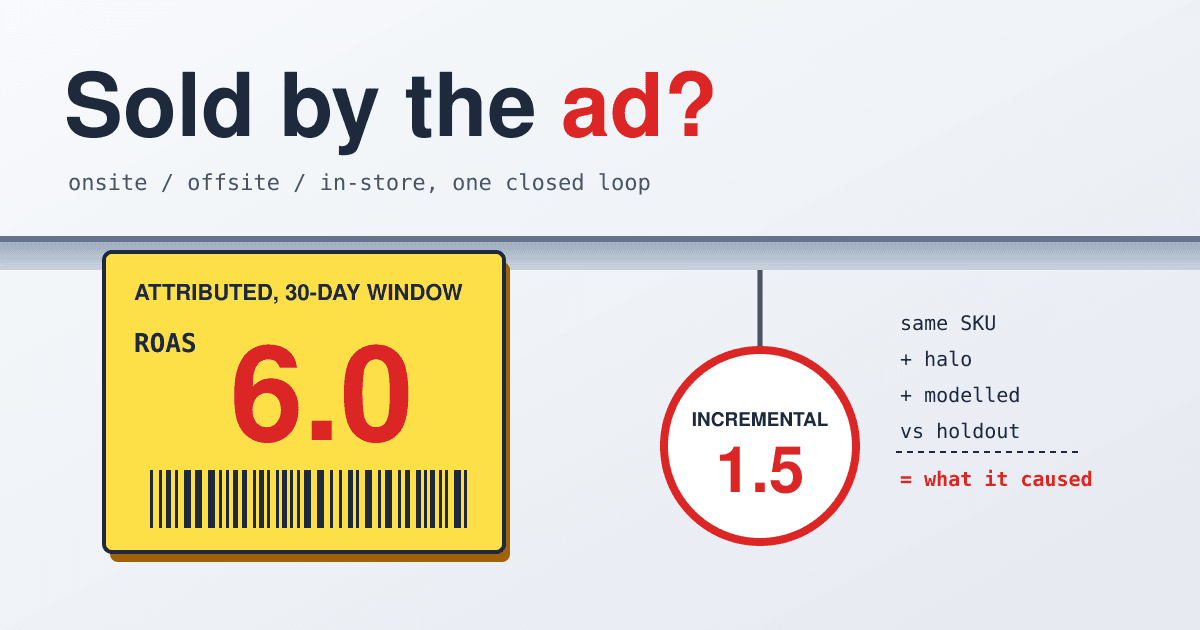
A closed-loop report tells you which sales followed an ad. It does not tell you which sales happened because of it. A loyal buyer who sees a sponsored listing for the cereal they buy every week counts as attributed, and would have bought it anyway. The European standard defines incremental ROAS (iROAS) as "sales lift divided by the total advertising spend", measured with an exposed versus non-exposed test, and the IAB/MRC text recommends randomised control trials "when feasible", with the control group picked by the same targeting and bidding logic as the exposed one.
The figures below are invented to show the arithmetic, not taken from any campaign.
Campaign, 30-day window, spend $10,000
Same SKU, after a click$18,000
Same SKU, after a view only$24,000
Halo, same brand and category$12,000
Extrapolated, unidentified shoppers$6,000
Attributed sales, ROAS 6.0$60,000
Lift over a randomised holdout$15,000
Incremental ROAS1.5
Same campaign, same money, two numbers four times apart. Neither is a lie; they answer different questions. Budget decisions, especially moving money out of another channel, should rest on the second one. Our incrementality testing guide covers how to set up the holdout.
Questions to ask before committing budget
Send these before the insertion order, and keep the answers with it. A network that answers in writing is one you can hold to its own report.
-
Which placements is this money buying: onsite, offsite or in-store, and in what split?
A bundle that mixes them hides which part did the work.
A good answer: A line per placement type, each with its own report.
-
Who counts the impressions, and against which standard?
Onsite, it is usually the retailer; offsite, often the partner platform.
A good answer: A named counter per placement and a link to its disclosure.
-
What attribution window applies, and can I set it?
The IAB/MRC text says the window must be disclosed before the campaign runs.
A good answer: The window in writing, plus day-level data so you can re-cut it.
-
Are click-based and view-based sales reported apart?
View-only credit is where most of the inflation risk sits.
A good answer: Two lines, as the European standard asks.
-
What counts as halo, and is it inside the headline ROAS?
Halo can be a large slice of the headline figure: a fifth of it in the worked example.
A good answer: Same SKU and halo as separate lines, with the halo rule written out.
-
What share of attributed sales is extrapolated, and how?
Modelled sales are not wrong, but they are not observed either.
A good answer: A percentage per report and a sentence on the method.
-
Can I run a holdout, and who pays for the unexposed group?
Without one, the report cannot separate caused sales from loyal ones.
A good answer: A randomised control, the same targeting logic for both groups, and the test length agreed up front.
-
Is invalid traffic filtered before sales are attributed?
The MRC requires SIVT filtration for outcomes.
A good answer: Yes, with unfiltered figures labelled apart if they appear at all.
-
What data can I take away for my own media mix model?
The guidelines encourage retailers to share it.
A good answer: Market, format, day or week, impressions, clicks, audience, device and cost, in a file.
-
How is shopper data used offsite, and under which privacy terms?
Offsite activation moves retailer data to other platforms.
A good answer: A data-flow description you can show your legal team; the IAB paper on commerce media and US state privacy laws lists the roles.
If you sell your own placements, these are the questions a careful buyer will ask you too, about your audience and your reporting. The answers belong in your media kit.
Quick answers
Is retail media only for brands sold in that retailer?
Mostly. Onsite sponsored products need a listed product, and closed-loop sales only see that retailer's tills. Some networks sell offsite audiences to non-endemic advertisers (a bank or an insurer, say), but then the sales loop has nothing of yours to close on.
Should onsite and offsite be judged on the same ROAS?
No. Onsite reaches people already shopping, so its attributed ROAS will look higher. Compare each against its own holdout, and the IAB/MRC guidelines recommend reporting the two apart for the same reason.
Does a 30-day window suit every product?
No. It is the European default, not a rule for your category. The IAB/MRC text asks for windows backed by evidence and fitted to the category's buying cycle; a weekly grocery item and a television are bought on very different clocks.
Can sales at other retailers count?
Some networks model them. The guidelines ask retailers to be open when they do, so ask whether any of the reported sales happened somewhere else and were estimated.
Sources
- IAB and MRC, Retail Media Measurement Guidelines, January 2024 (onsite and offsite reporting, windows, halo, extrapolation, incrementality)
- IAB Europe, Retail Media Measurement Standards, V1, April 2024 (30-day default window, same SKU and halo, new to brand, iROAS)
- IAB, 2026 Outlook Study (commerce media growth forecast)
- Koddi and Forrester, All Commerce Media Playbook, November 2025 and Ovative Group, Retail Media ROAS Demystified, May 2025, both read as public summaries on the IAB research hub
- IAB, Untangling the Issues in Commerce Media Networks, June 2025
All pages were read on 2026-11-12. The Forrester and Ovative figures come from their public summaries; the full reports sit behind a form. No price per impression is given here: none of the sources publishes one with a method.