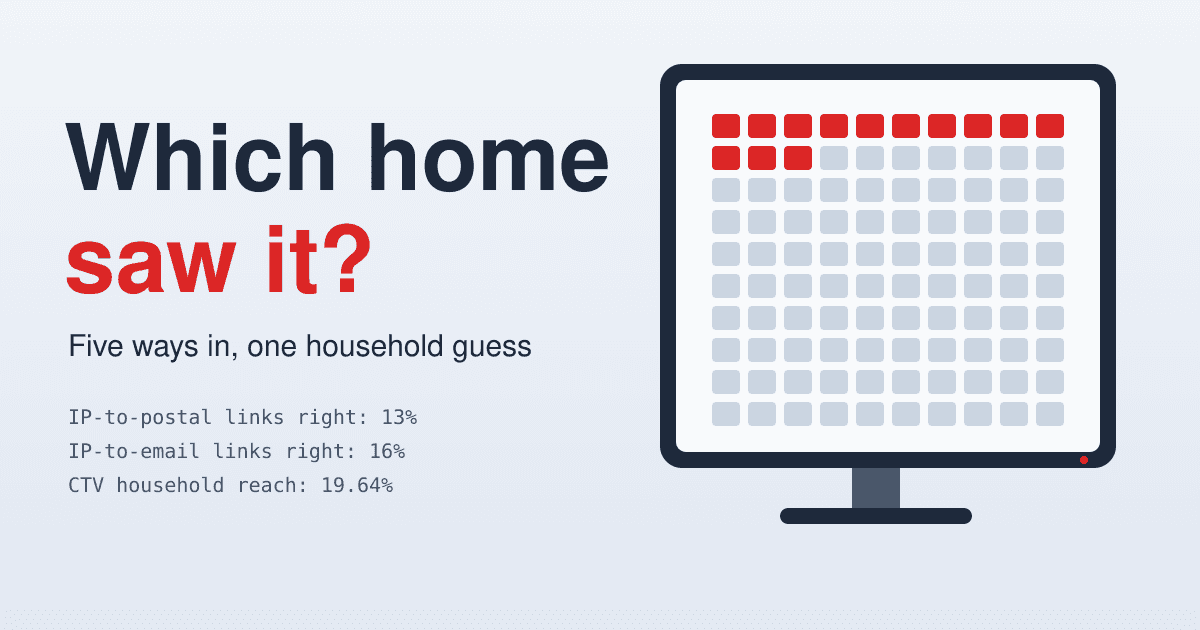
Which household did your streaming ad reach, and how would you know? Connected TV (CTV) is bought through bids and logged like web video: somebody bids, a server sends a video to a screen, and a log line says it played. What the log cannot say is who was sitting on the sofa.
On now: the short answer
There are five ways to buy a streaming ad, and the choice changes what you can check, not whether the household link is a guess. Measured against records from internet providers, commercial IP-to-postal links were right 13% of the time on average. Write the identifier, the app list and the reach figure into the order before the first impression runs.
- 13%IP-to-postal links that were accurate, on average (CIMM and Go Addressable study, 2025)
- 19.64%average household reach of a CTV campaign, at frequency 7.09 (Innovid, 2024 data)
- $10Krecommended minimum for one platform's self-serve streaming TV package (Amazon Ads)
Five doors into a streaming ad
CTV is the screen or the device: a smart TV, a streaming stick, a games console. Amazon Ads' own FAQ calls it that, and calls the video that arrives through it streaming TV or OTT. A quote that says "CTV" can mean any of the five doors below, so the first question is which one you are paying for.
-
01Platform self-serveone console
You buy inside a streamer's or retailer's own ads console. Amazon Ads says its streaming TV ads come in self-service and managed-service packages, with a $10K recommended campaign minimum for self-service and a $50K minimum for managed service, and that eligibility itself carries no minimum spend. That is one platform; the others were not checked for this post.
Ask: what the report shows besides impressions, and whether the household count comes from logged-in accounts or from a match.
-
02Open bidding in a DSPbiddable
You bid for CTV impressions through a demand-side platform. IAB's 2025 digital video report summary says nearly half of CTV inventory is expected to be biddable. Here a platform sits between you and each app, so the app list matters most.
Ask: the app-level delivery list, for every flight, before the invoice.
-
03A deal ID from a curated marketplacedeal
A seller packages inventory and gives you a deal ID to buy it by. The mechanics are the ones in the programmatic deal types guide, with a streaming app list instead of a news site list.
Ask: which apps are inside the deal today, and what happens when one leaves.
-
04FAST channelsfree, ad-supported
Free ad-supported streaming TV carries linear-style channels funded only by ads. Wikipedia lists aggregators owned by media groups (Pluto TV, Tubi), by device makers (The Roku Channel, Samsung TV Plus, LG Channels) and independents, and cites Variety for about 1,943 linear channels on major FAST platforms in May 2024, up from 1,455 in June 2022.
Ask: whether the channel list is fixed in the order, because the same channel can run a different number of ads on a different provider.
-
05Direct with a publisher or streamerdirect
You negotiate with the seller. IAB's 2025 summary says buyers expect more of streaming partners than they did of linear TV, and that failure to deliver outcomes is what limits deals with them. So a direct deal is where an outcome clause is most likely to be heard.
Ask: what the seller owes you if the audience delivered is lower than the audience booked.
How an ad finds a household, and how often the link is right
A TV set has no cookie. Much CTV targeting and measurement therefore works on the IP address of the home's connection, tied by a data provider to a postal address or an email. In 2025 the Coalition for Innovative Media Measurement (CIMM) and Go Addressable had Truthset test those ties: nearly one billion IP records from six data providers, checked against household assignments held by two internet providers and one cable and satellite distributor. Adweek published the findings.
-
13 of 100IP-to-postal links that were accurate, out of 100
-
16 of 100IP-to-email links that were accurate, out of 100
-
6.4 of 100IP-to-postal links two providers agreed on (6.4, drawn as 6), out of 100
Three more numbers from the same study, in its words. There are three times more IPs per postal address than internet providers report there should be. IPv6 addresses are under-represented by 72% in large datasets, and only 15% of commercial files capture them. And the large majority of links over the same 90-day period were unique to one provider.
Two readings of the result came out of the same release. Go Addressable, the trade group founded by AMC Networks, Comcast Advertising, DIRECTV Advertising, DISH Media and Spectrum Reach, said IP addresses cannot accurately identify and serve the household as the primary method, and pointed to deterministic identifiers. CIMM's managing director said IP addresses remain a foundational identifier for CTV and called it a fixable problem. An earlier CIMM and Truthset study put the match of hashed emails to household addresses as low as 32%.
What the study does not say. It tested commercial files that link an IP address to a home, not the delivery of any one campaign, and the public summary says nothing about a streamer's own logged-in households. So the question for a seller is which identifier the household count rests on, not whether CTV works.
What a campaign actually delivers: 7.09 and 19.64%
Innovid, an ad server, says that of the hundreds of billions of video impressions it served in 2024, 54% were on CTV, and that CTV impressions rose 18% in 2024, a rise it says trails the time people spend streaming. Its headline numbers for reach are the ones to hold against a media plan:
Average CTV household reach19.64%
0%every household in the target
The average CTV campaign had a frequency of 7.09 and reached 19.64% of households, in Innovid's words "only" that. The public summary does not give the base the percentage is taken against, and the full report sits behind a form, so read it as a pattern, not a benchmark for your plan. Frequency is the average number of times a reached household saw the ad; the reach and frequency post covers what to do with a high one.
The money is moving faster than the proof. IAB's summaries put US digital video ad spend at $64 billion in 2024 (up 18%), $72 billion projected for 2025 and above $80 billion in 2026, and its 2026 outlook has CTV growing 13.8% this year. The same IAB summary says CTV and social video were the top "must-buy" channels for advertisers in 2025.
No CPM range appears on this page: none of the sources read for it publishes one with a method, and a figure without a source would only look like data. The sourced numbers here are the ones above and the minimums in door 01. Ask each seller for a written rate card and compare cost per reached household, not cost per thousand views.
Three leaks buyers report, and where each is covered
DoubleVerify's 2025 streaming report says its monitoring of video ads on CTV rose 66% worldwide in 2024, and names three persistent challenges: a lack of app transparency, viewability issues and ad fraud. Each already has a page on this site.
-
App transparency
The buyer sees "CTV" and not the app. IAB Tech Lab's app-ads.txt, released in beta in 2018, applies the authorised-sellers idea to mobile apps and to over-the-top video apps, so a DSP can buy through approved seller accounts. The file mechanics are in the ads.txt and sellers.json guide.
Ask: for the app list with its app-ads.txt status, per flight.
-
Viewability
A video can play on a screen nobody is watching. The definitions and what to require are in the viewable impressions explainer.
Ask: which vendor measures it, and what share of the plan it can measure at all.
-
Ad fraud
Invalid traffic bills like real traffic until it is found and credited. What counts as general and sophisticated invalid traffic, and the credit clause to write, are in the invalid traffic post.
Ask: for a credit rate and a deadline in writing, before the flight.
Eight lines to put in the insertion order
These go into the order that the insertion order guide describes. Each one answers a point above, so strike the ones the seller cannot meet and note that it could not.
- Which door. Name the route (platform, DSP, deal ID, FAST or direct) and the seller of record.
- The identifier. State how households are matched (IP address, logged-in account, hashed email) and the vendor's own match rate for it.
- The app or channel list. A delivery report by app or channel, with every flight, not a total.
- Authorised sellers. Each app appears in its developer's app-ads.txt, with the seller account you are paying.
- Reach and frequency by household. Report both, and the share of households above your frequency cap, not only the average.
- Verification. A named third party measures viewability and invalid traffic, with a credit rate and a deadline.
- Creative. Name the VAST version and ask for the larger-screen creative the IAB Tech Lab CTV addendum describes, which now covers higher resolution for bigger screens.
- The outcome test. Hold out a group, as in the incrementality testing post, so the household count is not the only evidence.
New formats such as pause-screen ads, picture-in-picture, shoppable ads and brand bugs are still being standardised: IAB Tech Lab launched its Ad Format Hero initiative in October 2024 for that. Price them as one-offs until a spec exists.
Questions buyers ask
Are CTV and OTT the same thing?
Amazon Ads' FAQ separates them: CTV is the device that connects to a TV, OTT is the content delivered over the internet. Vendors often use them loosely, so ask what the quote covers: the screens, the apps, or both.
Can a small advertiser buy streaming TV?
On the one platform checked, yes: Amazon Ads says eligibility carries no minimum spend, with a $10K recommended campaign minimum for self-service and $50K for managed service. Other sellers set their own terms.
What are FAST channels?
Free ad-supported streaming TV, per the Wikipedia entry: channels with no paid subscription, funded exclusively by ads, mixing linear-style channels, on-demand programming and films.
Does a streaming ad need special creative?
It needs a spec that the seller accepts. IAB Tech Lab's VAST is the video ad serving template, and its 2024 CTV addendum updates it for higher-resolution creative on larger screens. Each seller's own spec page still decides what passes.
If IP matching is this weak, should I skip CTV?
The study does not say that, and both sides of its release said the problem can be fixed. It says to ask which identifier your seller uses and to test outcomes with a holdout, not to take the household count on trust.
Sources and what they are
- Adweek, CIMM and Go Addressable release landmark report on IP-to-household accuracy (trade press release, source of every match-rate figure; the report itself was not read)
- Innovid, The CTV Advertising Insights Report 2025 (ad-server vendor, public summary only: 54%, 18%, frequency 7.09 and household reach 19.64%)
- DoubleVerify, 2025 DV Global Insights: Trends in the Modern Streaming Landscape (verification vendor, public summary: the 66% and the three challenges)
- IAB, 2025 Digital Video Ad Spend and Strategy Full Report, IAB, 2026 Outlook Study and IAB research hub (trade body; read as summaries on the hub, the full reports need a free sign-in)
- Amazon Ads, Streaming TV ads (one platform's FAQ: minimums, eligibility and the CTV and OTT definitions)
- Wikipedia, Free ad-supported streaming television (secondary source, citing Variety for the channel counts)
- IAB Tech Lab, VAST, IAB Tech Lab, app-ads.txt release announcement and IAB Tech Lab, Ad Format Hero (standards body)
All pages were read on 2026-11-12. The match rates are averages across six data providers and say nothing about one vendor. The 19.64% has no published base. The price of a CTV impression is deliberately not given: none of the pages read published one with a method.