Size, source and lookback window: those three lines on a segment's label decide whether a media buyer reads on to the price. A first-party audience segment is a group of your own readers or visitors, picked by a rule you wrote from data you collected yourself, offered to advertisers as a target. This page is for the seller: what to cut your audience on, what never goes on sale, which consent each cut needs, how to describe it so a buyer can compare it, and how to price it without guessing.
The short answer
Cut on behaviour you observed or answers readers gave you, keep anything that reveals health, beliefs, origin or sex life out, and write a segment only for readers whose consent or opt-out status covers ad profiling. Describe each one with the fields of the IAB Tech Lab data label, and price it from your run-of-site rate times the lift a test shows, capped by the impressions its members can actually see.
- 1,558standard segment names in IAB Tech Lab Audience Taxonomy 1.1: 197 demographic, 497 interest, 864 purchase intent
- 5ways the data label lets you say how a reader got into a segment: observed, declared, inferred, derived, modeled
- 7 daysthe longest Safari keeps a cookie set by page script, under WebKit's tracking prevention
What to cut first-party audience segments on
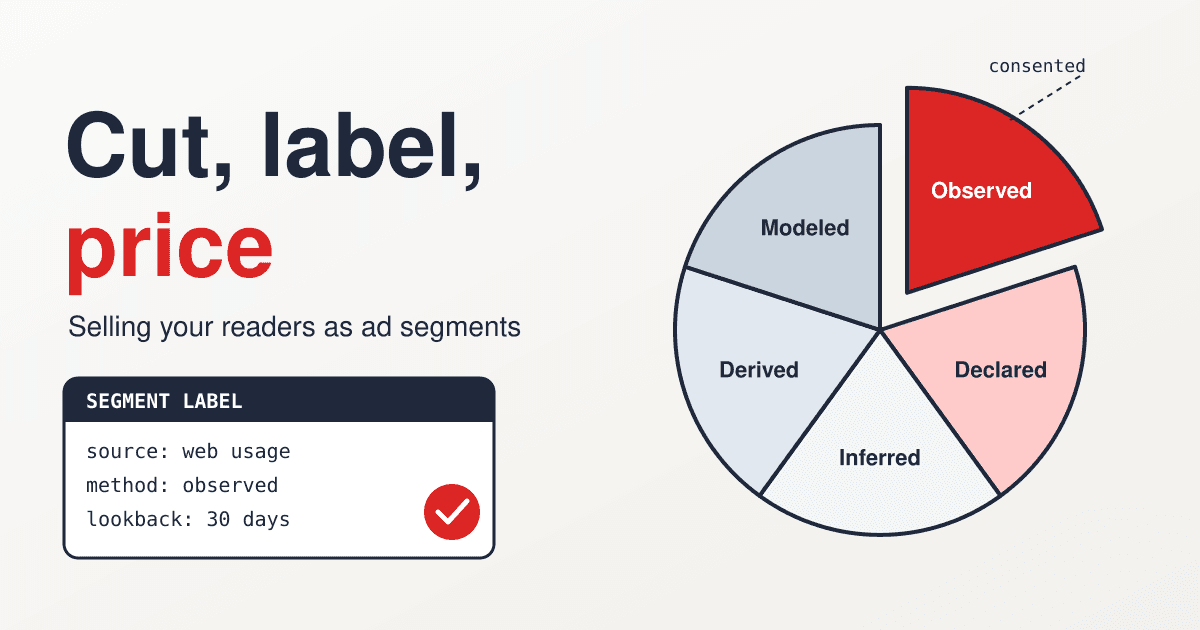
Start with what your site already knows for certain. The IAB Tech Lab Data Transparency Standard 1.1 asks every seller to name how a reader got into a segment, in one of five words, and those five words are a good map of the cuts available to a publisher. In the standard's terms: observed means the attribute was seen directly, declared means the reader told you, derived means it was computed from other known fields, inferred means a business rule decided it, and modeled means an algorithm extended it from a seed.
-
Section interestObserved
Rule: read 3 or more articles in the cooking section in the last 30 days.
Sells to: brands whose product sits next to that subject: cookware, grocery delivery, kitchen appliances.
-
Stated preferenceDeclared
Rule: ticked "weekly recipes" in newsletter settings, or chose a role at sign-up.
Sells to: buyers who trust a reader's own answer more than a click pattern; often B2B.
-
Shopping signalInferred
Rule: used the price comparison tool or opened 2 or more product reviews in a category in 14 days.
Sells to: performance buyers paying for intent, who will test it against a holdout.
-
Reader lifecycleDerived
Rule: paying subscriber for 12 months or more, computed from the billing record.
Sells to: brands that want loyal, logged-in readers and exclusive placements.
-
Extended reachModeled
Rule: browsers that resemble the section-interest seed, scored by a model.
Sells to: buyers who need scale; must be labelled as expansion, see the label below.
Two rules keep a cut sellable. Write the rule so a stranger could rebuild it (an action, a count and a window), because the label's "Segmentation Criteria" field asks for exactly that. And map it to the shared names in Audience Taxonomy 1.1: Tech Lab built the taxonomy because one vendor's "Auto-intenders" was another's "In-market for cars", and its three tier-one branches (demographic, interest, purchase intent) tell a buyer at a glance which kind of cut they are looking at. The taxonomy file has 1,558 named nodes; "Interest | Food & Drink | Cooking" is ID 371.
What never goes into a segment
Some cuts are not for sale whatever a buyer offers. Article 9 of the GDPR prohibits processing data revealing racial or ethnic origin, political opinions, religious or philosophical beliefs, trade union membership, genetic data, biometric data used to identify a person, data concerning health, and data about a person's sex life or sexual orientation, unless an exception applies such as explicit consent for specified purposes. California's CCPA, as amended calls a similar list "sensitive personal information", adds precise geolocation and account credentials, and gives residents the right to limit its use.
- Reading is revealing. "Readers of the diabetes section" is a health segment even though nobody filled in a health form. So are readers of a faith column or a support forum. Sell those pages by context instead: the ad sits next to the article, and no profile of the reader is kept.
- The standard already pruned it. Audience Taxonomy 1.1 deprecated segment names that could describe sensitive data types, and Content Taxonomy 2.1 added a "sensitive data" flag to topics that could generate such data, with OpenRTB guidance not to pass flagged topics. If the name you want for a segment has no live node in the taxonomy, take that as the warning.
- Edge nodes need a second look. The taxonomy still lists "Food Allergies" under Food & Drink. An allergy is health data in most readings; keep a node like that contextual unless your lawyer says otherwise.
The consent each segment rests on
A segment is a profile of a reader used to pick ads, and privacy law treats it that way. What follows is how the frameworks describe the steps, not legal advice; the right basis for your site depends on where your readers live and on your counsel.
EU and UK readers
Under the IAB Europe Transparency and Consent Framework policies, building the segment is Purpose 3, "Create profiles for personalised advertising", and serving an ad to its members is Purpose 4, "Use profiles to select personalised advertising". The policies say a cookie identifier "cannot be used to create a personalised ads profile without having obtained consent for Purpose 3". GDPR Article 7 adds that you must be able to demonstrate consent, and that withdrawing it must be as easy as giving it.
Do: write a reader into a segment only when their consent string carries Purpose 3, and drop them at the next refresh after they withdraw.
California readers
The California Attorney General explains that "sharing" under the CCPA means sharing for cross-context behavioral advertising: targeting a person based on personal information from their activity across numerous websites. Residents may opt out of sale or sharing, including through a user-enabled global privacy control (GPC), and a business cannot sell or share their data after receiving it.
Do: keep GPC and opt-out readers out of any segment that is sold or used off your site, and ask counsel where your on-site-only segments fall.
Check what your ad stack does by default. Prebid.js documentation notes that supplying first-party user data "may require special consent in certain regions", that its tcfControl module does not police user data by default, and that it can if the personalizedAds rule is enabled. Prebid also fills regs.ext.gpc from the browser's Global Privacy Control setting, so the opt-out signal reaches the bid request; your segment builder has to read the same signal.
How to describe a segment: the label a buyer reads
The Data Transparency Standard is, in effect, a nutrition label for audience data, and Tech Lab runs a compliance programme for it. You do not need the audit to use its fields: they are the questions a careful buyer asks anyway. Here are the ones that matter most, filled in for one sample segment.
| Field | What to write | Why the buyer reads it |
|---|---|---|
| Provider's Audience Name | Weekly home cooks | the name on the order and the invoice |
| Standardized Audience ID(s) | 371 (Interest | Food & Drink | Cooking) | compares your segment like for like with other sellers |
| Segmentation Criteria | 3+ cooking articles read in 30 days, logged in or consented browser | lets the buyer rebuild your rule in their head |
| Audience Precision Level | Browser | tells them a count is browsers, not people |
| Audience Scope | Single domain / App | shows the data never left your site |
| Audience Size | 38,000 (estimate) | counted in the unit named in Precision Level |
| Data Source(s) | Web Usage | where the raw data came from |
| Data Inclusion Methodology | Observed/Known | the strongest of the five words; modeled is the weakest |
| Audience Expansion | No | a "Yes" here means look-alike IDs were added |
| Cross-device Expansion | No | a "Yes" means IDs thought to share a person or home were added |
| Audience Refresh Cadence | Daily | how quickly withdrawn consent and lapsed readers leave |
| Source Lookback Window | Monthly | how old a qualifying visit can be |
| Privacy Compliance Mechanisms Used | TCF (Europe), GPC | which consent and opt-out signals you honour |
Check the age of a cookie before you promise a lookback. WebKit says that since Intelligent Tracking Prevention 2.1, persistent cookies created through document.cookie are capped to a seven-day expiry. A Safari reader who skips a week comes back with a new ID, so a 30-day window built on a script-set cookie holds up to 7 days of history for that reader, and the size may count one person twice. Logged-in IDs and cookies your server sets are not covered by that cap; say on the label which one the segment uses.
To pass the segment in a bid request, OpenRTB carries it in user.data, and the segtax extension names the taxonomy the IDs come from: 4 is Audience Taxonomy 1.1, and values from 500 up are registered vendor taxonomies, for sellers who keep their own names.
"user": {
  "data": [{
    "name": "example.com",
    "ext": { "segtax": 4 },
    "segment": [{ "id": "371" }]
  }]
}How to price a segment without guessing a market rate
No public source read for this page publishes a reliable price range for publisher segments, so this section gives a method, not a number. Every figure in the example below is made up to show the arithmetic.
- Count the ceiling first. A segment can only be shown ads when its members visit. Pull from your ad server the impressions those browsers saw last month: 38,000 browsers seeing 14 ad impressions each is 532,000 impressions. That is the most you can sell in a month, across every buyer together.
- Set the break-even price from a test. Run the same creative on run-of-site and on the segment, or on the segment against a held-out slice of it (the holdout test guide covers the set-up). If the segment converts 1.5 times as often, a buyer paying the same cost per result can pay 1.5 times your run-of-site CPM: a $6 rate becomes $9.
- Pick how it is sold. As a package CPM inside a private marketplace or guaranteed deal (the mechanics are in the deal types guide), as a data fee added to the media price, or as a flat fee for one buyer to hold the segment for a month. A flat fee only makes sense if it stays under the ceiling times your package CPM: here, 532 thousands times $9 is $4,788.
- Do not oversell the ceiling. Two buyers each booking 400,000 segment impressions in the same month need 800,000 from a pool of 532,000. Book against the ceiling, not against interest.
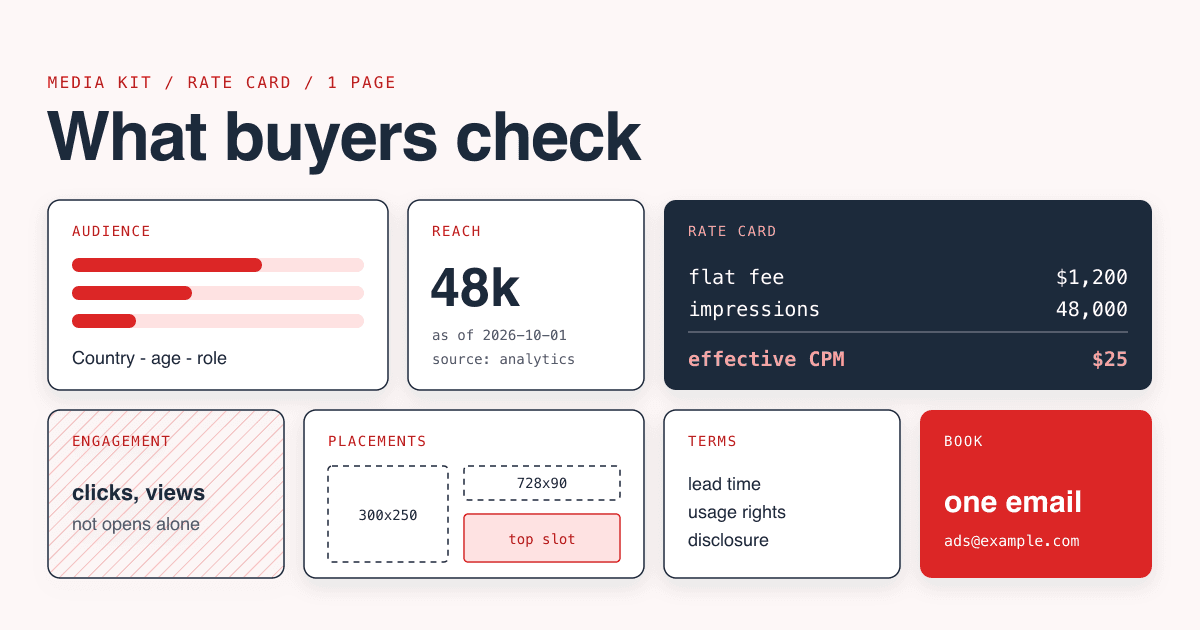
- Publish it on the rate card. Put the segment, its size, its price basis and the date of the count on the rate card, the way the media kit guide lays out every other line.
The test is what turns a segment from a label into a price. A buyer who sees the lift and the ceiling can do the sum themselves, and a sum they can check is easier to sign than a premium they have to take on trust.
Questions publishers ask
How big does a segment have to be?
There is no single rule in the sources above: ad servers and platforms set their own minimums, so check yours. Size alone is the wrong test anyway. A segment is big enough when its ceiling of monthly impressions covers the bookings you plan to take.
Can I sell my newsletter list as a segment?
Only with a basis that covers that use. Matching emails to ad IDs is "onboarding" in the data label's terms, and the standard then asks for an extra section naming the match key and whether the list was expanded before matching.
Should I use look-alike modeling to make a segment bigger?
You can, but label it: the standard requires "Audience Expansion: Yes" when modeled data is included, and buyers price modeled members below observed ones. Sell the observed core and the extension as two separate lines.
Is a segment different from contextual targeting?
Yes. Contextual targeting places an ad next to a page about a subject and keeps nothing about the reader. A segment follows the reader across your pages, which is why it needs the consent above and why sensitive subjects stay contextual.
Sources
- IAB Tech Lab, Data Transparency Standard Disclosure Schema 1.1 (PDF): field names, allowed values and the five inclusion methods.
- IAB Tech Lab, Audience Taxonomy and the Audience Taxonomy 1.1 file: node counts by tier and ID 371.
- IAB Tech Lab, consumer privacy safeguards in the Content and Audience Taxonomies: sensitive data flag and deprecated segment names.
- OpenRTB community extension: segtax: taxonomy IDs for segments in bid requests.
- Prebid.js, First Party Data: user data, consent and the GPC field.
- IAB Europe, TCF Policies: Purposes 3 and 4.
- GDPR Article 7 and Article 9: conditions for consent and special categories.
- California Attorney General, CCPA: sale, sharing, GPC and sensitive personal information.
- WebKit, Intelligent Tracking Prevention 2.1: the seven-day cap on script-set cookies.
All sources read on 2026-11-12; the dollar figures in the pricing section are an example, not market data.