We use analytics cookies to see how the site is used. They are only set if you accept. Accepting also turns on session recording (pages viewed, clicks and scrolls) so we can fix problems; what you type stays hidden. Read the privacy policy
Contextual Targeting Without Third-Party Cookies: Keyword, Category and Semantic Matching for a Niche Audience
Three ways to place an ad by what the page says instead of who the reader is: keyword lists, IAB categories and semantic models. What each one catches and misses, tested on four pages, and a set-up order for a small, specific audience.
By MediaProNet Editorial TeamPublished Reviewed
3SEM1K2CATEGORYNYTWIO4SCORED
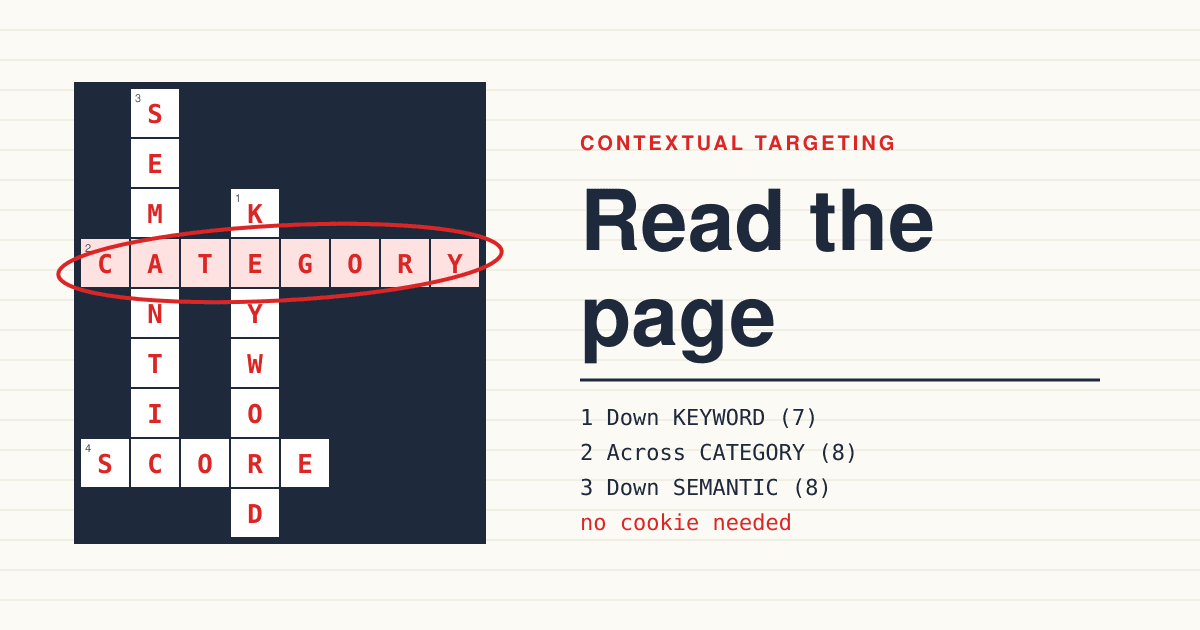
1 Down Keyword. 2 Across Category. 3 Down Semantic. 4 Across Score.
A stadium seating guide, a stargazing forum and a hunting scope review all contain the word "binoculars", and a birding shop that buys that word as a keyword gets its ad on all three. That one word shows the whole problem with contextual targeting: the ad goes where the page matches, so everything depends on how the match is made. There are three ways to make it, keyword, category and semantic, and a niche audience needs a different mix of them than a broad one.
Contextual targeting places an ad by what the page is about, not by who is reading it. It needs no cross-site profile of the reader, which is why it keeps working where third-party cookies do not. Safari has blocked cookies for cross-site resources by default since Safari 13.1 in 2020. Firefox's Total Cookie Protection keeps each cookie confined to the site that set it, by default. Chrome went the other way: in April 2025 Google said it would keep its current third-party cookie choice and not roll out a new standalone prompt, and in October 2025 it retired most Privacy Sandbox ad APIs, Topics and Protected Audience included. So cookies still follow some readers in Chrome and none in Safari, and a plan that has to reach both reads the page.
1 DownMatches the words printed on the page(7)
KEYWORD
Keyword matching: cheap, fast and literal
You give the platform a list of words and phrases; it shows the ad on pages that contain them, or that it judges to be about them. In Google Ads, content keywords make an ad eligible on a Display Network page when the keyword "matches a webpage's concepts or its central theme", and the system reads the page's text, language, link structure and page structure to decide. In open programmatic buying, a publisher can also pass its own keywords in the bid request: the AdCOM site and content objects carry a kwarray field for them.
Keywords win when your audience has its own vocabulary. A term that only your readers use, a species name, a part number, a technique, rarely shows up on the wrong page. They lose on three things:
Words with two lives. "Binoculars", "scope", "hide" and "migration" all belong to birding and to something else.
Words in the wrong place. A term in a sidebar, a comment or a "related posts" box can match a page that is about something else.
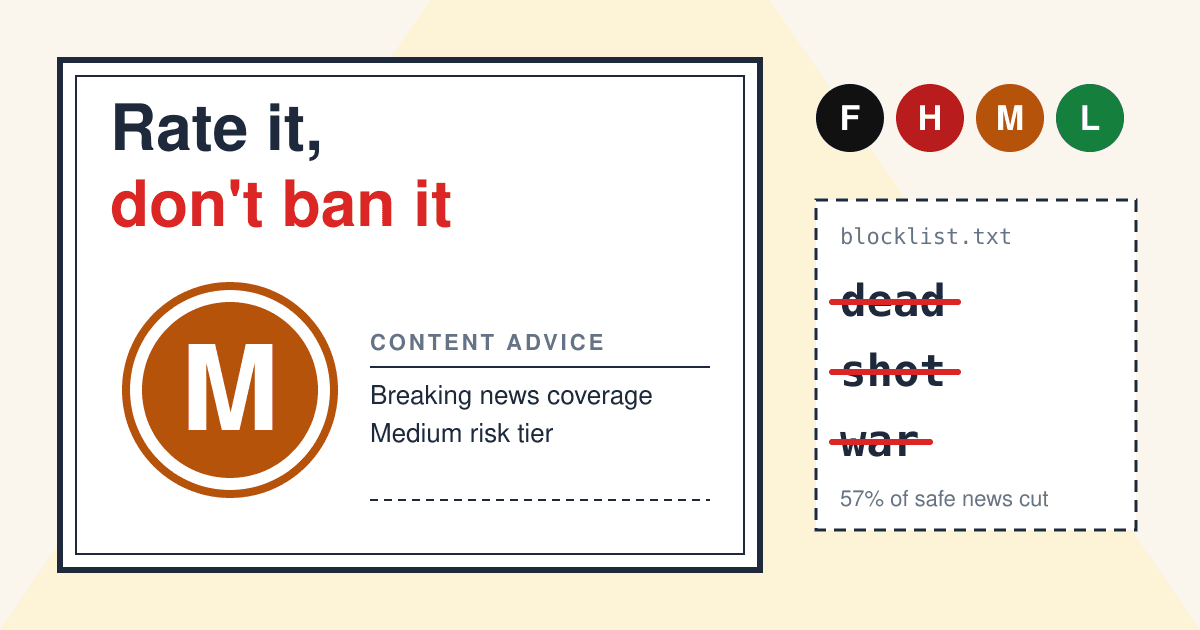
Tone. A list cannot tell a guide from a news story about a disaster. Pair it with a negative list, and see the brand safety post for why a long blocklist can cut good pages too.
2 AcrossA shelf in a shared library of topics(8)
CATEGORY
Category matching: one shared map, coarse at the edges
Here the page gets labels from a fixed list, and you buy the labels. The common list in programmatic is the IAB Tech Lab Content Taxonomy. Version 3.1, from December 2024, has 704 categories: 37 at the top, and the rest nested up to four tiers deep (our count of the published 3.1 file). A bid request says which list its labels come from: in AdCOM, cattax value 9 means Content Taxonomy 3.1, and the older 1.0 and 2.0 lists are marked deprecated.
Categories travel well: the same ID means the same thing at every exchange that reads 3.1, so a deal or a line item can carry them without a vendor in between. Google offers its own version as topics, which reach pages about a subject "regardless of whether your exact keywords appear on the page", in the words of its help page.
The catch for a niche is depth. Birdwatching is ID 259, one level under Hobbies & Interests, and the list stops there. Every page about birds you might sell to, from a feeder guide to a rare-sighting alert, wears the same label, and so does a page about a birding holiday you have nothing to sell to. A category is a good floor and a poor fence.
3 DownReads what the page means, not what it says(8)
SEMANTIC
Semantic matching: meaning, at the price of a black box
A semantic system reads the page as a whole: which things it names, how they relate, what the page is mainly about and whether its tone is positive, neutral or grim. It can tell that "scope" on one page is a spotting scope next to a warbler and on another is a rifle sight. It can rank a page by how close it is to the pages you say are on target, instead of answering yes or no.
There is no shared standard for it. Each vendor trains its own model, and the segment you buy, "spring migration readers" for example, is the vendor's own definition. That leaves three things to ask before paying a fee on top of media:
Can you see the list of URLs it matched, not only a total? Without it you cannot check a single decision.
Does it score the page that loads, or a cached copy, and how old can the copy be? News pages change after the first crawl.
Can you give it your own example pages, on target and off, and see how its picks change?
4 AcrossWhat every match comes down to, page by page(5)
SCORE
Four test pages, read three ways
The quickest way to choose is to run your own audience through all three methods. Below is that test for a shop selling birding binoculars, with four made-up page headlines. The marks show how each method treats each page when set up the way the sections above describe: a keyword list built on "binoculars", the Birdwatching category, and a semantic model fed ten birding pages as examples. They illustrate the mechanics; your own test will produce your own marks.
Spring warbler migration: where to look in May
On target, and the word "binoculars" never appears.
Keyword
Missed
Category
Hit
Semantic
Hit
Stadium seats with the best view, and what to bring
Mentions binoculars once. Not a birding page.
Keyword
Wrong page
Category
Missed
Semantic
Missed
Riflescope vs spotting scope: a hunter's buying guide
Shares the optics vocabulary with birding.
Keyword
Wrong page
Category
Missed
Semantic
Missed
Heron colony abandoned after the river spill
About birds, but a story no brand wants to sit beside.
Keyword
Missed
Category
Wrong page
Semantic
Missed
Read across the rows and the pattern is the usual one. Keywords pick up the wrong pages that share your words and miss the right ones that use other words. The category reaches the right subject but cannot see tone, so the grim news story gets the ad. A semantic model handles all four in this sketch, which is exactly the claim to test with real URLs before trusting it.
Solve itA set-up order for a small, specific audience(6 steps)
Setting it up for a niche audience
Write the list in your readers' words
Pull 30 to 50 terms from the places your audience talks: forum threads, review comments, the search terms that already bring them to you. Product words come last; readers name the bird, not the glass. Drop every term that has a second life you can name.
Set the category as the floor
Find the deepest node in the taxonomy that holds your niche, and look at its parent: if the node stops at tier 2, as Birdwatching does, the category alone will be broad. Use it to keep keyword matches inside the right subject, not as the whole targeting.
Write the exclusions before the inclusions
A negative keyword list for the second lives you found, and excluded categories for the topics your brand avoids. Keep it short and specific, for the reason the suitability tiers post gives.
Give the semantic model examples, not adjectives
If you add a semantic vendor, send ten URLs that are exactly right and ten that look close but are wrong. That pair teaches more than a description of the audience, and it doubles as your test set.
Start with the sites you already know
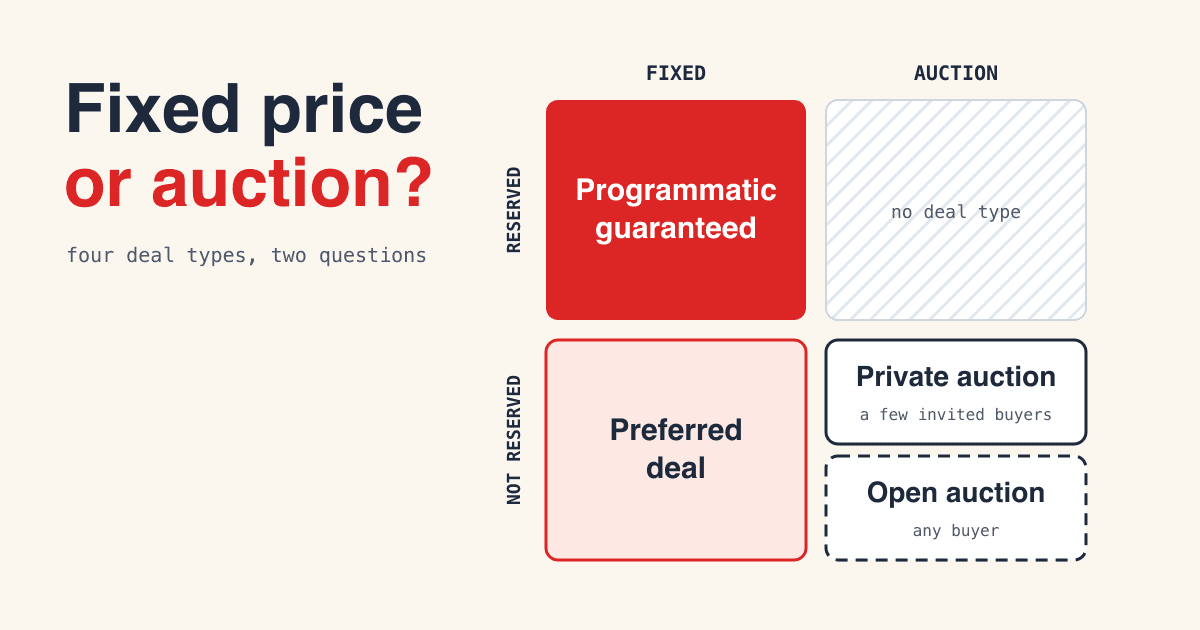
For a niche, a short list of specialist publishers often reaches more of the audience than any match on the open web. Buy those directly or through a deal (the deal types post covers which), and let contextual add the long tail around them.
Read the URL report every week
Sort the pages that served by spend, open the top twenty, and move each wrong one into the exclusions. To learn whether contextual adds sales and does not just take credit for them, hold out part of the budget the way the incrementality post describes.
HintsQuestions buyers and publishers ask(4)
Frequently asked questions
Is contextual targeting the same as Google's Topics?
No. Topics was a Chrome browser API that guessed a reader's interests from their own browsing, and Google retired it in October 2025 along with most of the Privacy Sandbox ad APIs. Contextual targeting reads the page in front of the reader and needs nothing from their history.
Does contextual targeting work in Safari and Firefox?
Yes. The match is made on the page, so it does not depend on a third-party cookie. Frequency caps and conversion tracking on the same campaign may still rely on one, and they are the parts that weaken in browsers that block them.
Which method should a small budget start with?
Keywords plus one category floor and a list of known sites. It costs no extra vendor fee, every decision shows up in the URL report, and it tells you within a few weeks whether a semantic vendor's fee would pay for itself.
How does a publisher make its pages easy to buy this way?
Label pages with Content Taxonomy 3.1 categories and send them in the bid request with cattax set to 9, add page keywords in kwarray, and say in your media kit which sections map to which categories.
AnswersWhere every fact on this page comes from(7)