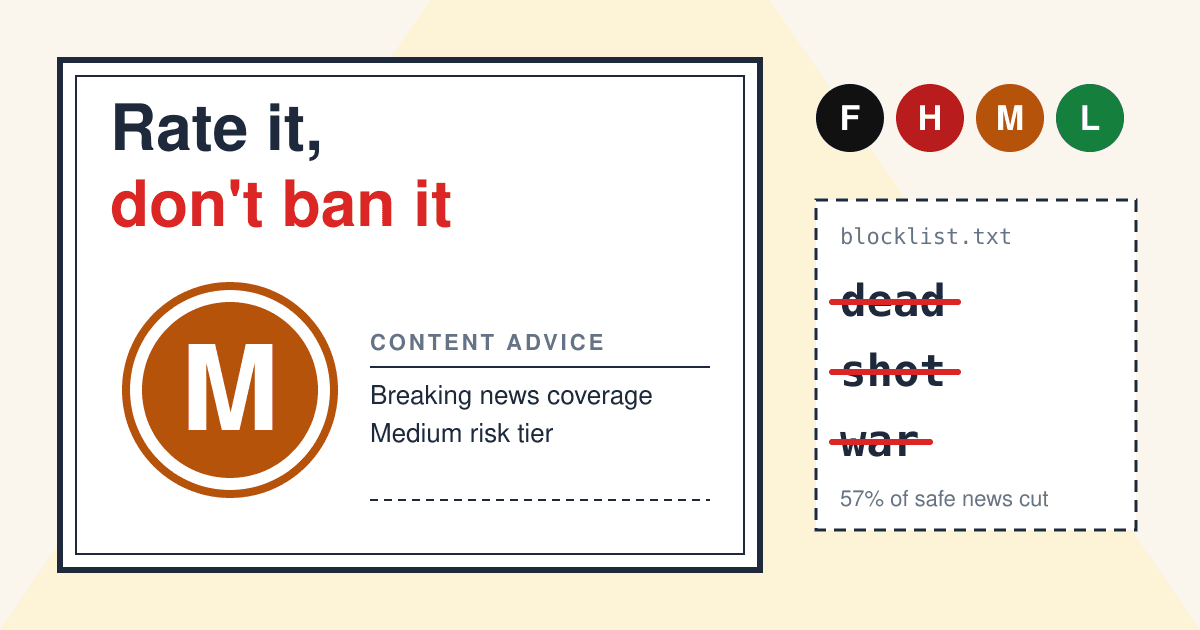
Dead, injury, lesbian, gun and shots were the five words that most often kept ads off perfectly ordinary news stories when a verification company ran a 2,000-word keyword blocklist over 225 neutral or positive articles from 15 news sites in July 2019 (CHEQ, 2019).
Short answer: brand safety is two settings, not one list. A floor of content no ad should fund, which you switch on everywhere, and a suitability tier per content category, which you pick for each brand. Keyword blocklists sit outside both: they read words, not meaning, and in that test they blocked 57% of safe stories. Keep the list short, buy news through tiers and inclusion lists, and read the block report every month.
The rating scale: one floor, three tiers
Register 01Floor and tiers. Defines the four levels every verification tool and platform setting maps to.
The shared vocabulary comes from the Brand Safety Floor + Suitability Framework, first published by the 4A's Advertiser Protection Bureau in 2018 and kept by the Brand Safety Institute. GARM, the advertiser alliance the World Federation of Advertisers ran until it discontinued it on 9 August 2024, built its own framework on the same scale; in July 2026 the WFA said it would not restart GARM or anything like it. The categories outlived the alliance: the framework was written for platforms, agencies and verification vendors to map their settings to, and it is activated through the IAB Tech Lab content taxonomy, so the words below are the ones you are likely to meet in a buying tool.
Floor
Content not appropriate for any advertising: child abuse material, incitement to violence, sale of illegal arms, promotion of illegal drugs, malware, promotion of terrorism. No setting turns this on. If a vendor or a seller lets you buy it, change the vendor or the seller.
High risk
Glamorized or gratuitous depictions: depictions of death or injury, glamorized illegal weapons or drug use, negative or partisan treatment of debated social issues. Most brands stay out; some entertainment and gaming advertisers opt in.
Medium risk
Dramatic depictions in entertainment, and breaking news or op-ed coverage of the same subjects. War films, crime dramas, a live report on a shooting. This is the tier that decides whether you advertise on news.
Low risk
Educational, informative or scientific treatment, and news features on the subject: a history piece about a war, a health article about addiction, an explainer on piracy.
The scale is set per category, and there are twelve. A bank can accept medium-risk crime news and still refuse medium-risk alcohol content; a spirits brand might take the alcohol coverage and refuse the crime. One global "strict" switch throws that choice away.
| Category | Floor | High | Medium | Low |
|---|---|---|---|---|
| Adult and explicit sexual content | Explicit sexual acts | Suggestive situations, full nudity | Sexuality in entertainment, artistic nudity | Sex education |
| Arms and ammunition | How to make or buy illegal arms | Glamorized illegal arms | News coverage of arms | Educational treatment |
| Crime and harmful acts | Graphic promotion of crime, harassment | Depictions of crime | Crime drama, crime news | Educational, news features |
| Death, injury or military conflict | Incitement, graphic harm, war-crime footage | Depiction of death or injury | War films, breaking news | Educational, news features |
| Online piracy | Piracy, counterfeiting | Glamorized piracy | Piracy in drama or news | Educational treatment |
| Hate speech and acts of aggression | Content that incites hatred | Hateful depiction outside education | Drama or news about hate | Educational treatment |
| Obscenity and profanity | Excessive profanity meant to shock | Glamorized obscenity | Genre profanity, news | Educational treatment |
| Drugs, tobacco, vaping, alcohol | Promoting illegal drugs, tobacco, vaping or alcohol | Glamorized drug use, urging minors to drink or vape | Use in drama or news | Educational, news features |
| Spam or harmful content | Malware, phishing | Glamorized spam | Spam in drama or news | Educational treatment |
| Terrorism | Promotion of terrorist acts | Disturbing depiction | Terror in drama or news | Educational, news features |
| Debated sensitive social issues | Harmful treatment that demeans a group | Partisan, negative framing | Op-ed and breaking news | Educational treatment |
| Misinformation | False content tied to real harm | Glamorized misinformation | News about misinformation | Features exposing campaigns |
One example of what each level holds per category, wording shortened from the Brand Safety Floor + Suitability Framework. The table scrolls sideways on a phone.
What a keyword blocklist actually cuts
Register 02Keyword cuts. Contains words lifted out of context, including dead, shoot and war.
A keyword blocklist is older and blunter than the scale. The tool scans a page, or its URL, for any word on your list and refuses the impression when it finds one. It cannot tell a war chest from a war, or a basketball shot from a gunshot. Publishers told CHEQ these lists had grown to as many as 3,000 words (CHEQ with the University of Baltimore, 2019).
In the 2019 test, the lines below were enough to take an ad off the page. Each comes from a story with nothing unsafe in it; the counts are how many of the 225 safe articles that one word blocked.
-
Cut on
dead14 blocks"In late April, the festival's financial backer pulled out, declaring the event
dead."Woodstock anniversary coverage, a national daily
-
Cut on
shoot7 blocks"I used to
shootthem in high school. I was open, so I took it."A basketball summer-league profile
-
Cut on
war7 blocks"The company now has a
warchest of about 10.6 billion euros."A telecom merger story, a business daily
-
Cut on
toxic"Staff have changed the process to weed out
toxicleaves that grow among the wild garlic."An employee-ownership feature, a business daily
-
Cut on
crime"A version of the film with the original number of solo songs would have been a
crime."A pop-music item, a lifestyle magazine
Examples and counts from CHEQ, Brand safety's technological challenge, September 2019, pages 6 and 12. Publications named in the report are described here, not named.
The same researchers put a price on it: US news publishers lost an estimated $2.8 billion a year to wrongly flagged pages, close to one in every four dollars of their potential programmatic revenue, and $3.2 billion across the US, UK, Japan and Australia together (CHEQ with the University of Baltimore, 2019). The figure is an estimate from a study the vendor commissioned, and it is seven years old; read it as the size of the problem, not as today's bill. The mechanism has not changed: a word list still reads words.
Does an ad next to hard news hurt the brand?
Register 03Adjacency evidence. Contains findings about advertising next to crime, war and political news.
The reason buyers block news is the fear that a reader blames the brand for the story beside it. Three findings are worth weighing before you keep that block on.
Finding 1
No real gap
Stagwell showed 50,000 US adults real articles about crime, inflation, the Middle East conflict and the presidential candidates, each with one of ten real ads, against a control of entertainment and sports stories. Purchase intent and favorability did not move in any way its chief executive called significant: "If there really was a brand-safety thing, you'd see 20- or 30-point differences, not 2- or 3-point differences" (Business Insider, May 2024; Stagwell, The Future of News).
Finding 2
11% of readers
The same study estimated that 11% of people read only the kind of news buyers call unsafe. Block those topics and that slice of the audience never sees the ad at all (Business Insider, May 2024).
Finding 3
400,000 to 5,000
In 2017 JPMorgan Chase cut the sites showing its programmatic ads from about 400,000 to 5,000 pre-approved ones and saw little change in cost per impression or in the visibility of its ads (New York Times, March 2017; Marketing Dive). An inclusion list did the safety work that thousands of blocked words were meant to do.
Two caveats. The Stagwell study was run with news publishers who had a stake in the answer, and it did find small partisan gaps on stories about the candidates, 1 to 10 points among Republicans who read stories about Biden. And a big bank's five thousand sites are not your five thousand sites. Neither changes the direction: what hurts a brand is the floor, not the news.
Set it up: the order that keeps reach
Register 04Setup. Contains instructions for a media buyer, in the order to apply them.
Switch on the floor everywhere
In every platform, DSP and verification tool, the floor is a single setting. Turn it on for every line item, and write it into each insertion order so a direct buy carries the same rule (the clauses are in our insertion order guide).
Write a one-page suitability brief per brand
Twelve rows, one per category, each with the tier the brand accepts: high, medium or low. Most brands land on medium for news-heavy categories and low for the rest. Get it signed off by whoever answers the complaint when a screenshot goes round.
Cut the keyword list to words about you
Keep the terms that are a risk to this brand in particular: your product name next to "recall" or "lawsuit", a crisis you are living through, a competitor's scandal. Delete the generic violence and sex words; the category tiers already handle those, and they read context.
Buy news and creators through inclusion lists
For the sites and channels you trust, an inclusion list or a private marketplace deal beats a filter. You pick the sellers, so a filter has nothing left to guess (see programmatic deal types).
Read the block report every month
Ask your vendor for blocked impressions by reason. If one word or one category blocks a large share of a site you otherwise like, open ten of the blocked pages. If they are fine, the setting is wrong, not the site.
For publishers and creators: get rated, not blocked
Register 05Publisher appeals. Suitable for publishers, newsletter writers and creators selling their own inventory.
When ads stop filling a page, the cause is often a buyer's word list, not your content. Most of it can be fixed without rewriting the journalism.
Slip A: ask what was set
A direct buyer can tell you which tool and which tier they run. If it is a long keyword list, show them the framework table above and ask them to move to category tiers for your domain, or to put you on their inclusion list.
Slip B: watch the words in the frame
Many filters read the URL, the title and the metadata before the body. A headline that says "killer deal" or a slug with "shot" in it can block a recipe or a sports page. Fix the wording you control around the story, never the facts inside it.
Slip C: sell sponsorships with the tier written in
A sponsored placement or newsletter slot sold directly can state its suitability tier in the order, so the brand knows what it buys and no filter stands between you. The same goes for a creator partnership: list the subjects the sponsored content will not touch.
Questions buyers ask
Is brand safety the same as brand suitability?
No. Safety is the floor: content no brand should fund. Suitability is the choice above the floor, per brand and per category, between high, medium and low risk.
Did the framework stop when GARM shut down?
No. The World Federation of Advertisers discontinued GARM on 9 August 2024 and said in July 2026 it will not restart it, but the floor and tiers are still published by the Brand Safety Institute and used in buying tools.
How long should a keyword blocklist be?
Short enough that you can read it in one sitting and name why each word is on it. If a word is there because it sounds violent, the category tiers already cover it.
Will turning off news blocking raise my CPM?
Not necessarily: more pages qualify, so you bid on more supply instead of crowding into the same safe pages as every other strict buyer. Chase saw little change in cost per impression even after cutting to 5,000 sites.
Sources
- Brand Safety Institute: Brand Safety Floor + Suitability Framework
- CHEQ: Brand safety's technological challenge, how keyword blacklists are killing reach and monetization (September 2019)
- CHEQ with the Merrick School of Business, University of Baltimore: The economic cost of keyword blacklists for online publishers (2019)
- Business Insider: Brands aren't hurt by advertising on hard news (May 2024) and Stagwell: The Future of News, ad adjacency study
- New York Times: Chase had ads on 400,000 sites, then on just 5,000 (March 2017) and Marketing Dive summary
- World Federation of Advertisers: WFA and X settle over GARM litigation (29 July 2026)
- IAB Tech Lab: Content taxonomy