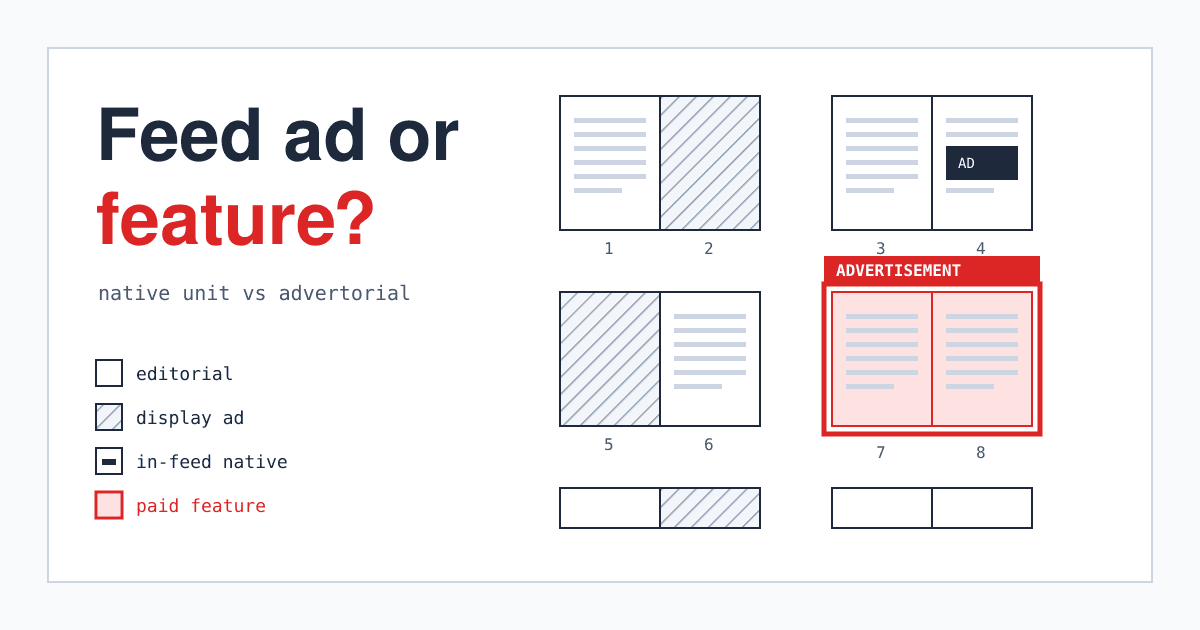
Two things on one news page can carry the same brand's money: a small tile in the list of stories, built from a headline, a picture and a link and dressed in the site's own template, and the full article that tile opens, and only the second is an advertorial. Both get filed under "native", both carry a paid label, and buyers mix them up on media plans all the time. They are bought differently, built by different people, measured on different numbers and suited to different jobs, so the first decision on any brief is which of the two you are actually ordering.
On one page
- Native ad (in-feed, in-content or a recommendation widget): you supply parts, such as a headline, an image, a logo and a link, and the site renders them in its own style. Bought by impression or click, often programmatically. Good for reach and traffic at a price per unit.
- Advertorial (branded, sponsored or custom content): a full article or video, written by you or by the publisher's studio, published on the publisher's own pages. Bought as a project with a fixed fee. Good for explaining, persuading and borrowing a title's voice.
- The two often run together: a native unit in the feed sends readers to the advertorial. The IAB counts both as native advertising and says all of them must carry a disclosure (IAB Native Advertising Playbook 2.0).
The three paid formats that borrow a publisher's look
The IAB's playbook names three formats that cover most of what is sold as native: in-feed or in-content ads, content recommendation ads, and branded or native content. Two of them, in its words, are "the paid ads used to promote/distribute the content"; the third "is the paid content itself" (IAB, Native Advertising Playbook 2.0, May 2019, p. 12). That third one is what most buyers and editors call an advertorial.
-
In-feed and in-content native ads
A unit in a list of stories, or between paragraphs and below an article
- What you supply
- Parts, not a finished ad: headline, image or video, logo, call to action, click-through link
- Who designs it
- The publisher. Its template sets the font, colors and layout around your parts
- Where the click goes
- Usually off the site, to your landing page; sometimes to an advertorial on the same site
- How it is bought
- CPM or CPC, direct or programmatic, priced like other ad inventory
-
Content recommendation ads
The "around the web" or "you may also like" boxes under and beside articles
- What you supply
- A headline, a thumbnail and a link to an article, video, product page or landing page
- Who designs it
- The widget network, in a grid styled to sit with the host site
- Where the click goes
- Off the site, to your page
- How it is bought
- Mostly CPC through the widget network, across many sites at once
-
Advertorials (branded or sponsored content)
A whole article, video or package in the publisher's editorial format
- What you supply
- A brief, facts, approvals, and often the money for production
- Who designs it
- The publisher's content studio, an agency, or you, in the publisher's article layout
- Where the click goes
- The reader is already on it: it lives on the publisher's own pages
- How it is bought
- A fixed fee per piece or package, usually with promotion included
The IAB lists other names for the same things: content recommendation ads are also called content discovery ads or recommendation widgets, and branded content is also called sponsored or custom content (IAB playbook, p. 14). When a rate card says "sponsored content", ask which of the two it means before you compare prices.
Native ad vs advertorial: what is different in practice
Google's ad server describes the core of a native ad well: it is "element-based", styled by the publisher instead of the advertiser. The advertiser sends separate pieces, and the publisher's native style turns them into an ad that fits each page. A banner, by contrast, arrives finished at a fixed size and is shown exactly as the advertiser made it (Google Ad Manager Help, Native ads elements). An advertorial goes one step further: the content itself is the paid unit, published in the same format as the site's editorial (IAB playbook, p. 14).
| Question | Native ad unit | Advertorial |
|---|---|---|
| What you hand over | Assets: headline, image, logo, link | A brief, or a finished article to the publisher's style guide |
| Size of the message | A headline and a line of text | Hundreds of words, images, sometimes video or a quiz |
| Lead time | As fast as any ad: assets in, campaign live | Weeks: brief, draft, approval rounds, production |
| Pricing model | Per impression or per click | Fixed fee per piece or package |
| Can you swap it mid-flight? | Yes, rotate headlines and images like any creative | Edits mean a new approval round with the publisher |
| What success looks like | Click-through rate, cost per click, conversions on your page | Time on page, scroll depth, video views, then brand or lead measures |
| Who carries the voice | You, inside the publisher's frame | The publisher's tone, which is a large part of what you pay for |
The last row is the real trade. Publisher studios sell advertorials on their newsroom's credibility: in interviews for a Columbia University Tow Center report, a former member of a major newspaper's brand studio said the team tried to make native ads that sound like the paper itself, and studios measured engagement as time on page, video views or scroll depth (Tow Center for Digital Journalism, Guide to Native Advertising, 2019). You are renting a voice, not only a slot.
Where each format runs
Not every kind of site sells both. A feed or an app with a stream of posts sells in-feed units; only a site with an editorial team, or at least an article format, can publish an advertorial. This is where to look for each.
| Kind of site or app | Native ad units | Advertorials |
|---|---|---|
| News and magazine sites | Yes In-feed units on section fronts, in-content units in articles | Yes Through the brand studio or the ad sales team, labelled as paid |
| Social and video feeds | Yes Promoted posts sit in the feed in the same format as organic posts | Partly The equivalent is a paid creator post, a separate deal with its own label rules |
| Apps with feeds or lists | Yes Native units built from the same parts, styled by the app | Rare Few apps publish long paid articles |
| Recommendation widgets | Yes Paid tiles under and beside articles on many sites | No But they are often used to send traffic to an advertorial |
| Niche blogs and directories | Partly Through ad networks, or a featured slot in a list | Yes A sponsored post or review, usually written by the site owner |
| Email newsletters | Yes A sponsored item set in the newsletter's own style | Partly A whole dedicated issue for one sponsor |
| Print magazines and newspapers | No No feed to sit in | Yes The original home of the format, as a paid page or supplement |
The pairing matters for planning. In the IAB playbook's own examples, an in-feed unit labelled "Advertisement" leads readers to a branded content page on the same site, while another in-feed unit labelled as paid content sends readers off the site to the advertiser's landing page (IAB playbook, pp. 17-18). The first is an advertorial with its own distribution; the second is a plain traffic buy. If a publisher sells you an advertorial, ask how many native units, newsletter slots or social posts promote it, and for how long: an article with no distribution gets the traffic of a page nobody links to.
Which one fits your campaign
Start from the job, not the format. A native unit is a small, cheap and replaceable message that earns a click; an advertorial is a larger, slower piece that does its work once the reader has arrived. Mark each goal on your brief against the grid below.
-
Send traffic to your own landing page at a known cost
In-feed nativeFitsPriced per click or impression, easy to test and scale
AdvertorialWeakReaders stay on the publisher's page; clicks out are a by-product
-
Explain a product that needs more than a headline
In-feed nativeWeakOne line of text cannot carry a comparison or a demo
AdvertorialFitsRoom for steps, examples, charts and quotes
-
Borrow the trust of a title your buyers already read
In-feed nativePartlyThe frame looks like the site, but the words are clearly yours
AdvertorialFitsWritten in the title's voice, often by its studio
-
Test many messages quickly
In-feed nativeFitsRotate headlines and images, keep the winners
AdvertorialWeakOne approved piece; changes cost a new review round
-
Collect leads or sign-ups
In-feed nativeFitsPoint the unit at your own form and count conversions
AdvertorialPartlyWorks if the article carries a clear next step, but you depend on the publisher's tracking
-
Reach a narrow trade audience
In-feed nativePartlyDepends on the targeting the network offers
AdvertorialFitsA trade title already gathers that audience in one place
-
Run on a small budget
In-feed nativeFitsMinimums are low and spend stops when you stop it
AdvertorialPartlyA fixed fee is paid up front, whatever the result
When the brief has both needs, run both: commission one advertorial and buy native units that drive readers to it, then retarget the readers who stayed. Price the units the way you price any traffic buy; our guide to converting CPM, CPC and CPA shows how to put two offers on the same scale.
The labels each format has to carry
Both formats look like the content around them on purpose, so the label is what keeps them honest, and it is the first thing a regulator checks. The IAB says every one of its three formats, the paid content included, must tell readers it is paid, in words that are "large and visible enough for a consumer to notice it" on the page and device in front of them (IAB playbook, pp. 12 and 20).
-
Ad · Advertisement · Sponsored
On every native unit, as a badge on the unit itself
Google Ad Manager requires one of these three words, localized, on a badge at least 15px high and wide (Ad Manager Help).
-
Advertisement · Paid Advertisement · Sponsored Advertising Content
On the advertorial, in front of or above the headline
The US FTC lists these as terms readers are likely to understand, and says where to put them (FTC native advertising guide).
-
rel="sponsored"
On every link inside a paid article that points to the advertiser
Google asks for paid links to be marked sponsored; nofollow is still accepted (Google Search Central).
Labels are often missed. The Tow Center report cites a 2015 study by a content marketing firm in which most people shown clearly labelled native ads still identified them as articles: 80% on one business newspaper's site and 65% on another publisher's. It also cites a 2017 review by an ad intelligence company of more than 12,000 pieces of native content, which found that 40% did not follow the FTC's rules (Tow Center, Guide to Native Advertising). Both studies are years old and came from companies in the trade, but they explain why buyers should check the label on the live page, not in the proposal. For the wording that works in the US, UK and EU, see our guide to disclosure labels.
What to agree before you pay for either
- The format, by its parts. For a native unit: headline length, image ratio, logo, call to action. For an advertorial: word count, number of images, any video, and whether it appears in print, on the site, or both.
- Who writes and who approves. Name the number of revision rounds and the deadline for each. The Tow Center interviews found clients hold strong bargaining power with publisher studios, so ask for what you need in writing.
- The exact label and where it sits. Get the wording and a screenshot of the label in place before launch, on mobile as well as desktop.
- Distribution for the advertorial. Which native units, newsletter slots and social posts promote it, for how many impressions or days.
- How long it stays live. An advertorial can sit in the archive for years; agree whether it stays, gets removed, or gets an end date on its links.
- The report. For units: impressions, clicks and viewability. For advertorials: page views, time on page, scroll depth and clicks out. Ask how each is counted.
If you sell this space rather than buy it, put both formats on your media kit and rate card as separate lines, with what each includes, so buyers do not have to guess which one "sponsored content" means.
Native ads and advertorials: common questions
Is an advertorial a type of native ad?
In the IAB's framework, yes: branded content is one of its three native formats, and the playbook says the content itself should be treated as a native ad type that needs a disclosure. In everyday buying, "native" usually means the small units and "advertorial" the full article, which is why it pays to say which one you mean.
Are promoted social posts native ads?
They work the same way: a paid post in the feed, in the same format as organic posts, with a label from the platform. A creator's paid post is closer to an advertorial, written in someone else's voice, and it falls under the creator disclosure rules covered in our labels guide.
Can I write the advertorial myself?
Often, especially on smaller sites and trade blogs. Larger publishers usually insist their studio writes or edits it, to keep their style, and charge for that work. Either way the publisher decides the label.
Does an advertorial help search rankings?
Do not buy one for links. Google asks for paid links to be marked rel="sponsored" or nofollow, which tells it not to pass ranking credit through them. Buy the article for its readers.
Sources
- IAB, Native Advertising Playbook 2.0, May 2019 (the three formats, their other names, disclosure for all three, examples of in-feed units leading on and off site)
- Google Ad Manager Help, Native ads elements (element-based ads styled by the publisher, attribution words and the 15px badge, comparison with banners)
- Tow Center for Digital Journalism, Guide to Native Advertising, 2019 (studio interviews, engagement measures, client bargaining power, the 2015 recognition study and the 2017 compliance review it cites)
- US Federal Trade Commission, Native Advertising: A Guide for Businesses (label terms and placement)
- Google Search Central, Qualify your outbound links (rel="sponsored" for paid links)
Pages read on 2026-11-12. The recognition and compliance figures are second-hand, quoted from the Tow Center report; the original studies were not re-checked for this post.