The cheapest of the three is rarely the one quoting the lowest fee, because an agency, a staff buyer and a freelancer each bill you in a different currency, and only one of those currencies is cash. A media buyer is the person who places your ads: plans where the money goes, books or bids for the space, watches the numbers and moves spend while the campaign runs. You can rent that work from a media agency, employ someone to do it in-house, or hire a freelance media buyer by the hour or month. This page treats the choice as a small tender: one job, three bids, opened side by side.
The short answer
On a small spend, hire a freelancer or a small agency, and keep every ad account, pixel and report in your own name so you can change buyer in a week. A staff buyer starts to pay off only when the work fills most of a full-time week and the salary is a modest share of the spend; below that, you pay for hours nobody needs. An agency earns its fee when you need several channels, reserved buys or creative under one roof, not when you need one person to run one platform.
- $78,760median yearly wage in May 2025 for the BLS group that includes marketing specialists, the closest federal match for a staff media buyer
- 30%share of US private-industry pay that went on benefits in June 2026, on top of wages
- 59 of 117media-buying sources in the ANA's K2 study who reported direct experience of non-transparent practices such as rebates
Three bids for the same job
Write the job down before anyone prices it, the way a builder writes a scope before inviting quotes: which channels, roughly how much spend a month, how many campaigns at once, who makes the creative, and what a good month looks like. Then read each bid against that page. They price different things, and the gaps are where the surprises live.
-
Bid AMedia agency
Priced as: a percentage of the spend it manages, a monthly retainer, a fee per project, or a mix; ask for it in writing per channel.
Covers: a team rather than one person, planning across channels, access to reserved and negotiated buys, reporting, often creative and analytics under the same contract.
Leaves out: whatever the contract does not name. Ask who owns the accounts, whether any media discounts or rebates come back to you, the notice period, and whether a junior runs your account day to day.
-
Bid BStaff buyer (in-house)
Priced as: a salary plus benefits, payroll taxes, tools, training and a manager's time; paid whether the month is busy or quiet.
Covers: full attention on your brand, knowledge that builds up inside the business, same-day changes, direct access to your sales and stock data.
Leaves out: cover for holidays and sick days, a second opinion, and the buying power an agency pools across clients. One person also cannot be expert in every channel.
-
Bid CFreelance buyer
Priced as: an hourly or day rate, a fixed monthly fee, or a fee plus a small share of spend; often a minimum monthly commitment.
Covers: a specialist in one or two platforms, quick to start, easy to scale up or down, no payroll costs on your side.
Leaves out: continuity if they take a bigger client, a backup when they are away, and anything outside the platforms they know. Their other clients compete for the same hours.
Cost, control and speed, compared line by line
A bid tabulation puts every quote on one sheet, one row per thing you care about, so the cheapest price stops hiding the weakest promise. Here is the sheet for the three ways to buy media. The cells describe the usual shape of each deal; your own quotes will vary, so fill in the real figures next to them.
| Line | A. Agency | B. Staff buyer | C. Freelancer |
|---|---|---|---|
| What you pay for | Managed spend or agreed scope | Time, whether used or not | Hours or a set monthly scope |
| Cost moves with spend? | Yes, if the fee is a share of spend | No, fixed | Partly; more hours as spend grows |
| Who holds the ad accounts | Often the agency, unless the contract says you | You | You, if you create them first |
| Sees your sales data | Only what you share | Yes, from the inside | Only what you share |
| Time to start | Weeks: pitch, contract, onboarding | Months: hiring and notice periods | Days to a few weeks |
| Time to change a live campaign | Through an account manager | Same day | Same day, if they have hours free |
| Cover when someone is away | Built in, a team | None unless you hire two | None unless agreed |
| Channel range | Wide | As wide as one person | Narrow, deep |
| Main hidden risk | Fees or rebates you cannot see | Paying for idle hours | Losing the one person who knows the setup |
Two rows settle most small-advertiser choices. "Cost moves with spend" decides what is cheapest at your size: a fixed salary is heavy on a small spend and light on a large one, while a percentage fee does the opposite. "Who holds the ad accounts" decides how hard it is to leave, and it is the one line you can fix in your favour on any of the three bids.
What a staff buyer really costs, and where an agency or freelancer breaks even
Salary is the visible part of an in-house buyer. The US Bureau of Labor Statistics has no separate occupation for media buyers; the closest group, market research analysts and marketing specialists (13-1161), had a median annual wage of $78,760 in May 2025. A senior hire who also manages the function sits nearer advertising and promotions managers (11-2011), median $133,660. On top of wages, BLS employer cost data show that in June 2026 US private employers paid $46.89 an hour in total compensation, of which $32.82 (70.0%) was wages and $14.07 (30.0%) benefits.
- Load the salary. If wages are 70% of the full cost, the full cost is the wage divided by 0.70. A $78,760 wage becomes about $112,500 a year, or about $9,380 a month, before software seats, training, a laptop and the time of whoever manages the buyer. That benefit share is the all-industry average, not a figure for this job; use your own payroll numbers if you have them.
- Turn it into an hourly figure. Spread over 2,080 paid hours (40 hours times 52 weeks), the loaded cost is about $54 an hour. That is the price of a staff hour whether it is spent buying media or waiting for the next campaign.
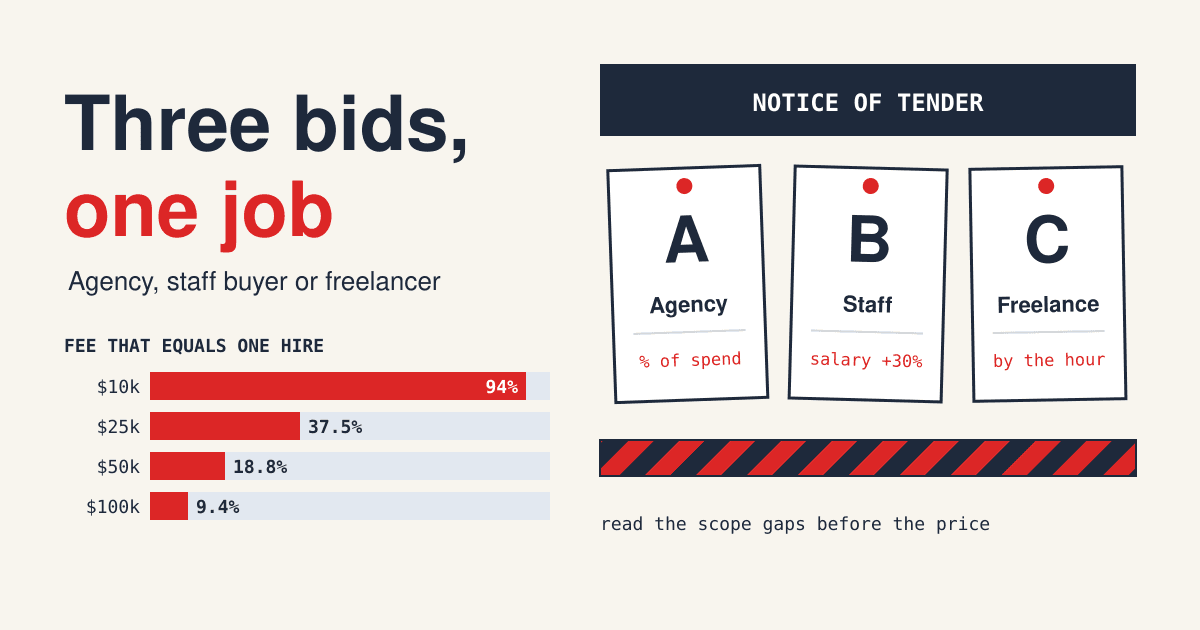
- Find the agency fee that costs the same. Divide the monthly staff cost by your monthly ad spend. On $10,000 a month of spend, an agency would have to charge 94% of spend to cost as much as one staff buyer; on $25,000, 37.5%; on $50,000, 18.8%; on $100,000, 9.4%. Compare those break-even rates with the fee in the quotes you actually get.
- Find the freelance hours that cost the same. Divide the monthly staff cost by the freelancer's quoted hourly rate. At an example rate of $75 an hour (an illustration, not a market figure), a freelancer could bill 125 hours a month before costing what a staff buyer does. Most single-platform accounts on a small spend need a fraction of that; ask the freelancer to estimate hours per month in writing.
- Price the speed you need. If a sale, a stock-out or a news event means someone has to change bids within the hour, that response time is part of the job. Write it into the freelance or agency agreement with a named backup, or accept that only a staff buyer gives it by default.
Read the chart this way: the longer the bar, the more room an agency or freelancer has to be cheaper than a hire. On a small spend the bar is long, which is why a full-time buyer is rarely the cheap option for a small advertiser.
Control: the clauses that keep the keys with you
Whoever you hire, control comes from paperwork and account settings, not from the type of buyer. These are the gaps to close before the first euro or dollar is spent.
- Create the ad accounts yourself. In Google Ads, a client account can have only one owner, and a manager account that creates a new account automatically becomes its owner. If a manager links an account you already have, it does not get ownership unless you turn it on, and you can remove its access by unlinking. So open the account under your business, then invite the buyer or link their manager account.
- Keep two admins of your own. Google's access levels reserve inviting users, changing access and unlinking manager accounts for Admin users, and Google warns that an account with only one administrator may lose access to its tags if that person becomes unavailable. Give the buyer Standard access unless they truly need Admin.
- Ask where every discount goes. The ANA's media transparency study, run by K2 Intelligence from October 2015 to May 2016, interviewed 150 sources; of the 117 directly involved in US media buying, 59 reported direct experience of non-transparent practices, including rebates (34 sources) and principal transactions (33), in holding companies and in some independent agencies. Write into the agency contract that rebates and volume discounts are disclosed and passed back, and that you may audit invoices against what the media owner was paid.
- Own the data and the setup. Pixels, conversion tags, audience lists, naming rules and reports should sit in accounts you own, so the next buyer starts from your history instead of from zero. Put a hand-over list in the agreement: what is returned, in what format, within how many days.
- Set the notice period and the hand-over. An agency contract often runs for months with a notice period; a freelancer may leave at short notice. Agree the same thing both ways, and pair it with the insertion order terms you already use with media owners (the IO terms guide lists them).
- Treat a freelancer as a contractor, not a part-time employee. The IRS weighs three kinds of evidence when deciding whether someone is an employee or an independent contractor: behavioral control (whether you control what the worker does and how), financial control (how they are paid, who supplies tools, whether expenses are reimbursed) and the type of relationship (written contracts, benefits, whether the work continues and is key to the business). If you set the freelancer's hours and methods like a staff member's, ask an accountant how that changes the arrangement; outside the US, check your own country's rules.
Which bid to award on a small spend
Work down the list and stop at the first line that is true for you.
- Award C, a freelancer, if you advertise on one or two platforms, the spend would not keep a full-time person busy, and you can write down what a good month looks like. Ask for a named backup and a written hours estimate.
- Award A, an agency, if you need several channels at once, reserved or negotiated buys such as TV, audio or direct deals with publishers (the deal types guide explains them), or creative and media from one team, and you have the time to read its invoices.
- Award B, a staff buyer, if the work fills most of a week every week, decisions depend on stock, prices or sales data that change daily, and the loaded salary is a modest share of the spend at the break-even rates above.
- Split the job if two of the lines are true: a staff buyer who owns the accounts and the reporting, with a freelancer or agency hired for one channel they cannot cover. It is a common shape once a small advertiser grows.
Whichever you pick, judge the buyer on results you can check yourself, not on the platform's own report alone; a holdout test is the cleanest way to see what the ads added.
Questions small advertisers ask
Is a percentage-of-spend fee a bad deal?
Not by itself. It ties the fee to the work on a growing account, but it also pays the buyer more when you spend more, whatever the results. If you take it, add a cap, a review date, or a part of the fee tied to an outcome you measure.
Can I start with a freelancer and move to an agency or a hire later?
Yes, and it is easier if the accounts were yours from day one. Ask the freelancer to document the account structure, naming and conversion setup as they go, so the next buyer can read it.
How do I check a buyer before hiring?
Give each candidate the same written scope and ask for a short plan: where they would put the first month's money, what they would measure, and what would make them stop a channel. Ask for read-only access to an account they run, with the owner's permission, rather than for screenshots.
Do platforms require an agency to buy ads?
Self-serve platforms such as search and social ads let any business open an account and buy directly. Some reserved buys and direct publisher deals are easier through an agency or a trading desk, which is one of the reasons to award bid A.
Sources
- US BLS, Occupational Employment and Wage Statistics: 13-1161 Market Research Analysts and Marketing Specialists, May 2025 median annual wage.
- US BLS, OEWS: 11-2011 Advertising and Promotions Managers, May 2025 median annual wage.
- US BLS, Employer Costs for Employee Compensation, private industry, June 2026: total compensation, wages and benefits per hour.
- ANA, Media Transparency Initiative overview and K2 Intelligence report: study dates, source counts, rebates and principal transactions.
- Google Ads Help, About ownership of client accounts: one owner per account, ownership on creation and on linking.
- Google Ads Help, About access levels: what Admin, Standard and other levels can do.
- IRS, Independent contractor (self-employed) or employee?: behavioral control, financial control and type of relationship.
All sources read on 2026-11-12. The break-even rates are arithmetic on the BLS figures above; the $75 hourly rate is an example, not a market rate.