A new channel cannot prove itself on money that buys fewer results than its own algorithm needs to learn, so the size of the test comes before the choice of channel. This page works through one plan end to end: where the 70/20/10 split comes from, what each share is for, how to size the 10% so it can actually return an answer, how long to leave it running, and the three lines that decide what happens next.
All the dollar figures below are one worked example on a $20,000 monthly budget, so you can redo the arithmetic with your own numbers. The platform rules are quoted from Meta and Google help pages, linked where they appear.
Where the ratio comes from
Where 70/20/10 comes from, and what it was never meant to be
The split was not born in media buying. In a 2012 Harvard Business Review article, Bansi Nagji and Geoff Tuff reported that outperforming firms in the industrial, technology and consumer goods companies they studied put about 70% of their innovation resources into core offerings, 20% into adjacent efforts and 10% into transformational ones. The same article notes that returns tended to run the other way round, with about 70% of them coming from the transformational share, and that the ideal balance differs from company to company.
Marketers borrowed the shape because the logic carries over: most money goes where results are known, a slice goes to things that have shown promise, and a small slice buys the chance to find the next proven channel. Read it as a starting point you adjust, not a rule a platform enforces.
The three shares
What each share of the budget is for
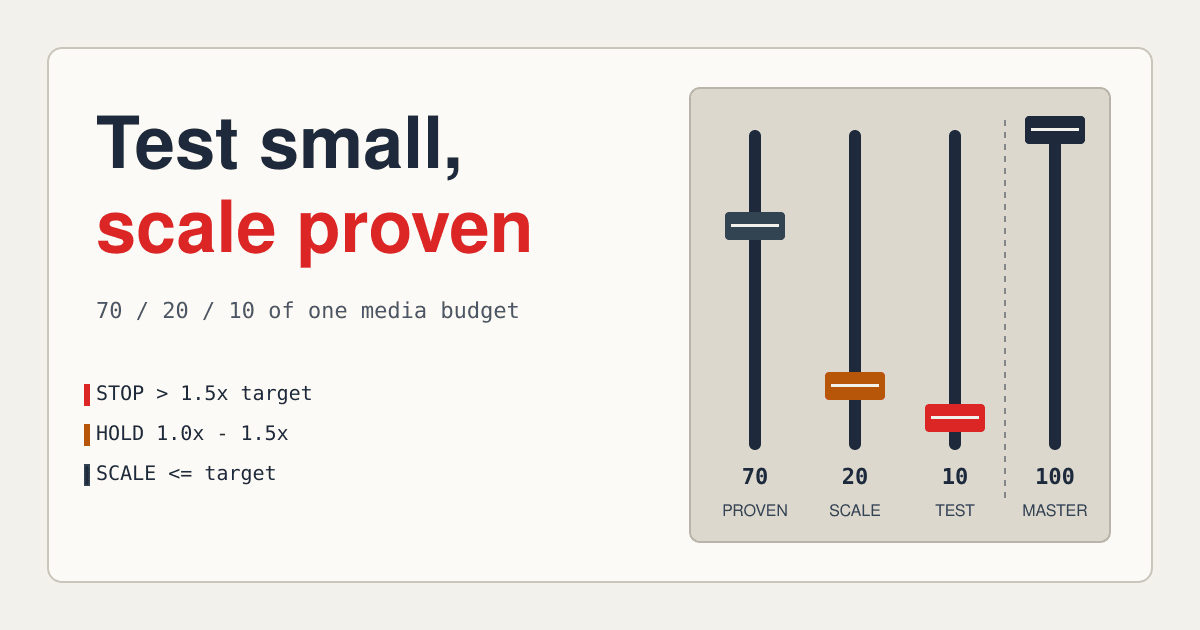
The split works only if each share has a job and a way out. On a $20,000 month it looks like this:
Money moves between the shares in one direction at a time. A test that clears its scale line moves up into the 20. A channel that holds its cost per result at the larger budget for a full month moves into the 70. A proven channel whose cost per result drifts above the stop line for a month drops back to the 20 and has to earn its place again. Without that traffic the 70 slowly fills with habits.
Sizing the test
How much a new channel needs to return an answer
The test share has to buy enough results for the platform to settle and for you to read the number. Two platform rules set the floor:
| Platform | What its help page says | Results to plan for |
|---|---|---|
| Meta ads | An ad set leaves the learning phase usually after about 50 results in the week after its last significant edit. | About 50 per week |
| Google Ads Smart Bidding | Google recommends judging performance over periods with at least 30 conversions, such as a month or longer (50 for Target ROAS). | 30 to 50 per read |
Now put prices on it. A new channel has no cost per result yet, so plan with a guess on the expensive side; this example assumes $40 per conversion.
Meta, optimizing for purchases
50 results a week at $40 is $2,000 a week, roughly $8,700 a month. The $2,000 test share buys about a quarter of one learning week. That test cannot answer anything.
Meta, optimizing for an earlier event
If an add-to-cart costs about $8, 50 of them a week is $400, about $1,730 a month, which fits inside the test share. You learn whether the channel finds intent at a sane price, then check purchases over the whole run.
Google Smart Bidding, judged over a month
30 conversions at $40 is $1,200, which the $2,000 share covers within the month with room for a slower start.
When none of it fits
Run tests one at a time instead of two half-funded ones, or lend the test share part of the 20 for a single month. Two tests that each buy half an answer cost the same as one that buys a whole one.
How long to run it
How long to leave the test running
Google gives two numbers for its own experiments: let one run for 2 to 3 weeks to gather data, and if no winner shows by then, allow at least 4 to 6 weeks. A sound test plan here uses both ends:
- Floor: four full weeks, so every weekday is counted four times, and at least one full purchase cycle (the days between a first click and a typical purchase) after the launch week.
- Result floor: the 30 to 50 results from the table above. The test ends at whichever floor comes last.
- Cap: our own rule is eight weeks. If a channel has not produced enough results by then at the planned spend, its cost per result is the answer.
Leave the test alone while it runs. Meta lists frequent budget changes among the edits that can send an ad set back into learning, and Google warns that changing a campaign mid-experiment makes the result harder to read. Set the budget once, at the size you sized it.
Why a hold zone
Why 50 results still leave a wide margin
Conversions arrive at random, and a count of them carries its own noise of about one divided by the square root of the count. That is plain counting arithmetic, the same for every channel:
| Results in the read | Noise, one standard error | Rough 95% range | A measured $40 cost per result could really be |
|---|---|---|---|
| 30 | about 18% | about 36% | $29 to $62 |
| 50 | about 14% | about 28% | $31 to $55 |
| 100 | about 10% | about 20% | $33 to $50 |
So a test that lands 10% above target has not failed, and one that lands 10% below has not won. The rule below gives that blur its own zone instead of letting a mood decide.
The rule, written first
The stop, hold and scale lines
Write these on the test plan before launch, using the cost per result of your proven channels as the target. The multipliers are our starting values; tighten them when your results run in the hundreds.
Stop
Cost per result above 1.5 times target at the read, or spend reaches 3 times target with no result at all.
Turn it off. Write down what was tested so the next try changes something real, such as the offer or the audience, not the button color.
Hold
Cost per result between 1 and 1.5 times target.
One more run of the same length with one change. If the second run is still in this zone, stop: two blurry reads in a row are an answer.
Scale
Cost per result at or under target, on at least the planned number of results.
Move it to the 20. Raise its budget one step at a time and read a full week after each step before the next.
Small steps matter for the reason in the last section: a big jump in budget is the kind of edit that resets learning, and it also buys the next, more expensive slice of the audience. Each step shows you the price of that slice before you commit the following one.
Sponsored placements run on the same rule without a learning phase. For a newsletter, podcast or creator, the test unit is the smallest buy that can return the planned results, often two or three placements with the same publisher, tracked with their own UTM tags and codes. If a channel claims credit you doubt, a holdout or geo test is the check that settles it.
Questions buyers ask about the split
Is 70/20/10 right for a small budget?
The shares matter less than the sizing step. If 10% of the budget cannot buy 30 to 50 results in a few weeks, give tests a bigger share for one month at a time, or run them less often, rather than running a test too small to read.
Can I test two new channels in the same month?
Only if the test share pays for both at full size. Otherwise run them one after the other: a half-funded test usually ends in the hold zone, and you pay for two runs to get one answer.
Should an unspent test share roll over?
Yes, into the next test, not into the proven share. Once the test money starts topping up proven channels, the pipeline of new channels quietly stops.
What if a proven channel gets more expensive?
Hold it to the same stop line. A month above 1.5 times target sends it back to the 20, where it has to earn its budget again like any test that passed.