How to get your first 100 users by hand, one at a time
A working method for founders who have shipped something and have nobody using it yet. Three stages, one weekly routine, message templates, and the community rules you must not break on the way.
By the MEDIAPRONET Editorial Team. Published , revised . 17 minute read, 13 sources.
The short answer
How do you get the first 100 users for a new product?
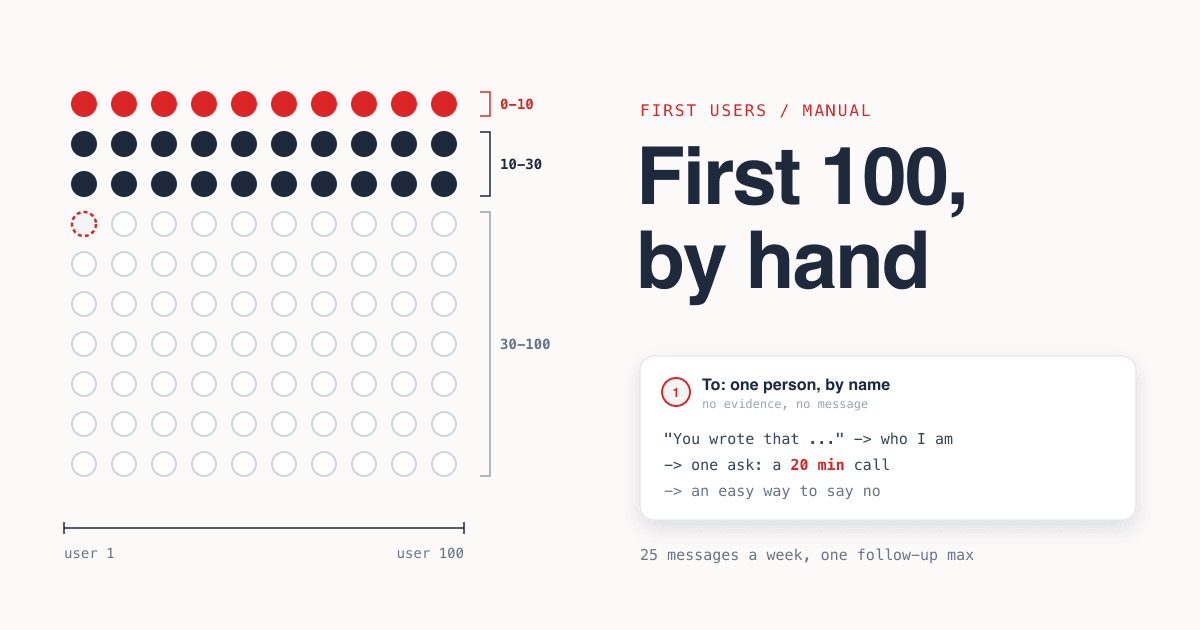
Recruit them individually. Find people who already have the problem, send each one a short personal message that refers to their situation, set them up yourself, and watch them use the product. Work in three stages - 0 to 10 from people you can reach directly, 10 to 30 from people like your best users, 30 to 100 by repeating whichever source worked - on a fixed weekly routine.
- Time needed
- Months, an hour or two a day
- Cost
- Free, apart from your time
- Skill level
- No sales experience needed
- Best for
- Products with fewer than 100 active users
What you will leave with
- Why founders recruit early users one at a time instead of announcing the product, in Paul Graham's own words and examples.[1]
- A three-stage plan (0-10, 10-30, 30-100) with a different source of users, daily task and exit sign for each stage.
- Three message templates you can adapt: a first contact, a single follow-up and an onboarding call invite.
- What Reddit, Hacker News and LinkedIn publish about promotion and unsolicited messages, so you do not lose an account while doing this.[7][9][12]
- The interview questions a Y Combinator partner recommends, and the ones he says to avoid.[4]
Why recruit your first 100 users by hand?
Because every user you set up yourself teaches you something a signup counter never will, and because announcing an unknown product rarely brings anyone. A hundred is small enough to do one at a time.
- new users needed next week to grow 10% a week from 100, in Paul Graham's example[1]
- 10
- users after a year of 10% weekly growth from 100, by his arithmetic[1]
- 14,000
- weekly growth Graham called good during Y Combinator, in 2012[2]
- 5-7%
- of in-person work with users that Graham says decided early Airbnb's fate[1]
- about 30 days
The standard reference is Paul Graham's 2013 essay "Do Things that Don't Scale". His claim is blunt: startups take off because the founders make them take off, and the most common unscalable thing founders must do is recruit users manually.[1]
His examples are specific. When someone agreed to try Stripe, the founders said "Right then, give me your laptop" and set them up on the spot, which Y Combinator calls a "Collison installation". The Airbnb founders went door to door in New York recruiting users. Wufoo sent each new user a hand-written thank you note.[1] The numbers look small, but a table in his 2012 essay "Startup = Growth" shows how weekly rates compound.[2]
The most common unscalable thing founders have to do at the start is to recruit users manually. Nearly all startups have to. You can't wait for users to come to you. You have to go out and get them.
Figure 1What a steady weekly growth rate multiplies to in one year
1% a week
1.7x2% a week
2.8x5% a week
12.6x7% a week
33.7x10% a week10 new users a week when you have 100
142x
Manual recruiting
- You choose who gets in, so early users actually have the problem.
- Every signup comes with a conversation and a watched first session.
- Slow and repetitive, but works with a rough product because you fill the gaps.
Broadcast marketing
- Reaches strangers whose need you cannot check.
- Produces visits and signups with no explanation attached.
- Feels productive. One spike can hide a product nobody returns to.
The call: Below 100 users, in our view, manual wins on learning per hour. Graham says the Big Launch "usually doesn't work", and Sam Altman's Startup Playbook says announcing a product in the press "almost never works".[1][3]
How do you break 100 users into stages?
Split it into 0-10, 10-30 and 30-100. Each stage has a different source of users and a different question you are trying to answer, so the daily work changes as you move up.
Figure 2The three stages of the first 100 users (our method, not a measured benchmark)
| Stage | Where users come from | What you do daily | What you learn | Sign you can move on |
|---|---|---|---|---|
| 0 to 10 | Where users come fromYour network, former coworkers, people who described the problem in public | What you do dailySend 3 to 5 personal messages. Do every setup yourself, live. | What you learnWhether the problem is real and whether anyone finishes setup | Sign you can move onAt least 3 people used it again without being asked |
| 10 to 30 | Where users come fromPeople who resemble your most active users, plus introductions from them | What you do dailySend 5 to 8 messages. Run onboarding calls. Fix what blocked the last one. | What you learnWhich kind of user gets value fastest, and their words for the problem | Sign you can move onYou can describe your best user in one sentence and find 50 more of them |
| 30 to 100 | Where users come fromThe one or two sources that produced active users, repeated on purpose | What you do dailyKeep messaging. Replace calls with a written setup guide once calls stop teaching you anything. | What you learnWhich steps can be automated without losing people | Sign you can move onNew users arrive from referrals or search without a message from you |
The stage boundaries follow the advice in the essay itself. Graham suggests getting an initial set of users, observing "which kind seem most enthusiastic", and then seeking out more like them. His example is Ben Silbermann, who noticed that early Pinterest users were interested in design and went to a conference of design bloggers to recruit more.[1]
He also recommends a deliberately narrow market, as Facebook did by starting with Harvard students only.[1] Stage two is about narrowing, not widening. Throughout, a "user" means someone who completed setup and came back, not a signup.
Where do you find the first ten users?
Among people who already have the problem and whom you can contact as an individual: your own network, former coworkers, communities where the problem is discussed, people who complained about it publicly, and users of the tool you replace.
If you built the product to solve your own problem, Graham says you only have to find your peers, "which is usually straightforward".[1] If you did not, start from who answers. In a Y Combinator talk, group partner Gustaf Alströmer says people you know are the most likely to respond but may be less honest so as not to offend you, and that coworkers and former coworkers can be a great source.[4]
He also reports the most common answers YC founders gave when asked how they found their early users: LinkedIn, Reddit forums, Slack or Discord communities, and sometimes in-person events.[4]
Figure 3Five places to look for the first ten users, and the trade-off of each
| Source | Strength | Watch out for |
|---|---|---|
| Your own network | StrengthMost likely to reply | Watch out forPolite answers. Watch what they do, not what they say. |
| Former coworkers | StrengthThey know the problem in detail | Watch out forA sample of one company |
| Communities | StrengthPeople describe the problem unprompted | Watch out forEach community has its own promotion rules. Read them first. |
| Public complaints | StrengthYou know they have the problem today | Watch out forOld posts. Check the date before you write. |
| Users of the tool you replace | StrengthThey already pay to solve it | Watch out forSwitching is work. Your product must be clearly better for them. |
How do you write a one-to-one message that is not spam?
Write it to one person, about something they said or do, with one small ask and an easy way to say no. If the same text could be sent to fifty people unchanged, it is a broadcast with a name pasted on top.
How to write and send one personal outreach message
Find the evidence5 min
Locate the post, comment or shared history showing this person has the problem. No evidence, no message.
Check the venue rules3 min
Read the community rules and the platform policy before contacting anyone there.
Open with their words2 min
Quote or paraphrase what they wrote in the first sentence.
Say who you are and why1 min
One sentence: you are building something for this problem. Do not hide that you made it.
Make one small ask2 min
Either a 20 minute call or trying one specific thing. Alströmer's own example message introduces himself, describes the project briefly and asks only for a 20 minute phone or video call.[4]
Give an exit1 min
End with a line that makes "no" easy. Log it in your tracker.
First message to someone who described the problem publicly
Use only where direct messages are allowed. The names, product and details below are invented as an example.
Hi Dana,

I read your post last week about exporting invoices to a spreadsheet by hand every month and losing an afternoon to it.

I am building a small tool that does that export automatically. It is early and rough.

Would you try it on one month of your invoices? I will set it up with you on a 20 minute call.

If this is not useful, just say so and I will not message again.

Sam (I am the developer)
One follow-up, a week later
Send once, only if they did not reply. Never send a third message. Invented example.
Hi Dana,

Following up once on the invoice export tool. Since I wrote, I added multi-currency export, which you mentioned in your post.

No need to reply if the timing is wrong.

Sam
Onboarding call invite after they say yes
Send the same day they agree. Invented example.
Great, thank you.

Here are three times for a 20 minute video call: Tuesday 10:00, Wednesday 15:00 or Thursday 9:30 (your time zone). Pick one or suggest another.

Please have last month's invoices to hand. We will set it up together on your real data. Nothing to install beforehand.

Sam
What counts as spam and gets you banned?
Repetition, volume and irrelevance. The platforms define spam by behaviour, not by intent, and they say explicitly that manual actions count too.
Reddit's help centre defines spam as "repeated or unsolicited actions (whether automated or manual) that negatively affect users, communities, and/or Reddit itself", and lists sending large amounts of unsolicited chat or private messages among the things that may violate the policy. Doing it by hand does not make it acceptable. The same page notes that community moderators decide what counts as unwanted or spammy content in their own communities.[7]
Figure 4What four venues publish about promotion and unsolicited contact (checked 11 October 2026)
| Venue | What the published rule says | What it means for manual recruiting |
|---|---|---|
| What the published rule saysRule 2: "Participate authentically in communities where you have a personal interest, and do not spam". Enforcement options include temporary or permanent account suspension.[6] Reddiquette, an informal guide written by the community, cites a "9:1 ratio" rule of thumb: only 1 out of every 10 of your submissions should be your own content.[8] | What it means for manual recruitingBe a real member first. Read each subreddit's rules. | |
| Hacker News | What the published rule says"Please don't use HN primarily for promotion." "Don't solicit upvotes, comments, or submissions."[9] The FAQ says HN penalizes or bans submissions, accounts and sites that break its rule against asking for upvotes.[11] | What it means for manual recruitingPost your own work only part of the time, and never ask anyone to vote or comment. |
| Show HN | What the published rule saysFor something people can try. "Don't post landing pages or fundraisers." "Please don't ask friends to upvote or comment."[10] | What it means for manual recruitingWait until the product can be tried, and be there to answer. |
| What the published rule saysNo "untargeted, irrelevant, obviously unwanted, unauthorized, inappropriate commercial or promotional, or gratuitously repetitive messages". Do not use invitations to send promotional messages to people you do not know.[12] | What it means for manual recruitingOne relevant note fits. A pitch pasted into connection requests does not. |
What does not work, and costs you the account
- Avoid: Copy-paste replies The same "I built a tool for this" comment under every matching thread. Reddit lists mass-posting repetitive content for exposure or financial gain among the things that may violate its spam policy.[7]
- Avoid: Generated posts Hacker News asks users not to put generated text in posts or comments and not to automate posting.[9]
- Avoid: Chasing non-replies One follow-up is a reminder. A third message is pressure. Silence is an answer.
How do you onboard and learn from each user?
Set each person up yourself on their real data, watch without steering, and ask about what they do today instead of what they think of your idea.
Graham argues that what should be "insanely great" in the first months is not the product but the experience of being your user, and that you can give users that experience with "an early, incomplete, buggy product, if you make up the difference with attentiveness".[1] The onboarding call is where you do that.
You can learn a lot more from a five-minute video interview than 500 or 5,000 survey responses.
Questions Alströmer recommends asking
- Tell me how you do X today.
- What is the hardest thing about doing X?
- Why is it hard?
- How often do you have to do X?
- Why is it important for your company to do X?
- What do you do to solve this problem for yourself today?
Questions he says to avoid
- Avoid: "Will you use our product?" He notes they will probably say yes, and it will mean nothing.
- Avoid: Which features would make the product better? Their job is to describe the problem. Yours is to design the solution.
- Avoid: Yes or no questions, which give you no concrete examples.
- Avoid: Two questions at once.
Both lists are condensed from the machine-generated transcript on the talk's page, not quoted word for word.[4] His wider rule is to hold back your idea until the end of the conversation, or not introduce it at all, because pitching early biases the answers. When someone tries a prototype, he says not to tell them what to do.[4]
A widely read book on this subject is Rob Fitzpatrick's The Mom Test, which its own site describes as being about "how to talk to customers & learn if your business is a good idea when everyone is lying to you".[5] We do not summarise its rules because we could not check them on a first-party page.
How much outreach does 100 users take each week?
Multiply the people you contact by your reply rate and your try rate. With the placeholder rates below, 100 users from outreach alone means about 1,000 personal messages, which is why you need a routine and not a burst, and why introductions from the users you already have matter.
Outreach maths: contacts to users
Enter your own numbers. After two weeks of real outreach, replace the defaults with the rates from your tracker.
- People contacted
- 250
- Replies
- 63
- Users who tried it
- 25
- New users per week
- 2.5
The reply rate and try rate are your own assumptions, not benchmarks. We found no primary source for typical rates, so the defaults are placeholders. Nothing here predicts your result.
Figure 5A worked example of one outreach batch
- People contacted individually200
25% continue
Replied50Assumed 25%
40% continue
Tried the product20Assumed 40% of replies
50% continue
Still using it two weeks later10Assumed half
This is unglamorous work. Most messages get no answer and the count moves by ones. Graham describes founders who would "rather sit at home writing code than go out and talk to a bunch of strangers and probably be rejected by most of them".[1]
What makes it survivable is a fixed week with a small daily quota. The schedule below is our suggestion. At the calculator's placeholder rates it adds two or three users a week, so expect the full hundred to take months unless your real rates are better or users start introducing you to others.
A weekly cadence one founder can sustain
Monday, 60 min
Build the list
Find 25 specific people, each with a link to evidence of the problem.
Tuesday to Thursday, 45 min a day
Send and reply
Send 5 to 8 messages a day, each written for one person. Answer replies the same day.
Tuesday to Friday, as booked
Onboarding calls
Set each person up on their real data, watch, and ask who else has this problem.
Friday, 45 min
Review and fix
Count messages, replies, tries and returning users. Fix the one thing that blocked most people. No outreach at weekends.
First 100 users tracker
0 of 12 done
Before you start
Stage 1: 0 to 10
Stage 2: 10 to 30
Stage 3: 30 to 100
What do you do when it stalls, and when does manual stop working?
Diagnose which step is losing people before you change anything. Manual recruiting stops being the main method when your own hours, not demand, become the limit, and you switch gradually, not all at once.
Common stalls and what to change
If Almost nobody replies
The list is wrong, not the wording. Contact only people with recent, specific evidence of the problem.
If People reply but do not try it
The ask is too big. Offer to set it up with them on a call, or do the first run for them, as Viaweb did for merchants.[1]
If People try it once and never return
Stop recruiting for a week. Call the ones who left and ask how they solve the problem today. More users will not fix a product problem.
If You have run out of people to contact
Ask existing users where to find more people like them,[3] or narrow to the kind of user who is most active and look where that group gathers.[1]
If A moderator removed your post or warned you
Stop posting there, re-read the rules and ask the moderators what is allowed. Do not switch accounts.
Graham is clear that this is a starting method. Growth has to slow down eventually, he writes, but if the market exists you can usually start by recruiting users manually and then "gradually switch to less manual methods".[1] Altman describes the same order: recruit users manually first, then test other growth strategies and do more of what works.[3]
5 quick answers
Common questions
Short answers to the follow-up questions readers ask most.
Not here? Ask usThere is no reliable benchmark, and anyone quoting one is guessing. The arithmetic on this page points to months, not weeks: 25 personal messages a week at an assumed 25% reply rate and 40% try rate adds two or three users a week from outreach alone. Introductions from existing users shorten that. Re-estimate with your own reply and try rates after two weeks.
Sources
- [1]Do Things that Don't ScalePaul Graham, 2013
- [2]Startup = GrowthPaul Graham, 2012
- [3]Startup PlaybookSam Altman
- [4]How to talk to users (talk by Gustaf Alströmer, with transcript)Y Combinator Startup Library
- [5]The Mom Test by Rob Fitzpatrick (official book site)Robfitz Limited
- [6]Reddit RulesReddit
- [7]SpamReddit Help
- [8]ReddiquetteReddit Help
- [9]Hacker News GuidelinesHacker News (Y Combinator)
- [10]Show HN GuidelinesHacker News (Y Combinator)
- [11]Hacker News FAQHacker News (Y Combinator)
- [12]LinkedIn Professional Community PoliciesLinkedIn
- [13]CAN-SPAM Act: A Compliance Guide for BusinessFederal Trade Commission
How this guide was put together. We read each cited essay, talk transcript and policy page on 11 October 2026 and report what it says; quotations are verbatim from those pages, and the interview questions are condensed from a machine-generated transcript. The FTC guide was read in an archived copy dated 10 October 2026. The growth figures are Paul Graham's published arithmetic from 2012 and 2013, not measurements of any product, and platform rules can change after the date checked. The three stages, daily counts, weekly cadence, templates, calculator defaults and the funnel are our own editorial method and invented examples, not benchmarks.