How to choose your first distribution channel
A method for founders who are doing a little of everything and learning nothing from any of it. Shortlist three channels, test one at a time, and let the numbers decide.
By the MEDIAPRONET Editorial Team. Published , revised . 19 minute read, 11 sources.
The short answer
How should a new product choose its first distribution channel?
Let price and buyer rule out most channels, then shortlist the three where your buyer already spends attention and that you can execute yourself. Test one at a time for two weeks with a capped budget, a single metric and a kill rule written in advance. Keep a channel only if it can win a paying customer for less than that customer pays in the first year. Expect most tests to fail.
- Time needed
- 2 weeks per test
- Test budget
- Capped; a few hundred dollars
- Shortlist size
- 3 channels
- Expected result
- Most tests fail
What you will leave with
- Why the authors of Traction, Peter Thiel and Brian Balfour all argue for one dominant channel, and where their advice differs.
- How your price point removes whole groups of channels before you test anything.
- A scoring method that cuts a long list of channel ideas down to three.
- A two-week test design: hypothesis, single metric, budget, and a kill rule you write before you start.
- The arithmetic that says whether a channel works: cost per paying customer against first-year value.
- When a curated directory listing is a sensible thing to do, and when it is a distraction.
Why should a new product start with one distribution channel?
Because growth tends to come from one channel at a time, and eight half-run channels produce eight results too weak to read. The people who wrote the standard frameworks agree on this point.
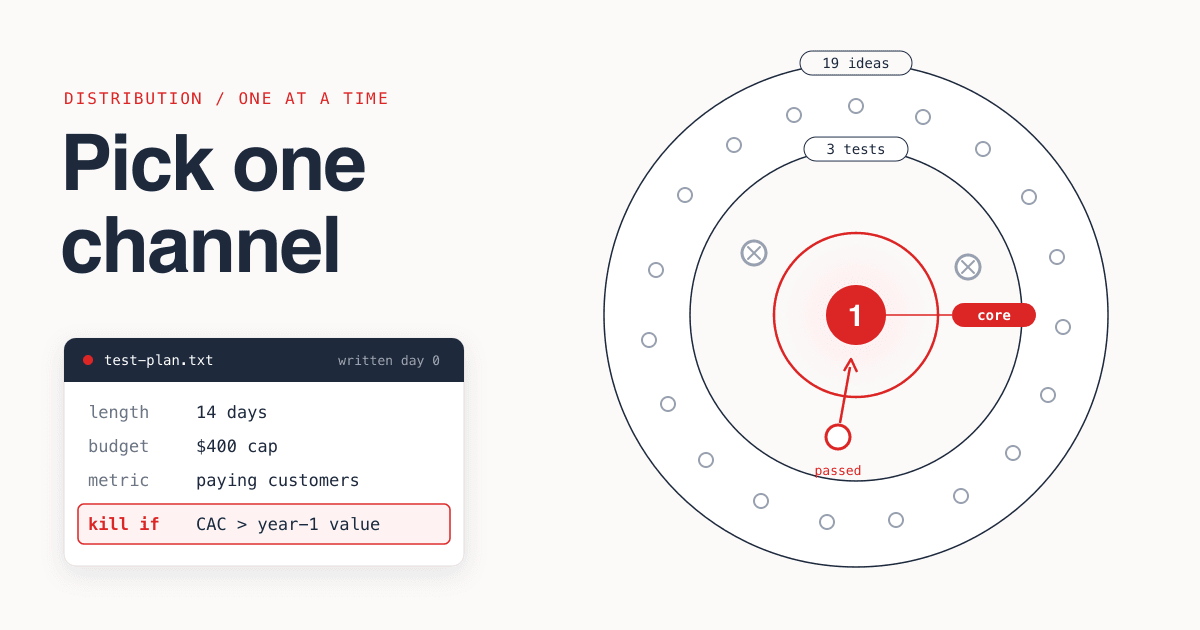
Gabriel Weinberg and Justin Mares built Traction around nineteen customer acquisition channels, with founder interviews behind each one.[2] Their Bullseye framework starts from a blunt premise, "Everyone starts off with biases", and ends on a blunt conclusion: "At any stage in a startup's life cycle, one traction channel usually dominates in terms of customer acquisition."[1]
Weinberg introduces the framework with a passage from Peter Thiel's 2012 startup class.[1] The wording below comes from Blake Masters's essay-form notes of that class, so treat it as a careful record, not a transcript.[3]
It is very likely that one channel is optimal. Most businesses actually get zero distribution channels to work.
Figure 1The Bullseye framework narrows nineteen channels to one
- Outer ring: brainstormed19 channels
At least one idea for every channel, none dismissed
15.8% continue
Middle ring: tested cheaply3 channelsThe few most promising; three is typical, not fixed
33.3% continue
Inner ring: core channel1 channelsThe one that produced results
Brian Balfour makes the same claim from the growth side: in his words, a company with product-channel fit "will get 70%+ of their growth from one channel". He supports it with named company examples, not a published dataset.[4]
Lenny Rachitsky reached a similar result by asking founders directly. In his 2020 research on major consumer apps he found seven strategies behind their first 1,000 users, wrote that most "found their early users from just a single strategy", and that none succeeded with more than three.[6] His B2B piece found only three sources for the first ten customers: personal network, going where customers spend time, and press, which he calls rarely the way to start.[7] Both are founder interviews, not samples, so read them as patterns.
The nineteen traction channels, as the author lists them
- Viral marketing, publicity, unconventional PR, search engine marketing, social and display ads
- Offline ads, search engine optimization, content marketing, email marketing, engineering as marketing
- Targeting blogs, business development, sales, affiliate programs, existing platforms
- Trade shows, offline events, speaking engagements, community building[2]
How do price and buyer decide which channels can work?
What a customer pays you per year sets the ceiling on what you can spend to win them, and that ceiling removes most channels before you test anything.
Products are built to fit with channels. Channels do not mold to products.
Balfour's companion essay states the rule plainly: "channels are determined by your model". Low revenue per user forces low-cost channels such as virality and user-generated content that ranks in search. Very high revenue per user, which he puts at six to seven figures, can pay for enterprise and outbound sales.[5] The middle is what he calls the danger zone: too much friction for the cheap channels, too little revenue for the expensive ones.
Thiel's class drew the same map five years earlier, including a middle zone with "no good distribution channel", and gave the test every channel must pass: a great business needs customer lifetime value above the cost of acquiring the customer.[3]
Christoph Janz turned this into arithmetic in 2014. The table shows how many customers a business needs to reach $100 million in annual revenue at each price point. Your goal is smaller, but the ratio is the lesson: every step down in price means ten times more customers, so the channel must be ten times cheaper per customer.[8]
Figure 2Christoph Janz's five ways to build a $100 million business (2014)
| Customer type | Customers needed | Revenue per customer per year |
|---|---|---|
| Enterprises ("elephants") | Customers needed1,000 | Revenue per customer per year$100k+ |
| Medium-sized companies ("deers") | Customers needed10,000 | Revenue per customer per year$10k+ |
| Small businesses ("rabbits") | Customers needed100,000 | Revenue per customer per year$1k+ |
| Consumers or prosumers ("mice") | Customers needed1 million | Revenue per customer per year$100+ |
| Ad-monetized active consumers ("flies") | Customers needed10 million | Revenue per customer per year$10+ |
The vocabulary
- CAC
- Customer acquisition cost. Andreessen Horowitz defines it as "the full cost of acquiring users, stated on a per user basis", and names two common problems: leaving out costs, and reporting a "blended" figure that mixes in users who arrived organically.[10]
- LTV
- Lifetime value. The same source defines it as the present value of future net profit from a customer, and calls using revenue instead a common mistake.[10]
- Payback period
- How long a customer takes to repay what it cost to win them. Balfour writes that most startups need to keep it under one year.[5]
- Product-channel fit
- Balfour's term for a product whose attributes match what a channel demands, for example quick time to value for paid marketing.[4]
Which channel types are realistic for a first test?
Ten channel types cover what most new products can run without a team. They differ most in how fast they give a readable signal and how much they cost to try.
Figure 3Ten channel types for a first test, compared (editorial judgement, not measured data)
| Channel type | Best for | Time to first signal | Money needed | How it scales |
|---|---|---|---|---|
| Personal network and warm intros | Best forB2B with a buyer you can name | Time to first signalDays | Money neededNone | How it scalesRuns out; that is fine for a first ten |
| Communities where buyers already talk | Best forDeveloper tools, niche SaaS, prosumer tools | Time to first signalDays | Money neededNone | How it scalesSlowly, limited by your time |
| Launch platforms and curated directories | Best forTools that early adopters browse for | Time to first signalDays to weeks | Money neededNone to low | How it scalesLow ceiling, long tail |
| Founder-led outbound to a short list | Best forHigher-priced B2B | Time to first signal1 to 2 weeks | Money neededLow | How it scalesBy hiring, later |
| Paid search and social ads | Best forSelf-serve products with quick time to value | Time to first signalDays | Money neededMedium to high | How it scalesWith budget, until costs rise |
| Newsletter or creator sponsorship | Best forProducts that match one audience closely | Time to first signal1 to 2 weeks | Money neededMedium | How it scalesOne placement at a time |
| Content and search | Best forProblems people already search for | Time to first signalMonths | Money neededLow | How it scalesCompounds, slowly |
| Existing platforms and marketplaces | Best forPlugins, apps, integrations | Time to first signalWeeks | Money neededLow | How it scalesWith the platform, at its mercy |
| Engineering as marketing (a free tool) | Best forTechnical founders with a narrow utility idea | Time to first signalWeeks | Money neededLow | How it scalesDepends on how the tool gets found |
| Press | Best forA real story for a defined readership | Time to first signalUnpredictable | Money neededLow | How it scalesPoorly; spikes, not a stream |
Figure 4Speed of feedback against cost to test
Fast signal Speed of feedback, Cheap to test Cost
Fast and cheapStart here
Personal network, communities, launch platforms and directories. Start here.
Fast signal Speed of feedback, Costly to test Cost
Fast and costly
Paid ads and sponsorships. Good tests if your price can carry the cost.
Slow signal Speed of feedback, Cheap to test Cost
Slow and cheap
Content, search, a free tool. Worth starting, but not as the first two-week test.
Slow signal Speed of feedback, Costly to test Cost
Slow and costly
Events, a hired sales team, a PR retainer. Not a first test.
How do you shortlist three channels?
Write one concrete idea per channel, strike what your price rules out, then score the rest on four questions and keep the top three.
The brainstorm step comes from Bullseye: think of at least one idea for every channel, so that your biases do not choose for you.[1] The scoring below is our own method, not part of the book. Give each idea 1 to 5 on each question and add them up.
Four scoring questions (editorial method)
- Buyer attention Can you name the specific place, by URL or by name, where your buyer already spends time? A vague answer scores 1.
- Price fit Could first-year revenue from one customer plausibly cover what this channel costs per customer? If not, score 1 and stop.
- Founder fit Can you do this well yourself, this month, without hiring? Writers should not pick calls they will avoid making.
- Speed Will you see a readable result inside two weeks?
A starting point by product and buyer (rules of thumb)
If Low-priced self-serve tool, bought by an individual
Start with communities where those individuals already talk. Sales calls cannot pay for themselves at this price.
If Developer tool or open-source project
Start with developer communities, then a small free tool or integration. Rachitsky lists developer and open-source communities among where B2B companies found early customers.[7]
If B2B product priced in the thousands per year, with a buyer role you can name
Start with your personal network and warm intros. The question, in Rachitsky's words, is "how far your own network will take you before you move on".[7]
If High-priced product sold to large companies
Start with founder-led sales to a short named list. Nothing else gives a signal in two weeks at this price.
If Plugin, app or integration for an existing platform
Start with that platform's own marketplace and its user community.
If Price sits in the awkward middle: too high for impulse, too low for sales calls
Recognise the danger zone Balfour describes.[5] Test a cheap channel and reconsider price or packaging alongside it.
How do you run a two-week channel test?
Fix four things before you start: a hypothesis, one metric, a spending cap and a kill rule. Then run the smallest version that can produce a readable number.
The size of the test is the part founders get wrong, in both directions. The Traction authors give the scale: "run four Facebook ads versus forty", and expect a rough idea of a channel's effectiveness "with at most a thousand dollars and a month of time", often less.[1] We cut that further for a first test. The two-week length and a cap of a few hundred dollars are our choice: long enough for a fast channel to show a result, small enough that failing is cheap.
How to run a two-week channel test
Write the hypothesis in one sentence20 min
Name the buyer, the place, the action and the number. Example: "Freelance designers in two design communities will start a trial if I show the before-and-after export, and 20 will sign up."
Pick one metric and make it countable1 hour
Choose the first action that shows intent: an activated signup, a booked call, a paid order. Tag every link for this test so the count is not mixed with other traffic, and add a "how did you hear about us" field as a backstop.
Cap money and hours10 min
Set a cash limit and an hours limit and treat both as spent. Free channels are paid for in founder time.
Write the pass line and the kill rule30 min
Before any result exists, write the number that means "keep going" and the number that means "stop". Decide them from your price, using the calculator below.
Run the smallest real versionDays 1 to 14
Three useful posts, ten warm conversations, four ads, one sponsored slot. Small, but done properly. A sloppy test only tells you that sloppy does not work.
Check once at the midpoint30 min
On day 7, fix execution problems such as a broken link or a confusing page. Do not change the metric, the audience or the kill rule.
Decide on day 14 and write it down1 hour
Kill, repeat once with one named change, or focus. Record the numbers and what you learned about the message, then start the next channel on the shortlist.
Channel test plan
Fill this in before the test starts and do not edit it until decision day.
CHANNEL TEST PLAN

Channel:
Dates: [start] to [start + 14 days]

Hypothesis:
[Buyer] who are in [specific place] will [action] when they see [message or offer].

Single metric:
[e.g. activated signups from tagged links]

How it is counted:
[tagged link / dedicated page / "how did you hear about us" field]

Budget cap: [amount]
Hours cap: [hours]

Pass line (keep going): at least [number] by day 14
Kill rule (stop): fewer than [number] by day 14

Assumptions behind the pass line:
- Price per customer, first year: [amount]
- Expected signup-to-paid rate: [percent] (my guess, not a benchmark)
- Most I can pay per paying customer: [amount]

Day 7 check: execution fixes only. No change to metric, audience or kill rule.

RESULT (fill in on day 14)
Reached: [number]   Signups: [number]   Paying: [number]
Cash spent: [amount]   Hours spent: [hours]
Decision: kill / repeat once with this one change: [change] / focus
What I learned about the message:
How do you know a channel works?
A channel works when it can win a paying customer for less than that customer is worth in the first year, and when there is visibly more of the same audience left to reach.
Here is a worked example with invented round numbers, to show the arithmetic only. A founder spends $400 on one newsletter slot for a tool priced at $300 a year.
Figure 5Worked example: one $400 test, start to finish
- People reached4,000
10% continue
Visits to the page40010% of reach
10% continue
Signups40$10 per signup
40% continue
Activated1612.5% continue
Paying customers2$200 per customer
Channel test economics
Enter your own test. Use it before the test to set a pass line, and after it with the real counts.
- Cash cost per signup
- $10.00
- Paying customers
- 2.0
- Cash cost per paying customer
- $200
- First-year revenue from the test
- $600
- First-year revenue per $1 of cash spent
- 1.50
- Value of your time spent (add this to cash)
- $1,000
Every input is your own assumption or a small-sample count. The result is arithmetic, not a forecast, and revenue is not profit: subtract your cost of serving each customer before comparing it with what you spent.
The pass line we suggest for a first test is modest: first-year revenue per $1 of cash above 1, with your time counted honestly. That mirrors the one-year payback Balfour describes[5] and the 12-month line in David Skok's SaaS guidelines, where he writes that profitability is "anemic" if recovering CAC takes longer.[9]
Do not hold a two-week test to mature benchmarks. Skok writes that the best SaaS businesses have an LTV to CAC ratio higher than 3, and adds that many healthy ones miss the guidelines early on.[9] You cannot know lifetime value yet, which is why this guide uses first-year revenue and treats it as generous: Andreessen Horowitz defines LTV on net profit, not revenue, and CAC as the full cost.[10]
Focus on it
- It met the pass line you wrote in advance
- The customers are the kind you want, not just the kind that showed up
- You can name where the next ten times as many people are
- You could run it again next week without dreading it
Kill it
- It missed the kill rule after a properly run test
- Signups came but nobody activated or paid
- It worked only because of a one-off favour or a lucky post
- The audience is already used up
The call: In between, repeat once with a single named change. Two inconclusive rounds count as a kill.
Is a curated directory listing a sensible first channel?
It is a sensible low-effort baseline when people in your category browse directories. It is not a substitute for the one channel you focus on, and it will not answer a two-week test on its own.
A listing is a permanent public profile for your product: name, tagline, description, screenshots, category and a link to your site. It sits in the fast-and-cheap corner of the matrix with a low ceiling. Paul Graham's remark about launches fits listings just as well: "All you need from a launch is some initial core of users."[11]
On MEDIAPRONET there are two ways in. A free listing requires the site's badge on your own site, is published automatically after at least a week once our check finds that badge, and carries an Unverified label. A paid listing goes live right after payment; see pricing. The listing page stays; pinned placement is for a limited window. No plan promises traffic, leads or sales.
Sensible when
- Your buyers are founders, developers or early adopters who browse categories of new tools
- You already have a clear tagline and good screenshots, so it takes an hour
- You want a baseline running while you test a higher-effort channel
- You will check outbound clicks against signups in your own analytics
Not sensible when
- Your buyer is a procurement team or a local customer who never browses tool directories
- You expect it to be your main source of customers
- You need an answer inside two weeks and choose the free path, which spends the first week or more waiting to be published
- You would submit to fifty directories instead of running one real test
The call: Treat it as a task to finish, measure once, and move on from. Pick a few relevant ones from an audited comparison of directories instead of all of them.
To measure it like any other test, start the clock on the day the listing is public. MEDIAPRONET shows owners the views and outbound clicks recorded on the listing. It does not report signups or revenue, so count those on your side and run them through the calculator above.
What mistakes make channel tests useless?
Most failed tests fail as experiments before they fail as channels: no number was written down first, several things changed at once, or the channel was too slow to read.
What does not work
- Avoid: Eight channels at 5% effort each Every result is too small to read, so every channel stays "maybe" forever.
- Avoid: Choosing the channel you already know Bullseye makes you write an idea for every channel for this reason: in the authors' words, "Everyone starts off with biases."[1]
- Avoid: Setting the kill rule after seeing the result You will always find a reason to continue. Write it first.
- Avoid: Judging a slow channel on a fast clock Two weeks of content tells you nothing about search. Either test a fast proxy or accept a longer window on purpose.
- Avoid: Counting vanity signals Likes, upvotes and page views are not the metric unless your hypothesis said so.
- Avoid: Reporting a blended cost Mixing signups that arrived on their own into a paid test hides whether the paid part pays. Andreessen Horowitz lists blended CAC as a common problem.[10]
- Avoid: Waiting for users to arrive Graham: "You can't wait for users to come to you. You have to go out and get them."[11]
Channel test checklist
0 of 14 done
Before the test
During the test
Decision day
One more caution. A failed test that shows the message does not land is product information, and it cost you two weeks instead of a year. The Traction authors draw the same line: if several rounds of testing turn up no promising channel, "your product may require more tweaking."[1]
6 quick answers
Common questions
Short answers to the follow-up questions readers ask most.
Not here? Ask usOften none in cash, and for a first test we suggest capping it at a few hundred dollars. The authors of Traction put the ceiling higher, at a thousand dollars and a month for a rough idea of a channel, and say it is often cheaper and shorter; their example is four ads instead of forty. Free channels such as communities and warm introductions cost founder hours instead, so set an hours cap as well as a cash cap and count both.
Sources
- [1]The Bullseye Framework for Getting Traction (excerpt from Traction, by Gabriel Weinberg and Justin Mares)Gabriel Weinberg, 2015
- [2]The 19 Channels You Can Use to Get TractionGabriel Weinberg, 2015
- [3]Peter Thiel's CS183: Startup - Class 9 Notes EssayBlake Masters, 2012
- [4]Product Channel Fit Will Make or Break Your Growth StrategyBrian Balfour, 2017
- [5]Get Out of the ARPU-CAC Danger Zone with Channel Model FitBrian Balfour, 2017
- [6]How the biggest consumer apps got their first 1,000 usersLenny Rachitsky, Lenny's Newsletter, 2020
- [7]How today's fastest growing B2B businesses found their first ten customersLenny Rachitsky, Lenny's Newsletter, 2020
- [8]Five ways to build a $100 million businessChristoph Janz, The Angel VC, 2014
- [9]SaaS Metrics 2.0 - A Guide to Measuring and Improving what MattersDavid Skok, For Entrepreneurs, 2013
- [10]16 Startup MetricsAndreessen Horowitz, 2015
- [11]Do Things that Don't ScalePaul Graham, 2013
How this guide was put together. Every framework, quotation and figure attributed to a named author was checked against the text of that author's own published page, or in the case of Peter Thiel against Blake Masters's notes of his class, on 11 October 2026. For Traction we relied only on the two excerpts Gabriel Weinberg published under his own name, not the full book, and read them from archived copies because the host refused automated requests that day. Those sources are essays, book excerpts and founder interviews; none is a controlled study, so they show how experienced practitioners reason, not measured success rates. The channel comparison table, the matrix, the scoring questions, the decision rules, the two-week length and the pass line are editorial judgement, and the worked example uses invented round numbers.