A locked room where two lists meet
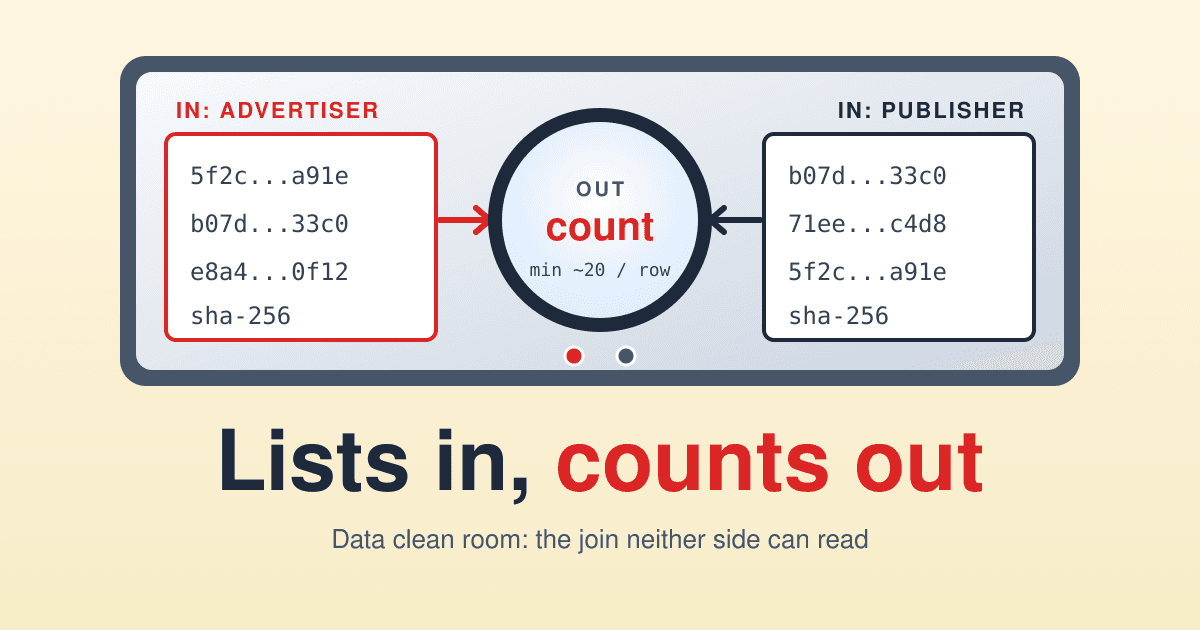
Nobody's customer list leaves its owner in a data clean room; both files go into a sealed space, and the only thing allowed back out is a count big enough to hide any one person. That is the whole idea. An advertiser holds the emails of people who bought from it. A publisher holds the emails of people who log in to read it. Each would like to know how many people sit in both files, and each would like to show ads to that overlap, but neither may hand its list to the other under its privacy promises, and neither would want to.
A clean room is the software that runs this comparison. It can be a feature inside a big ad platform, a product from a data vendor, or a space built on a cloud data warehouse. The IAB Tech Lab, the standards body of online advertising, describes clean rooms as the tools organizations with first-party data use to share it, for three jobs: finding and reaching audiences, learning about customers, and measuring campaigns (IAB Tech Lab, Data Clean Rooms Guidance).
64%of companies using privacy-preserving technology use clean rooms, in IAB's State of Data 2023 survey, as quoted by the IAB Tech Lab.
200data decision-makers at brands, agencies and publishers answered that survey, done by Ipsos, plus 20 in-depth interviews (IAB, State of Data 2023).
v1.1of PAIR, the publisher and advertiser matching protocol, was finalized in July 2025 (IAB Tech Lab, PAIR).
The same IAB study found that most companies with a clean room were not using its advanced measurement features (IAB, State of Data 2023, public summary). Many rooms get bought and then used as a list-matching tool and little else. Keep that in mind before paying for one.
What each side carries in, and what stays outside
Like a lab where people change clothes before they enter, a clean room only accepts data prepared in a set way. The usual join key is an email address, trimmed, lowercased and then hashed (turned into a fixed string of characters by a one-way function such as SHA-256), so that the raw address never travels. Both sides must prepare it exactly the same way, or the same person ends up with two different strings and the match rate drops for no visible reason.
Advertiser brings
- Hashed emails (sometimes phone numbers) of customers or leads
- Per person: what they bought, when, and for how much, or a segment label such as "lapsed buyer"
- For measurement: conversion events with a time stamp
Publisher brings
- Hashed emails of logged-in readers or subscribers
- Per person: sections read, newsletter opens, or ad exposures with a time stamp
- Its own segment labels, such as "reads the travel section weekly"
Stays in the changing room
Names, raw emails, street addresses and anything a contract or a privacy notice does not cover. Amazon's clean room, for example, says it accepts only pseudonymized information and that an advertiser's own uploaded data cannot be exported or accessed by Amazon (Amazon Ads, Amazon Marketing Cloud). Hashing is pseudonymization, not anonymization: a hashed email still points at one person for anyone holding the same address, which is why the rules in zone 04 exist.
One join, message by message
Different rooms use different machinery, but a publisher and advertiser overlap runs through the same steps. The diagram reads top to bottom; each step says who sends what to whom.
-
1Advertiser to room
Uploads 40,000 hashed customer emails with a "bought in the last year" flag. The numbers in this walk-through are an example, not a benchmark.
-
2Publisher to room
Uploads its logged-in readers, hashed the same way, with the sections each one reads.
-
3Room to itself
Joins the two tables on the hashed key. Neither party can read the other's rows; in rooms built on PAIR, each side's keys are encrypted again by the other side, so they can be compared without ever being turned back into plain text (IAB Tech Lab).
-
4Advertiser to room
Sends a question it is allowed to ask: how many of my buyers read the travel section, by month?
-
5Room to itself
Runs the query, then checks every result row against its privacy threshold and drops or blurs any row with too few people in it.
-
6Room to advertiser
Returns counts only: for example 6,200 shared people, 1,900 of them travel readers. No email, hashed or not, comes back.
-
7Room to publisher
For a campaign, receives a segment it can target on its own site: "advertiser buyers who read travel". The publisher serves the ads; the advertiser never learns who was in it.
Step 7 is the part a buyer pays for. The overlap becomes an audience the publisher can sell, the advertiser can buy, and neither has had to reveal its list. The same pattern runs backwards for measurement: the publisher brings ad exposures, the advertiser brings purchases, and the room returns how many exposed people bought, which is what the Tech Lab's ADMaP protocol, finalized in February 2025, standardizes (IAB Tech Lab, ADMaP).
The rule that keeps the door shut: too few people, no answer
A cleanroom airlock will not open both doors at once. A data clean room has the same kind of interlock: a result row describing too few people is never released, because a small count could single out one customer. Google's Ads Data Hub publishes its thresholds, which makes it a good reference for what to expect elsewhere (Google, Ads Data Hub privacy checks):
~20users per result row in noise injection mode, the recommended mode, which also adds calibrated random noise to the numbers.
~50users per row in the older difference checks mode, which also blocks combinations of queries that could isolate a person.
~10users per row when a query reads only click and conversion data.
Google's own example shows what that does to a report. Three campaigns go in; the one that reached 18 people comes out as nothing (Google, Ads Data Hub privacy checks):
| Campaign | Users | Impressions | Released? |
|---|---|---|---|
| 123 | 314 | 928 | Yes |
| 124 | 2,718 | 5,772 | Yes |
| 125 | 18 | 45 | Filtered: under 20 users |
Other rooms differ in the number, and some add a cap on how often the same data may be queried (Google calls it a data access budget), but every room has this gate. For a small buyer it is the main practical limit: slice a modest overlap by month, region and product, and most rows fall under the threshold and vanish.
What a room costs to run
The software fee is often the smallest part. Two published reference points:
$0
Amazon Marketing Cloud is available at no cost to eligible advertisers, through a web interface and an API (Amazon Ads). It joins your uploads with Amazon's own ad data, so it only helps if you advertise with Amazon.
$3,504 / year
Compute in the AWS Clean Rooms pricing example: three 3-minute queries a day on the default 32 processing units at $2.00 per unit-hour comes to $9.60 a day (AWS Clean Rooms pricing). Prices vary by region.
What neither figure includes is the person who writes the queries. Clean rooms are queried in SQL or through templates someone has to set up, keys have to be prepared the same way on both sides, and a publisher partner has to agree to join. Ask any vendor who does that work, and for how many hours a month.
Does a small buyer need one? Five questions
Answer in order. The first "no" usually ends the tree with a cheaper tool.
-
Q1Do you hold your own list of customers with emails, collected with consent that covers advertising use?
YesGo to Q2.
NoStop. A clean room has nothing to compare. Buy the publisher's own audience segments or contextual placements instead.
-
Q2Is that list in the tens of thousands, not the hundreds?
YesGo to Q3.
NoStop. After the overlap and the privacy threshold, a small list returns mostly filtered rows. An ordinary upload such as Google's Customer Match, where a list stays eligible as long as at least 100 members are added or updated within 540 days, does more for you (Google Ads Help).
-
Q3Does the publisher you want to buy from offer a clean room, or work with one you can join?
YesGo to Q4.
NoStop. A room is a two-party tool. Without the partner it is an empty building; ask what audience matching the publisher does offer.
-
Q4Is the question one only a join can answer, such as "how many of my buyers read this site" or "did people who saw the ad buy more"?
YesGo to Q5.
NoStop. Reach, viewability or click questions are answered by the publisher's normal reporting.
-
Q5Does the spend at stake justify someone writing queries every month?
YesA clean room fits. Start with one question, one partner and one campaign.
NoStop for now. Run the test as a single, scoped project with the publisher instead of a standing subscription.
Most small buyers stop at Q2 or Q3, and that is fine. A sponsored placement on a site whose readers already match your customers, chosen by looking at the site, does much of what an overlap count tells you, and you can find such sites in our directory.
Questions buyers ask about clean rooms
Is a clean room the same as a data management platform?
No. A data management platform collects and stores audience data for one company to use. A clean room holds two or more parties' data for a set time, lets them run approved queries on the joined data, and returns aggregated results, with neither side able to read the other's rows.
Does the publisher see my customer list?
Not as a list. It sees counts, and in an activation it receives a segment to target, but not who in its audience bought from you. Check the agreement: what each side may receive should be written there, not only in the software settings.
Why did my overlap report come back nearly empty?
Usually one of three things: the two sides prepared their emails differently before hashing, so the same person did not join; the overlap was small; or the query split it into so many rows that most fell under the privacy threshold. Ask for one total first, then split it.
Are clean rooms from different vendors compatible?
Increasingly. The IAB Tech Lab replaced its first interoperability standard with PAIR, donated by Google, which lets rooms run by different parties compare doubly encrypted keys without decrypting them (IAB Tech Lab).
Sources
- IAB Tech Lab, Data Clean Rooms Guidance (updated July 2025): use cases, the 64% figure from IAB State of Data 2023, PAIR, ADMaP and the deprecated OPJA standard
- IAB Tech Lab, PAIR protocol
- IAB, State of Data 2023: public summary only, the full report needs an account
- Google, Ads Data Hub privacy checks: aggregation thresholds and the filtered campaign example
- Amazon Ads, Amazon Marketing Cloud: no-cost access and pseudonymized inputs
- AWS, Clean Rooms pricing: the compute cost example
- Google Ads Help, Customer Match: list membership rules