Programmatic 8 min read
Supply Path Optimization for Programmatic Buyers: Count the Hops, Find the Fee Leaks, Cut the Resold Routes
The same impression reaches a DSP about 30 times, 14 of them through resellers that each take a cut. What SPO is, where the fees leak, how to read a path in schain and sellers.json, which resellers to keep, and seven steps to trim the rest.
- Buyer100¢
- DSPfee
- SSP70¢
- Resellerless
- Publisherpaid
Two bid requests for the same banner, on the same page, at the same second, can reach your demand-side platform by different roads, and the longer road has more toll gates on it.
Short answer
Supply path optimization (SPO) is the work of choosing which route your programmatic money takes to a publisher: which supply-side platforms (SSPs) and resellers you let it pass through, and which you switch off. Every extra company in the payment chain is one more fee, and most extra routes add nothing a direct one does not. A buyer trims paths by reading the SupplyChain object and sellers.json behind each bid, keeping one or two direct routes per seller, keeping the few resellers that control inventory nobody else can sell, and buying through path-level inclusion lists or curated deals.
What is supply path optimization?
Jounce Media, an ad tech research firm, defines it as "a collection of techniques that enable programmatic media buyers to make intentional choices about the ad tech platforms that power programmatic trades" (Jounce, Little Black Book of SPO, 2024). In plain words: you decide the road, instead of letting every road decide for you.
A supply path is the chain of companies an impression passes through between the publisher and your DSP. The shortest common path is publisher, one SSP, your DSP. A longer one adds a reseller: another SSP or ad network that buys the auction from the first one and offers it to you again. Jounce calls reselling "any programmatic sales arrangement in which more than 1 company processes payment on behalf of a publisher".
The industry standard that lists those companies says why it exists: buyers need to ensure "that all intermediaries are entities with which the buyer wants to transact and that inventory is purchased as directly as possible" (IAB Tech Lab, SupplyChain object). If you want the file-level detail of how a publisher authorizes sellers, our ads.txt and sellers.json guide covers it; this post is about what a buyer does with that information.
Where does the money leak between buyer and publisher?
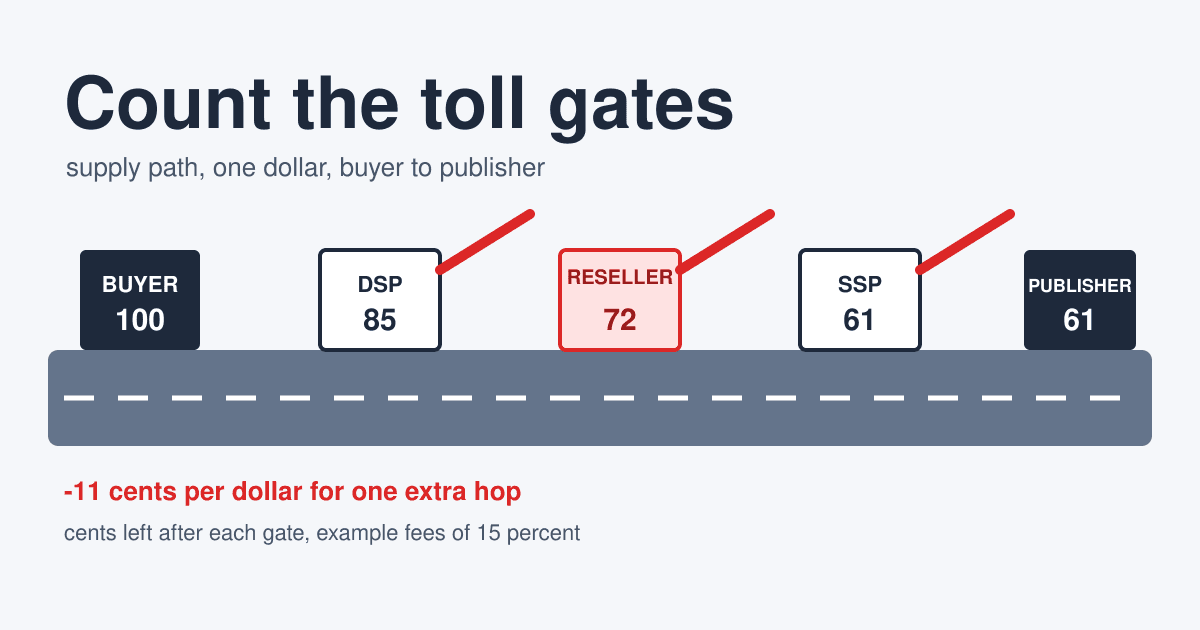
At every gate. Jounce puts the floor plainly: "At a minimum, the DSP and SSP each take a percentage of the marketer's gross ad spend, typically resulting in a 70% net payout to the publisher" (Jounce, 2024). That 70 cents is the direct road. On a longer road the publisher gets less, and the same book names "three primary drivers of excess supply chain fees":
- Flat CPM campaigns. The DSP charges "a fixed price for each impression, regardless of the actual auction clearing price", so a cheap win leaves a wide margin with the platform, not with you.
- Dynamic fee auctions. SSPs that "modify their take rate from one impression to the next, typically expanding their fee for high DSP bids".
- Multi-hop reselling. "Long supply chains in which the SSP pays another supply chain intermediary rather than the publisher."
| Gate | Direct road | Resold road |
|---|---|---|
| Your budget enters the DSP | 100.00¢ | 100.00¢ |
| DSP fee (15%) | 85.00¢ | 85.00¢ |
| Reseller SSP (15%) | no gate | 72.25¢ |
| Publisher's SSP (15%) | 72.25¢ | 61.41¢ |
| Reaches the publisher | 72.25¢ | 61.41¢ |
Fees are only part of the leak. In its December 2023 study of 21 large advertisers' log-level data, the Association of National Advertisers (ANA) found that "only 36 cents of every dollar that enters a demand-side platform (DSP) effectively reaches the consumer", and put the efficiency gain on the table at $22 billion. Its 2026 follow-up on direct contracts says following best practices could raise that from 36 cents "to 50 cents or more" (ANA, Programmatic Transparency). The 36 cents counts losses beyond fees too, such as low-quality sites, so read it as the size of the problem, not as the fee share.
Why is one impression offered to you 30 times?
Because publishers run many auctions for each ad slot. Header bidding lets a page ask several SSPs at once, and Jounce notes that "most publishers partner with more than 10 different SSPs". Some of those SSPs then pass the auction on to other SSPs, which Jounce calls rebroadcasting: "turning a single SSP auction into many DSP bid requests".
16 direct paths
14 rebroadcast paths
Your DSP cannot hear all of them. Each DSP and SSP connection "typically operates between 100,000 - 1,000,000 QPS" (queries per second), and "there is no DSP that has the capacity to listen to 30x auction duplication for each available impression", says the same source. So the SSP or your DSP throws requests away before you bid, and if the dropped ones are the direct ones, you end up paying the longer road's tolls without choosing to. That is the case for trimming paths yourself: not only cheaper media, but deciding which copy of the auction your bid sees.
How do you tell a direct path from a resold one?
Read two things that travel with, or sit behind, every bid request.
Direct road
- news.example owner, paid by the SSP
- ssp-one.example sends you the bid request
schain: complete: 1, 1 node; sellers.json: PUBLISHER
Detour
- news.example owner, paid by SSP one
- ssp-one.example resells the auction
- ssp-two.example sends you the bid request
schain: complete: 1, 2 nodes; sellers.json at ssp-two: INTERMEDIARY
The SupplyChain object (schain). Every company that handles payment adds a node with its ad system domain (asi) and the seller account it pays (sid). The spec says "the last node represents the entity sending this bid request", and a complete flag of 1 means the chain runs all the way back to the owner of the site or app (IAB Tech Lab). Count the nodes: one is the short road. A chain marked incomplete tells you nothing about the hops before the first known node, so treat it as the long road until proven otherwise.
sellers.json. Each ad system publishes who sits behind each seller ID, with a seller_type of PUBLISHER, INTERMEDIARY or BOTH. PUBLISHER means the inventory "is on a site, app, or other medium owned by the named entity and the advertising system pays them directly"; INTERMEDIARY means it is not, or the system does not pay the owner directly (IAB Tech Lab, sellers.json 1.0).
"schain": {
  "ver": "1.0",
  "complete": 1,
  "nodes": [
    { "asi": "ssp-one.example", "sid": "4471", "hp": 1 },
    { "asi": "ssp-two.example", "sid": "9013", "hp": 1 }
  ]
}
Made-up domains and IDs. Two nodes with hp: 1 means two companies are paid on the way to you: one hop more than the direct road.
Which indirect routes are worth keeping?
Not every extra hop is a toll for nothing. Jounce says "not all reselling is bad reselling" and names three kinds where the middle company, not the publisher, "controls the final ad serving decision" (Jounce, 2024):
Outsourced yield management
Smaller sites hand all their ad sales to one sales house. The hop is "additional, but necessary": there is no shorter road to that site.
Check: the publisher's ads.txt names the sales house, ideally as its manager domain.
Proprietary placements
A site gives one partner exclusive control of certain ad units, so those units are only sold through that partner.
Check: the units are not also offered on a direct path.
Content syndication
A media company's shows or articles run inside other companies' apps and sites, common in connected TV.
Check: the content owner appears in the chain and in sellers.json.
The reverse trap also exists: a short road to a poor site. Jounce's 2026 guide warns that "a high efficiency path to low quality supply is at least as wasteful as a multi-hop path to high quality supply" (Jounce, Marketer's Guide to SPO, 2026). Filter for quality first, then for directness.
How does a buyer trim supply paths, step by step?
- Get the path data. Ask your DSP or agency for a report by seller ID and SSP, with schain node count, for the last 30 days of spend. If nobody can give you one, that is the first finding.
- Drop what fails the basics. Seller not in the publisher's ads.txt, an incomplete schain, or a confidential seller you cannot identify in sellers.json: block those routes.
- Plan by seller, not by domain. Jounce's guide suggests orienting planning "around sellers - the companies that initiate programmatic auctions". It reports that, as of late 2025, the top 100 premium sellers "collectively capture 70% of all programmatic investments" across more than 100,000 sites, apps and streaming services.
- Keep one or two roads per seller. For each publisher or sales house, keep the direct SSPs that deliver at a fair clearing price, and the resellers from the list above. Cut the rest.
- Turn the list into targeting. The 2026 guide describes two ways: path-level inclusion lists in the DSP, which "replace legacy site and app inclusion lists", or curated deal IDs from the sell side that "pre-filter the bidstream".
- Read the fee terms. Ask whether your DSP charges a flat CPM or a percentage of the clearing price, and whether your SSPs' take rate changes per impression. Those are two of the three fee drivers above, and SPO does not fix them.
- Re-check every quarter. Publishers add and drop SSPs, and a new reseller can appear in your logs without anyone telling you. Rerun step 1 and compare.
The shortest road of all has no exchange on it: a sponsorship, newsletter slot or banner bought straight from the site owner. For smaller buys that is often the simplest way to know where every cent goes.
Supply path optimization questions
Does SPO mean buying only from DIRECT sellers in ads.txt?
No. DIRECT in ads.txt says the publisher controls that account; it does not say no other company sits in the chain of the bid you received. Read the schain node count and the sellers.json seller type too, and keep the necessary resellers described above.
Will cutting paths reduce my reach?
Usually less than it looks. When the same impression reaches you 30 times, cutting the 14 rebroadcast offers leaves the 16 direct ones to the same page. Check reach per seller before and after the change.
Can a small advertiser do SPO without a big DSP contract?
Partly. You can ask for the seller and SSP report and buy through curated deals. Path-level lists depend on what your DSP offers. Buying placements directly from publishers skips the question.
Is SPO the same as blocking made-for-advertising sites?
No, they work together. MFA blocking removes poor sites; SPO removes extra roads to sites you want. Jounce classes under 5% of web supply as MFA as of late 2025, down from about 25% in summer 2023, and still says to avoid it (Jounce, 2026).
Who should run SPO, the DSP or the buyer?
Both. DSPs filter some resold traffic themselves, but their choices follow their own costs. Ask what they cut, and set your own seller list on top.
Sources
Read on 2026-11-12. Fee examples in the ledger are our own illustration.
Continue Reading
More articles you might enjoy
Programmatic
ads.txt and sellers.json: How Publishers Declare Who May Sell Their Ad Space, and How Buyers Check It
ads.txt lists the ad companies allowed to sell a website's ad space; sellers.json and the SupplyChain object show who is behind each seller account. The line format, DIRECT vs RESELLER, the crawler rules, and the four checks a buyer runs on one bid request.
Media Buying
Buying Billboard Screens by the Spot: DOOH Loops, Audience Multipliers and the Proof-of-Play Log
A digital billboard sells slices of a looping playlist, and a programmatic bid turns one play into a number of people. How the loop, the multiplier and the proof-of-play log fit together, and what to write into the order.
Media Buying
Programmatic Guaranteed, Preferred Deal, Private Auction or Open Auction: Which Deal to Ask For
The four ways to buy ad space programmatically, in the order a seller offers each impression: what each deal reserves, how it is priced, who may bid, and what to send a seller when you ask for one.