Side A
Host-Read or Dynamically Inserted: Podcast Ad Formats and What Pre-, Mid- and Post-Roll Slots Cost
Who reads a podcast ad, how it gets into the episode and where it plays set its price. Host-read vs pre-produced, baked-in vs dynamic insertion, pre-, mid- and post-roll, with sourced CPM ranges and a worked buy.
Libsyn Ads' rate table puts a 60-second host read recorded into the episode at $24 to $26 per thousand downloads, and a pre-produced spot spread across many shows by a programmatic platform at $12 to $15, so one minute of audio can cost about twice as much depending on whose voice carries it and how it reaches the file (Libsyn Ads).
Short answer
A podcast ad is three choices stacked on each other. Who reads it: the host, in their own words, or a voice actor in a spot the brand supplies. How it gets into the audio: recorded into the episode for good (baked-in), or stitched in by the hosting server each time someone downloads (dynamic insertion). Where it plays: before the episode (pre-roll), inside it (mid-roll) or after it (post-roll).
Almost all of it is sold on CPM, a price per thousand downloads or impressions. The IAB's revenue study calls CPM's lead "continued dominance" over flat fees and series ownership (IAB and PwC, 2023, p. 18). Host reads cost the most, mid-roll is the dearest slot and post-roll the cheapest.
Where the ad breaks sit in an episode
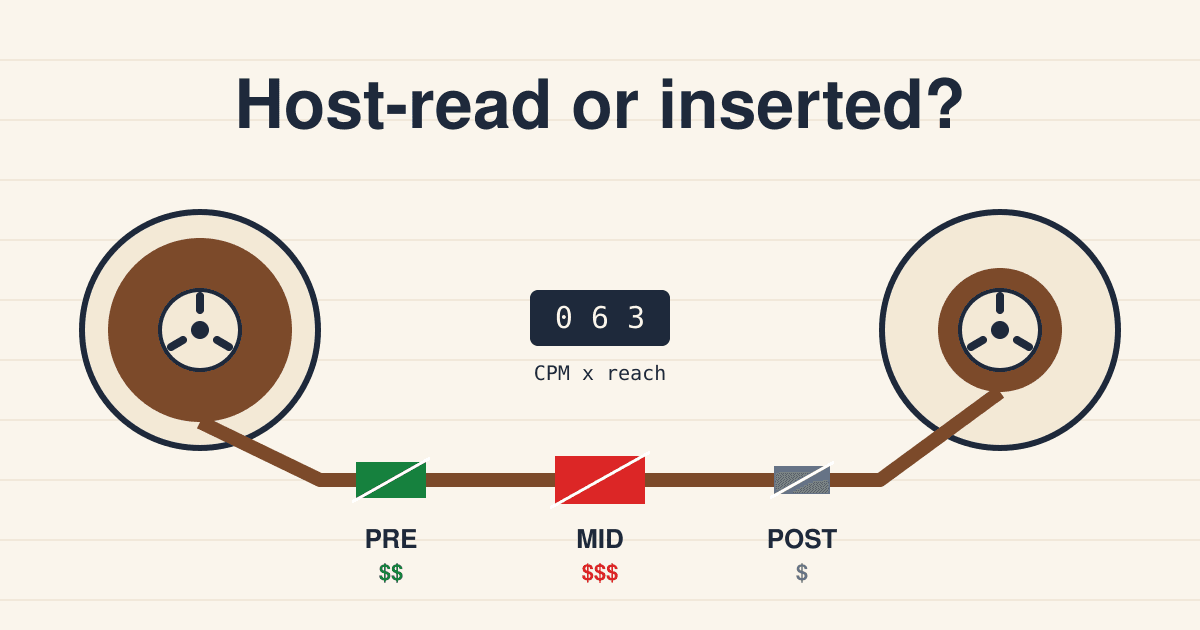
Read an episode as one strip of tape. Ad breaks are spliced in at three places, and buyers spend very unevenly across them: in 2022, mid-roll took 63% of US podcast ad revenue, pre-roll 31% and post-roll 6% (IAB and PwC, 2023, p. 17). The IAB sums it up as publishers keeping "a 60% to 30% split between mid-roll and pre-roll inventory".
-
Pre-roll
31% of US podcast ad revenue in 2022
Plays before the episode starts. Acast lets the podcaster move it up to 25% of the way into the episode (Acast).
Heard by nearly everyone who presses play, before they know whether the episode will hold them. Middle price
-
Mid-roll
63% of US podcast ad revenue in 2022
Placed inside the episode; Acast offers it only in episodes of at least 10 minutes (Acast).
The listener is already settled into the show, so Acast prices it as its most expensive slot. Highest price
-
Post-roll
6% of US podcast ad revenue in 2022
Plays after the episode ends; Acast lets the podcaster move it up to 50% from the end (Acast).
Many listeners stop when the conversation stops, so the slot reaches the fewest ears. Lowest price
No public source measures pre-, mid- and post-roll rates as separate averages, so sellers quote the order (mid highest, post lowest) rather than a fixed premium (Castos, 2026). Ask each seller for its own slot prices in writing.
Host-read, pre-produced, baked-in, inserted: the four takes
Two questions are easy to merge, and sellers' decks often do. Host-read versus pre-produced is about the voice. Acast describes host reads as "longer, editorialized" messages the podcaster delivers, and pre-recorded ads as spots the advertiser supplies, "usually featuring a voice-over artist" (Acast). Baked-in versus dynamic is about delivery. A baked-in read is edited into the episode file and "stays in that particular episode forever"; a dynamic ad is inserted by the server, so it can change by date, place or listener (Libsyn Ads).
The two axes are independent. A host read can be dynamically inserted too: Acast inserts its host-read sponsorships dynamically so they stay timely (Acast). Dynamic insertion is now how most of the money moves: it carried 92% of US podcast ad revenue in 2022, up from 48% in 2019 (IAB and PwC, 2023, p. 10).
| Take | Voice | How it gets in | Where it can run | CPM |
|---|---|---|---|---|
| Baked-in host read | Host, 30 or 60 s | Recorded into the episode, stays forever | Pre or mid-roll of one new episode | $24 to $26 (60 s), $18 to $22 (30 s) |
| Dynamic episodic | Host or pre-produced | Inserted into a chosen episode | Pre or mid-roll of a new episode | $18 to $22 |
| Dynamic back catalog | Host or pre-produced | Inserted into any episode in the catalog | Pre or mid-roll, any episode; target shows, dates, genres | $14 to $16 |
| Programmatic | Pre-produced | Delivered by a platform across many shows | Pre or mid-roll; target place, demographics, behaviour | $12 to $15 |
Source: Libsyn Ads rate page. Length matters less than the take: half of US podcast spots sold in 2022 ran 16 to 30 seconds, and 35% ran 31 to 60 seconds (IAB and PwC, 2023, p. 16).
Which take fits which job
- The host's endorsement is the product. Buy a host read. The price is higher because the audience hears someone they chose to listen to; Acast quotes host-read sponsorships at $25 to $40 CPM against $15 to $30 for pre-recorded ads (Acast).
- The offer changes or ends. Buy dynamic. A baked-in read keeps playing in old episodes after your promo code expires, and you cannot pull it.
- You need a region or a date window. Buy dynamic or programmatic: only an inserted ad can be held to a country, a city or a flight.
- You want reach at the lowest rate. Back catalog or programmatic, with pre-produced creative you can reuse across shows.
What a thousand downloads costs, and what moves it
Acast's planning range for a network buy is $15 to $30 CPM for pre-recorded ads and $25 to $40 for host-read sponsorships on individual shows, with business, finance and B2B shows at $40 or more (Acast). Targeting raises the rate on top: a network campaign with only country targeting costs around $15 CPM on its self-serve platform, and adding regions, cities, podcast categories or audience segments pushes it up.
The show's category moves the rate as much as the format. Libsyn Ads lists these average CPMs for baked-in host reads:
- 01 Business $30
- 02 Health and Fitness $27
- 03 Technology $26
- 04 Education $26
- 05 Fiction $24
- 06 Science $23
- 07 Comedy $23
- 08 Society and Culture $23
- 09 Games $22
- 10 Leisure $22
Source: Libsyn Ads rate page. Libsyn's monthly marketplace average, the last measured series, ended at $21.37 for a 60-second spot in September 2024 (Castos, 2026); treat every table here as a starting point for a quote, not a price.
A worked buy, line by line
Podcast pricing is one sum: cost equals reach times CPM divided by 1,000, where reach is the downloads or impressions the episode collects in its first 30 days (Libsyn Ads). Take a show that collects 40,000 downloads per episode in that window, and price each take at the midpoint of Libsyn's range:
- 001 Baked-in host read, 60 s Mid-roll, new episode 40,000 x $25 / 1,000 = $1,000
- 002 Dynamic episodic, 30 s Pre-roll, new episode 40,000 x $20 / 1,000 = $800
- 003 Dynamic back catalog Pre or mid-roll, any episode 100,000 x $15 / 1,000 = $1,500
- 004 Programmatic, pre-produced Pre or mid-roll, many shows 100,000 x $13.5 / 1,000 = $1,350
Lines 001 and 002 buy the same 40,000 downloads; the host read costs $200 more and runs a minute instead of 30 seconds. Lines 003 and 004 buy impressions, not episodes: you set the number and the platform fills it. What 40,000 downloads means depends on who counted them; our guide to what one podcast download counts covers the measurement rules.
Ask before you sign
- Is the read baked-in or inserted, and if inserted, for how long does it keep running in old episodes?
- Am I billed on downloads in a window (which one?) or on delivered impressions?
- What is the price for each slot, pre, mid and post, and how many ads share each break?
- For a host read: who writes the script, how many takes do I approve, and is there a make-good if the read is cut?
Podcast ad format questions
Is a host-read ad always baked in?
No. Voice and delivery are separate choices. A host can record a read once and the server can insert it into new or old episodes, which is how Acast runs its host-read sponsorships (Acast).
Why is mid-roll the most expensive slot?
The listener is already into the episode, and Acast notes they are often doing something else, like exercising or washing up, so they are less likely to skip. It is also where buyers put most of their money: 63% of US podcast ad revenue in 2022 (IAB and PwC, 2023, p. 17).
Can I buy host-read ads on a self-serve platform?
Some platforms sell both: Acast offers host-read sponsorships on its self-serve platform (Acast). Others keep them off it: Spotify asks advertisers to contact a representative for custom sponsorships such as host-read ads (Spotify Advertising).
Do podcasts ever sell ads for a flat fee?
Yes, but it is a small share of the market. CPM buying dominates in the IAB's revenue study, ahead of flat fees and series ownership (IAB and PwC, 2023, p. 18). Small shows sometimes prefer a flat fee, because a CPM on a few thousand downloads makes a very small invoice (Castos, 2026).
Sources
- IAB and PwC, U.S. Podcast Advertising Revenue Study 2023, part 2: delivery mechanism (p. 10), spot length (p. 16), placement (p. 17), pricing model (p. 18).
- Libsyn Ads, podcast advertising rates: CPM by ad unit and by category, cost formula, 30-day window.
- Acast, How much does podcast advertising cost?: format definitions, CPM ranges, placement rules, targeting prices.
- Castos, Podcast advertising rates in 2026: end of the Libsyn monthly CPM series, no public per-slot averages.
- Spotify Advertising, podcast ads: host-read sponsorships through a representative.
Continue Reading
More articles you might enjoy
Media Buying
Podcast Downloads Under IAB v2.3: The 1-Minute Rule, the Measurement Window, and What an Ad Buyer Should Ask
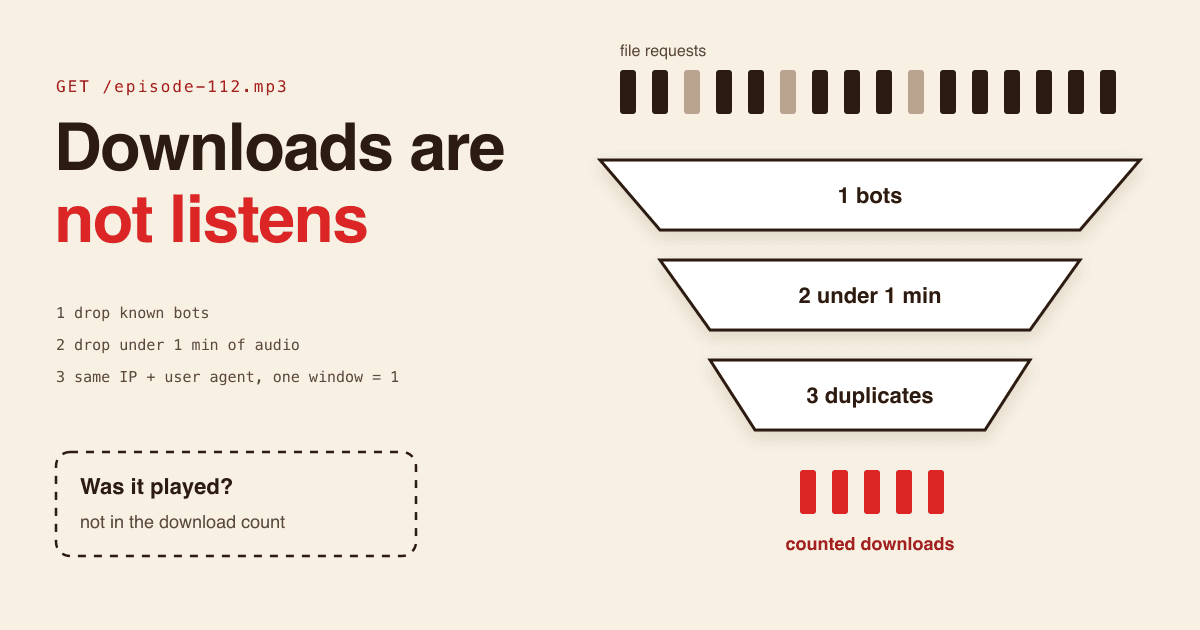
A podcast download proves an episode file reached a device, not that anyone played it. How IAB Tech Lab Podcast Measurement v2.3 (September 2026) filters requests into downloads, why certified hosts can disagree, and what to ask before you buy podcast ads on a CPM.
Media Buying
Creative Fatigue: Read the Wear Bars Before an Ad Runs Bald
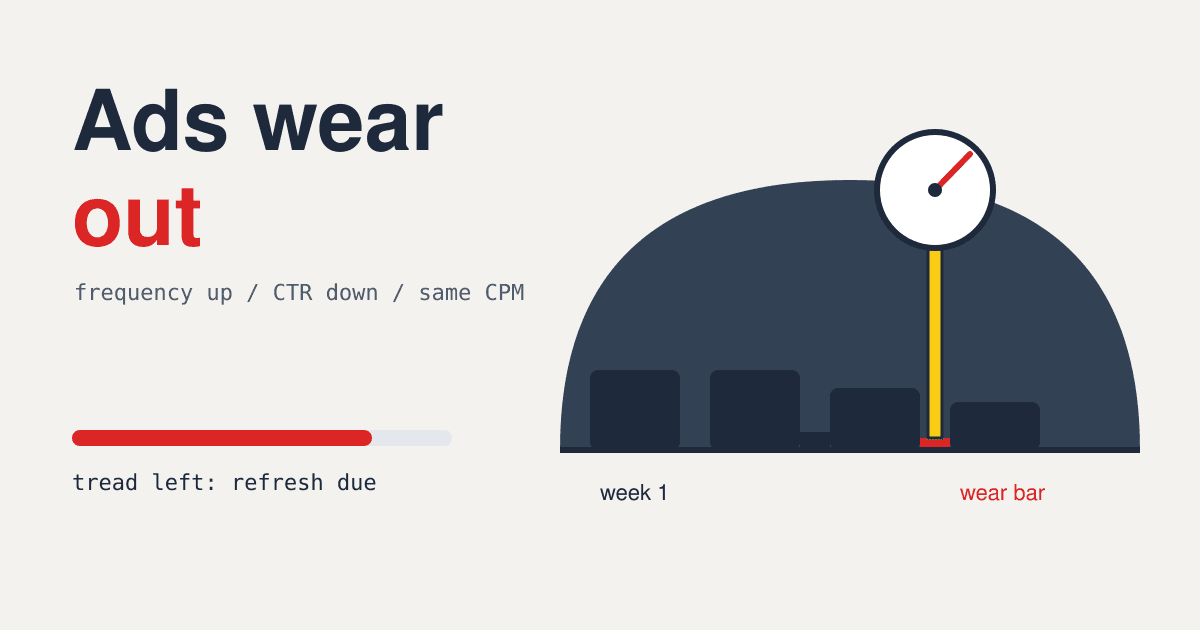
Five readings that show an ad is worn out, four look-alikes that are not, the sum for how many weeks a creative lasts, and a weekly refresh routine built on platform rules and published research.
Media Buying
Dayparting Without Guesswork: Reading 168 Hourly Cells Before You Switch Any Off
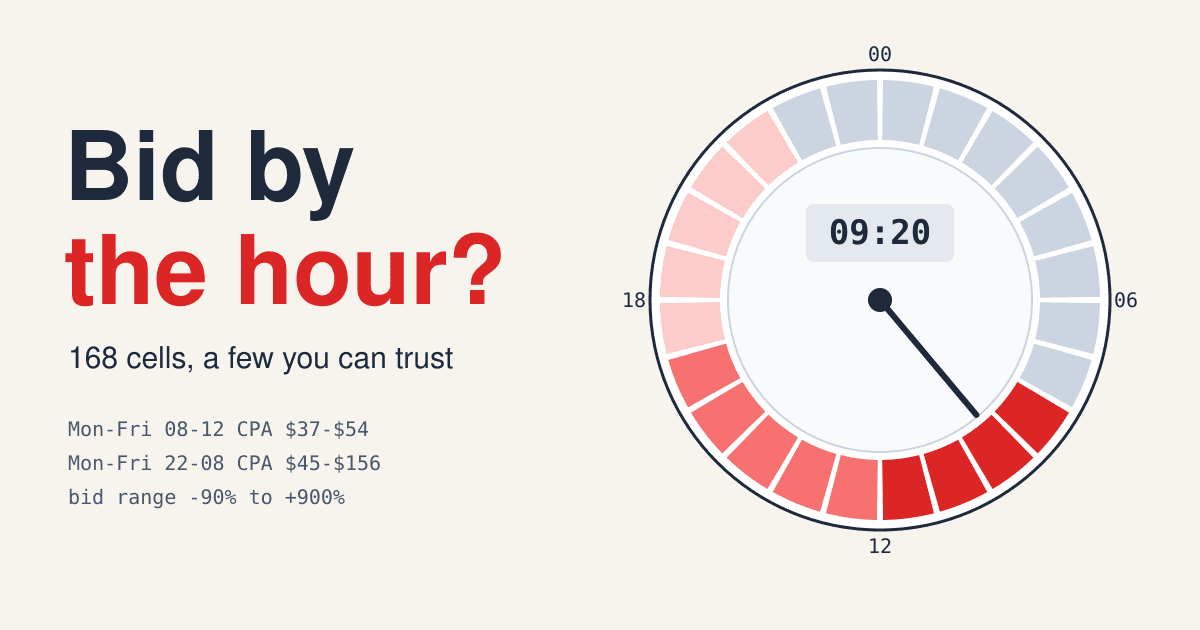
How to read your own conversions by hour and weekday, group thin cells into blocks you can trust, and tell when an ad schedule earns money and when it only shrinks reach. With the Google Ads rules that changed in 2026.