Lift the floor on one ad slot from nothing to $1.00 and two numbers move in opposite directions: the average price you report goes up, and the money you bank can go down. That gap is the whole subject of this page. A price floor is a gate in front of your auction, and every gate turns someone away; the job is to turn away only the buyers who were bluffing.
The short answer
A hard floor rejects every bid below it, so it buys a higher average price with lost fill. A soft floor was a second-price tool that capped how far a winning price could drop, and in today's first-price header auctions it does little. A dynamic floor sets a different price per slot, size, device or page and tests itself against a holdout. In the worked example below, a static $1.00 floor cut revenue per 1,000 requests by 6%, and a well-fitted dynamic floor raised it by 3.6%.
- -6.0%revenue per 1,000 requests with a static $1.00 hard floor (worked example)
- +3.6%with a dynamic floor that fits every group of buyers (worked example)
- 80%share of a $1.00 bid a pricing rule sees under an 80/20 revenue share in Google's own example
Hard, soft and dynamic floors, by what each one does to a bid
Prebid, the open-source header bidding library, defines a floor as the lowest CPM price a bid will need to meet in each auction, and treats it as a signal to bidders of the price to beat. The three kinds differ in what happens to a bid that falls short.
-
Hard floor
The minimum net amount accepted for an ad. Microsoft's yield management docs put it plainly: if this price is not met, no bids are accepted and the auction ends without a winner, or a default creative serves. In Google Ad Manager the matching setting is a floor price, where the lowest winning bid must be no less than the floor.
Bid under it: rejected. Bid over it: pays as usual.
-
Soft floor
Set above a hard floor, it is the lowest net price you are willing to price-reduce a bid to. In a second-price auction the winner pays the greater of the soft floor and the second bid. Bids between the two floors still win; they are just not discounted.
Bid under the hard floor: rejected. Between the floors: sells, no discount.
-
Dynamic floor
Many floors instead of one, each matched to a rule: ad unit, slot, media type, size, domain or a custom field such as device type in Prebid's Price Floors Module, usually refreshed from a floor provider's endpoint. Google Ad Manager offers a target CPM that dynamically adjusts the floor price to keep an average minimum, and a beta that sets floors per query.
Bid under it: rejected. The floor itself: moves with the segment.
Prebid's own advice on the first kind is blunt: it does not recommend setting static floors, because they are blunt tools and you will forget to update them.
The worked example: five groups of buyers and one $1.00 bar
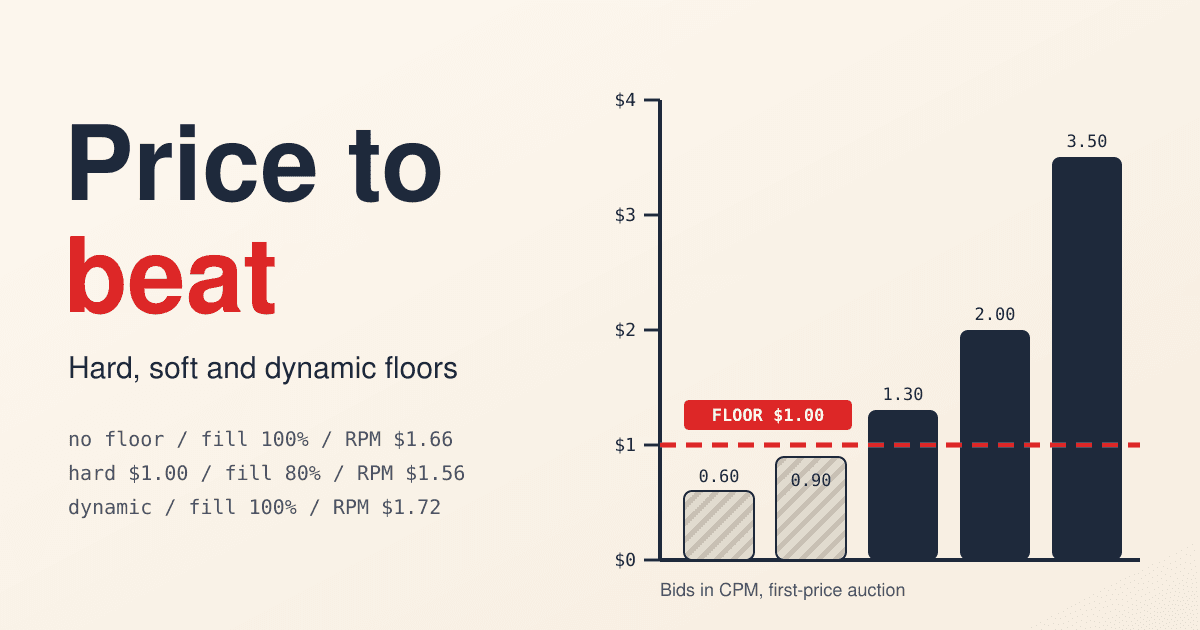
Take one ad slot and 1,000 ad requests, sold in a first-price auction, the kind Google Ad Manager moved to in September 2019 and the kind header bidders work in. Split the requests into five groups of 200. Each group has one top bidder. The numbers are made up to show the mechanics; they are not market prices.
-
Group A$0.60
Bids what the impression is worth to them and walks away above $0.60. Any floor over $0.60 loses these 200 requests.
-
Group B$0.90
Shades its bid: it would pay up to $1.20 but bids $0.90 because nobody asks for more. A floor up to $1.20 pulls its bid up to the floor.
-
Group C$1.30
Bids its value. Clears a $1.00 floor, not a $1.50 one.
-
Group D$2.00
Bids its value. Clears every floor in the example.
-
Group E$3.50
Bids its value. Clears every floor in the example.
Scale: $0 to $4 CPM. The red mark on each track is the $1.00 floor. Requests that do not sell earn nothing here; a real page may fill them with a house ad or backfill.
The two buyers who matter are A and B. A is honest and cheap: a floor above its bid is pure loss. B is the buyer every floor is built for: in a first-price auction a bidder pays what it bids, so it bids below its value, and a floor is the only thing that tells it to bid more.
Fill rate, average CPM and revenue for each floor setting
Fill rate is sold requests divided by all requests. Average CPM is what the sold ones paid. Revenue per 1,000 requests (RPM) is the number that pays the bills, and the only one of the three that cannot be gamed by turning buyers away.
| Floor setting | Fill rate | Avg CPM paid | Revenue per 1,000 requests | vs no floor |
|---|---|---|---|---|
| No floor | 100% | $1.66 | $1.66 | base |
| Hard $1.00, static | 80% | $1.95 | $1.56 | -6.0% |
| Hard $1.50, static | 40% | $2.75 | $1.10 | -33.7% |
| Hard $0.50, soft $1.00 | 100% | $1.66 | $1.66 | 0% |
| Dynamic, right for every group | 100% | $1.72 | $1.72 | +3.6% |
| Dynamic, one group misjudged | 80% | $2.00 | $1.60 | -3.6% |
How each row is worked out, with 200 requests per group and revenue = CPM x requests / 1,000:
- No floor. Everyone sells at their bid: 200 x ($0.60 + $0.90 + $1.30 + $2.00 + $3.50) / 1,000 = $1.66.
- Hard $1.00. A is turned away, B lifts to $1.00: 200 x ($1.00 + $1.30 + $2.00 + $3.50) / 1,000 = $1.56. Average CPM rises to $1.95 because the cheap requests left the sample.
- Hard $1.50. A, B and C all fall short: 200 x ($2.00 + $3.50) / 1,000 = $1.10, at the best-looking CPM on the page.
- Hard $0.50, soft $1.00. In a first-price auction nobody is discounted toward a second bid, so the soft floor has nothing to hold up. Every bid clears $0.50, and the result equals no floor.
- Dynamic, right. Floors of $0.50 for A, $1.20 for B and below the bids of C, D and E. Only B changes, from $0.90 to $1.20: 200 x $8.60 / 1,000 = $1.72.
- Dynamic, one miss. The same model sets $0.70 on group A by mistake and loses its 200 requests: $1.72 - $0.12 = $1.60.
- No floor $1.66
- Hard $1.00 $1.56
- Hard $1.50 $1.10
- Hard $0.50 + soft $1.00 $1.66
- Dynamic, right $1.72
- Dynamic, one miss $1.60
Two things show in the table. The hard-floor rows have the best average CPM and the worst revenue, so a report that tracks CPM alone will praise the wrong setting. And the gain from the right dynamic floor is small next to the loss from a wrong one: one misjudged group wipes it out. That is why floor tools test themselves.
Why soft floors mattered in second-price auctions and fade in first-price ones
A soft floor only has work to do when the winner pays less than its bid. Two single-impression cases in a second-price auction show it:
Top bid $2.00, second bid $0.80
No floor: the winner pays $0.80. A $1.50 soft floor or a $1.50 hard floor: the winner pays $1.50. Both floors earn $0.70 more on this impression.
Top bid $1.20, second bid $0.80
A $1.50 hard floor: no sale. A $0.50 hard floor with a $1.50 soft floor: the bid sells, and since it may not be reduced below the soft floor or charged above itself, it pays $1.20. The soft floor kept the sale the hard floor would have lost.
Once the winner pays its own bid there is no discount for a soft floor to stop. When Google announced the move to a unified first-price auction in Ad Manager, it said publishers would need to rethink how they use price floors. After its tests it reported that first-price auctions had a neutral to positive impact on publishers' total revenue on average, compared with second-price ones. The soft-floor idea lives on in a new form: a target CPM that lets some impressions sell below the line while holding an average.
Six steps to set a floor without emptying the queue
Measure revenue per 1,000 requests, not CPM
Put fill rate, average CPM and RPM in the same report for every floor change. A CPM that rises while RPM falls means the floor is turning away buyers who would have paid.
Set floors net of revenue share
Google Ad Manager applies pricing rules to the value a bid would pay the publisher after Google's share. In its own example a $1.00 bid under an 80/20 split is worth $0.80, and is filtered by any floor above $0.80. Check how each wrapper and exchange in your stack counts it.
Split before you raise
A single floor treats group A and group E the same. Prebid's module matches floors by ad unit, GPT slot, media type, size and domain, and Prebid.js can add custom fields such as device type. Its own sample rules price a 300x600 banner at $1.80 and a 300x250 at $0.80 on the same page.
Keep a holdout running
Prebid's skipRate skips all floor rules on a random share of auctions, so you can see what bids look like without them. The docs say it will often start at a high value like 90%, meaning floors apply only 10% of the time while you learn.
Decide what floors do to deals
Prebid does not enforce floors on deal bids unless you switch floorDeals on, and in Google Ad Manager private auctions now have a deal-level toggle to skip pricing rules that might block them. A buyer who agreed a deal price should not meet a surprise floor.
Review on a schedule, or hand it to a model
Overlapping rules in Google Ad Manager resolve to the higher price, so stale rules pile up quietly. Google also warns that incorrectly configured pricing rules can lead to low fill rates. Put a monthly check in the calendar, or use a floor provider whose prices update with demand.
The research behind floors supports doing this carefully rather than skipping it. In a large field experiment on a search engine's ad auctions, reserve prices set from optimal auction theory made revenues increase substantially (Ostrovsky and Schwarz, Journal of Political Economy, 2023). That was search advertising in a generalized second-price auction, not display header bidding, so read it as proof that well-set reserves can pay, not as a figure to expect.
Price floor questions publishers ask
Does a higher floor always mean more revenue?
No. In the worked example a static $1.50 floor gave the highest average CPM and cut revenue per 1,000 requests by a third. A floor raises revenue only when the buyers it pushes up outweigh the buyers it turns away.
Is a soft floor still worth setting?
Only where an auction still discounts a winner toward the second bid. In a first-price header auction the winner pays its bid, so a soft floor above the hard floor changes nothing; a target CPM is the closer modern tool.
How do I know a dynamic floor is helping?
Compare RPM in auctions where floors applied with RPM in the auctions skipped by the holdout, over the same pages and days. Without a holdout you are comparing this week with last week, and demand moves more than floors do.
What happens to the requests a floor turns away?
They go to whatever sits below the auction: a house ad, backfill or an empty slot. Count that as part of the floor's cost, and if you sell direct, list the placement where buyers can find it so unsold space has another route.
Sources
- Prebid.org, Price Floors Module documentation: floor definition, rule dimensions, static floor advice, skipRate, floorDeals.
- Google Ad Manager Help, Pricing rules: floor price, target CPM, optimized floors, net-of-share example, overlapping rules, deal toggle.
- Google, Simplifying programmatic: first price auctions for Google Ad Manager, March 2019.
- Google, Rolling out first price auctions to Google Ad Manager partners, September 2019.
- Microsoft Learn, Create a floor rule (Xandr yield management): hard and soft floor definitions.
- Ostrovsky and Schwarz, Reserve Prices in Internet Advertising Auctions: A Field Experiment, Journal of Political Economy 131(12), 2023.
The worked example uses made-up bids to show the arithmetic. Every other figure comes from the sources above, checked on the review date.